
Personalized Engraving Chopping Board: Wood choice matters more than any design you put on it. The best boards use dense, closed-grain hardwoods such as maple, walnut, and cherry. These resist deep knife scarring, which means fewer places for bacteria and moisture to settle. The cutting board overview on Wikipedia explains why tight grain is favored for kitchen use.
Maple is the classic, pale and sturdy, with a clean look that shows engraving clearly. Walnut is darker and richer, and it makes a stunning serving board, though laser engraving shows lower contrast on dark wood. Cherry sits in between and ages to a deeper color over time.
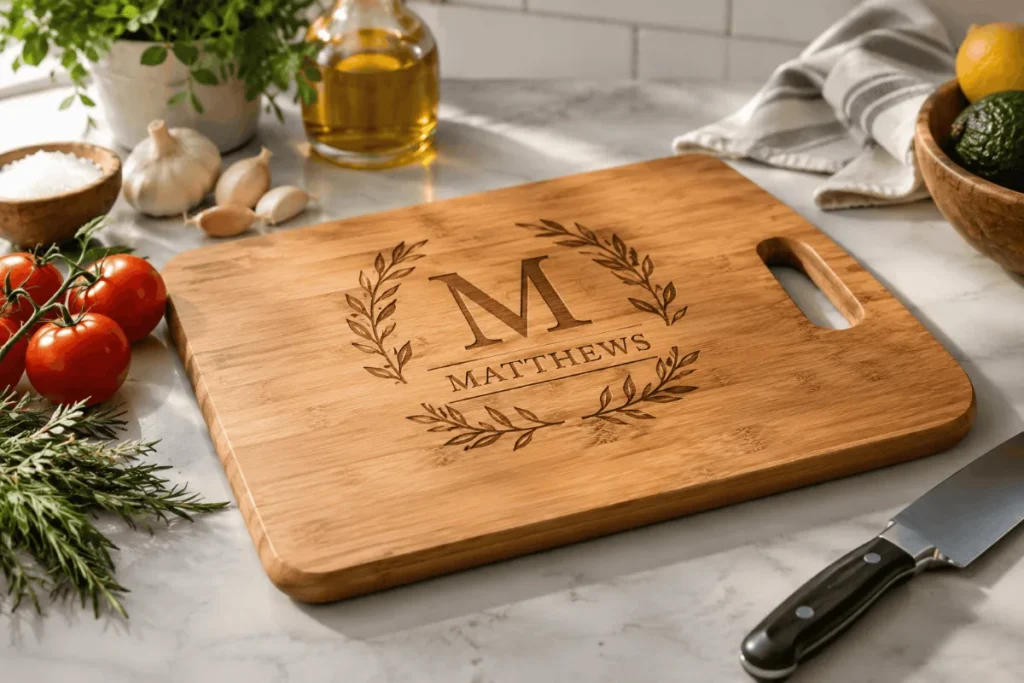
Bamboo is popular because it’s cheap and eco-friendly, but it’s technically a grass and quite hard. In my experience, bamboo dulls knives faster than maple, and the glued strips can separate over time if the board gets wet. Acacia and olive wood look beautiful and suit serving boards, though they can be pricier and more prone to cracking.
If you’re curious about hardness, the Janka hardness test is the standard scale for comparing woods. Extremely hard woods are tough on knife edges, and very soft ones scar quickly, so the middle range is the sweet spot.
How Engraving Works (and Why It Isn’t All the Same)
Most sellers use a laser to burn the design into the surface. Laser engraving removes a thin layer of wood and darkens it, which creates crisp lettering and detailed graphics that don’t wear off with washing. This is what most people mean when they search for a personalized engraving chopping board.
Some shops use CNC routing, which carves deeper grooves for a bolder, tactile look. It’s striking but can trap food and moisture if placed on a working surface. Others use UV or color printing, which can look bright but isn’t true engraving, and it may fade or scratch with heavy use.
What tends to surprise people is how much the finished color depends on the wood. Maple gives dark, high-contrast lines. Walnut gives subtle, tone-on-tone results. Ask the seller for sample photos on the exact wood you’re ordering, because mockups can look different from the real thing.
Where to Put the Engraving
Here’s a practical tip most guides skip. Don’t put a deep engraving in the main cutting zone if you plan to chop on it daily. Knife cuts will mar the design, and engraved grooves can hold food residue.
The smart approach is to engrave one side and use the other for cutting. Many people treat the engraved side as a display and serving surface, and flip it for prep. Alternatively, ask for the engraving along an edge or in a corner, where it won’t take much abuse.
If the board is purely a gift for serving cheese and charcuterie, engrave the center with confidence. If it’s a working board, keep the design modest and tucked away. A board that looks great but can’t handle a knife is a missed opportunity.
Choosing the Right Size and Features
For everyday chopping, a medium board (around 16 by 12 inches) fits most counters and handles most tasks. Large boards give you room to work but are heavy and harder to wash in a standard sink. Small boards, around 12 by 8 inches, are perfect for serving and for tiny kitchens.
Thickness affects stability. Thicker boards resist warping and feel solid, and I’d pick at least three-quarters of an inch for anything meant for real prep. A juice groove catches liquid from fruit and roasts, which keeps your counter cleaner. Handles or cutout grips make carrying easier, and rubber feet stop the board from sliding.
Think about storage, too. A gorgeous oversized board that doesn’t fit in your cabinet will end up leaning on the wall forever.
Design Ideas That Hold Up
Simple designs age best. Family names, a monogram, a wedding date, or a short phrase look classic and stay legible. Coordinates for a meaningful place are popular, as are handwritten recipes or signatures copied from a family member’s note. Those carry real sentiment and don’t look like mass-produced gifts.
Skip tiny text and thin lines unless the seller confirms they’ll come out clearly, because very fine detail can look muddy on wood grain. Keep the layout balanced, and proofread everything twice. A typo on a personalized item is permanent, and most sellers won’t refund custom work for a mistake in your own text.
My lean is to choose a bold serif or clean sans-serif font and leave plenty of empty space around it. Restraint almost always looks more expensive.
Food Safety and Care
Wood boards are fine for food prep when they’re cared for properly. The CDC’s food safety guidance recommends using separate cutting boards for raw meat, poultry, and seafood and for ready-to-eat foods like vegetables and bread. That’s good advice for any board, including your engraved one. Keep the pretty board for produce, bread, and cheese, and use a plastic board for raw meat.
Wash wooden boards by hand with warm, soapy water and dry them upright. Never soak them or put them in the dishwasher, since heat and moisture cause cracks and warping. Every few weeks, rub on food-grade mineral oil or a board conditioner to keep the wood from drying out.
If you want more detail on handling food safely, the FDA’s food safety pages are a reliable source. Replace any board that has deep, stubborn grooves or cracks, because those are hard to clean thoroughly.
How to Buy Without Regrets
Look for sellers that name the wood species and provide dimensions, thickness, and finish details. Check whether the finish is food-safe, since some boards come coated with treatments meant for decoration only. Read reviews for photos of real customer orders, not just the seller’s gallery.
Ask about proofs. A good shop will send a digital preview of your text and layout before engraving, and that’s worth waiting for. Confirm production and shipping times, especially around the holidays. As of October 2026, it’s smart to order early if you want a board for the end-of-year season, since personalization can add days or weeks to delivery.
Check the return policy, too. Custom items are often final sale, so you want to be sure about the wood and layout before you pay. Prices vary widely by wood, size, and shop, so compare a few listings instead of assuming the cheapest or the priciest is best.
Who Should Buy One, and Who Should Skip It
It’s a great pick for weddings, housewarmings, anniversaries, and family gifts, particularly for people who cook or love to host. It works well as a keepsake, too, such as a board engraved with a family recipe or the date of a first home.
Skip it for someone who strictly wants a dishwasher-safe, low-maintenance kitchen. A wooden board takes a bit of care, and a gift that creates chores isn’t always a gift. In that case, a printed or engraved serving platter might suit better.