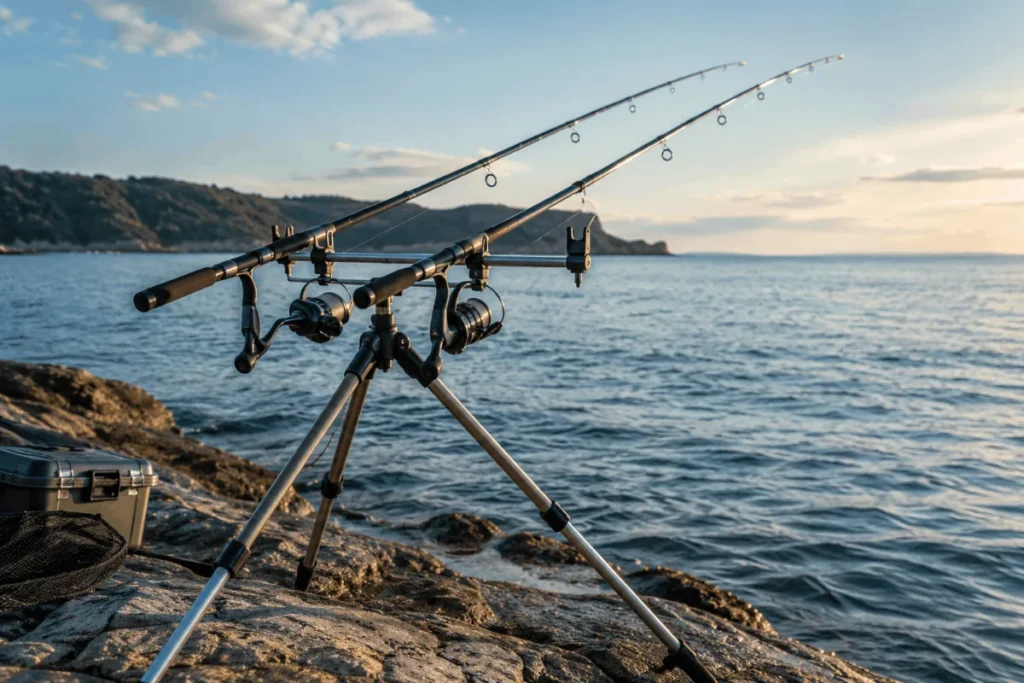

A fishing tripod is a three-legged stand that holds your rod upright with the tip pointed at the water, so you don’t have to hold it or lean it in the sand. It’s most common in surf fishing, where long rods and heavy sinkers make holding a rod for hours impractical. Full-sized beachcasting rods are too heavy to hold for long stretches, and a tripod also lifts the line clear of breaking waves and lets you see bites register on the rod tip. A tripod isn’t always the right choice, though. On firm sand, a lighter sand spike can do the job, and the comparison below shows when each makes sense.
Why use a tripod instead of holding the rod
Fatigue is the obvious reason. A long rod with a heavy sinker wears you out, and tired anglers make slower, sloppier decisions. A stand also gives you free hands to rebait, eat, or cast a second line.
The rest comes down to the line. A tripod keeps the rod and line higher than a sand spike does, which reduces the amount of line dragging through swash and weed. The rod tip also works as a visual alarm. It twitches against a steady holder in a way that is easy to spot.
Some tripods have two heads so you can fish two rods, but that only helps where it’s legal. Rod limits are covered in the rules section below.
Tripod or sand spike?
A sand spike is a spiked tube driven into the ground with a holder on top. It is lighter and easier to carry, but it only works on sand, shingle, or mud, and it can tip over if the ground is too loose. It also lacks the rig and bait-bucket extras many tripods offer, and very long rods may be too much for one.
| Tripod | Sand spike | |
|---|---|---|
| Rod height | Higher; keeps line clear of waves | Lower |
| Surfaces | Sand, shingle; spiked feet struggle on concrete | Sand, shingle, mud only |
| Carrying | Bulkier | Lighter, easier to carry |
| Long beach rods | Suited to them | May be too short or unstable |
| Extras | Bucket hooks, rig holders on many models | Usually none |
Many beach anglers who travel light on firm sand prefer spikes. If you fish with a long rod, from varied surfaces, or for hours at a time, a tripod is the more flexible tool.
Choosing a tripod
Height. Sea fishing tripods run from roughly 3 to 7 feet. For beachcasters of 12 feet or longer, most anglers prefer one at least 5 feet tall, and very cheap, very small tripods are often unsuitable for surf. Shorter stands are fine for bank fishing with shorter rods.
Telescopic or single-piece. Telescopic legs are easier to carry and can be adjusted on uneven ground, while single-piece tripods can feel more solid.
Heads and rod cups. Look for a model whose butt cups can move up and down. Raising the rod helps clear breakers, and lowering it reduces wind buffeting. A double head costs a little more but gives you a second rod position.
Feet. Spiked feet bite into sand and shingle, but spikes don’t steady a stand on concrete or stone. Some piers and boardwalks restrict stakes or sharp feet, so check posted rules before you plan around spikes.
Build. Most tripods are aluminum. Whichever metal you buy, inspect joints, leg clamps, and the rod cups, since those take the stress.
Prices change often and vary by brand, so check current listings and read reviews from anglers who fish in conditions like yours. This guide doesn’t recommend specific models because Headlinza hasn’t tested any.
How to set up a fishing tripod
- Check the tide first. The NOAA Tides & Currents site publishes predictions for thousands of stations in the US and its territories. Pick your spot well above the waterline, since a rising tide undermines legs set in wet sand.
- Spread the legs wide and push each foot firmly into the sand.
- Set the height so the rod tip rides high and the line clears the swell.
- Lock every clamp and give the stand a firm shake.
- Add weight if it’s windy. Many tripods come with a leg-lock kit, and hanging a bag of weights or rocks from the bucket hook steadies the stand. Don’t hang loose gear from the legs, which can unbalance it.
- Cast, then place the rod in the holder with the reel secured and the drag set (see below).
- Watch the tip for bites and keep an eye on the tide.
Most trouble comes from rushing step 1 or 2. A stand set in soft or wet sand sinks and tilts, and a falling rod can end up in the surf.
Setting the drag
Once the rod is in the holder, your drag matters more than usual. A drag set too tight can let a strong fish topple the rig. Too loose, and line pours out and tangles.
A common rule of thumb is to set the drag to slip at about 20 to 30 percent of your line’s pound test, and many anglers start a little loose. Wired2Fish suggests a spring scale for measuring it: tie the line to the scale, pull straight off the reel, and adjust until the scale reads in that range. That advice comes from general sport-fishing practice rather than a surf-specific manufacturer, so follow your reel maker’s guidance. If your reel has a clicker or alarm, turn it on so you hear a run before you see it. Test the setup with a firm tug by hand before leaving a rod unattended, even briefly.
Check the rules before you go
Rules on rod counts, attendance, and licensing vary by state, county, and even beach.
- Rod limits. Every state sets its own limit on how many rods an angler can fish at once. One fishing-media roundup says most states cap anglers at two rods, with exceptions. That roundup is not specific to surf or saltwater, so check your state wildlife agency.
- Land manager rules. Beaches on refuges, seashores, or county land often add their own conditions. At Chincoteague National Wildlife Refuge in Virginia, anglers may use only three surf fishing poles per licensed angler, and the poles must be attended at all times. The same refuge prohibits pneumatic bait launchers. Use that as an example of the kinds of rules to look for, not as a rule that applies elsewhere.
- Licenses. Many anglers do not need federal registration, but state saltwater license rules still apply. NOAA says its National Saltwater Angler Registry does not replace state licensing requirements, and most anglers do not need to register with it. Check your state’s rules and, if you are unsure, NOAA’s registry FAQ.
Beach safety
Don’t leave a rod unattended near waves, and keep children and pets clear of the legs and line, since a loaded tripod is a trip hazard.
Check conditions before you leave home. NOAA’s National Weather Service advises beachgoers to check local surf zone and beach hazards forecasts before heading out. Headlinza’s Los Angeles paddleboarding guide shows how to read a marine forecast for wind, swell and advisories. It is written for paddlers, but the forecast checks apply to anyone on the coast.
If you get caught in a rip current, the National Hurricane Center says rip currents pull you away from shore rather than under, so relax and float, then swim parallel to the shoreline. Avoid swimming directly back against the waves. If you see someone else in trouble, throw them something that floats and call 911, rather than entering the water yourself.
Fishing line and wildlife
Discarded line is one of the most avoidable problems on any beach. Monofilament does not biodegrade and is hard for animals to see, so birds and other wildlife can become entangled or swallow it. The Florida Fish and Wildlife Conservation Commission’s recycling program says only single-strand line, such as monofilament and fluorocarbon, can be recycled. Braided or wire line cannot.
If there is no recycling bin, the program advises cutting line into 6- to 12-inch pieces and using a covered trash bin, since animals can pull longer pieces back out. Carry out everything you bring in.
Common mistakes
- Setting up too close to the water. It’s the classic error. The tide undermines the legs and you end up wading after gear.
- Using a tripod that’s too short. The tip drops and the line drags through the surf.
- Skipping the stability check. A tripod that wobbles in calm air will fall in wind.
- Skipping maintenance. Salt water attacks joints, clamps and cups. Rinse with fresh water after each trip, dry it, and follow the manufacturer’s care guidance.
Banks, piers and boats
On a lake or river bank, a short tripod or folding stand works while you watch a float or line. Soft ground can be tricky, so look for wide feet or a flat base. On piers, spiked feet are hard to steady on concrete, and many anglers use railing-mounted rod rests so the line doesn’t rub against metal or rock. On boats, mounted rod holders are the usual choice.
Who should try it
A tripod is worth buying early if you fish from beaches, use long rods, or like to relax between bites. It’s also kind to your shoulders over a long session. You can skip it if you fish only from boats, move constantly between spots, or like to feel every nibble in your hands. Many anglers own both a tripod and a spike and pick one based on the beach.
The practical takeaway
Before you buy, check three things: how long your rod is (for a beachcaster of 12 feet or more, aim for a tripod of at least 5 feet), what surface you’ll be standing on, and what your local rules allow. Then set the stand above the tide line, test it before you cast, and carry out your line. For more outdoor hobby guides, browse Headlinza’s Hobbies & Interests section.
Last updated: October 29, 2026