
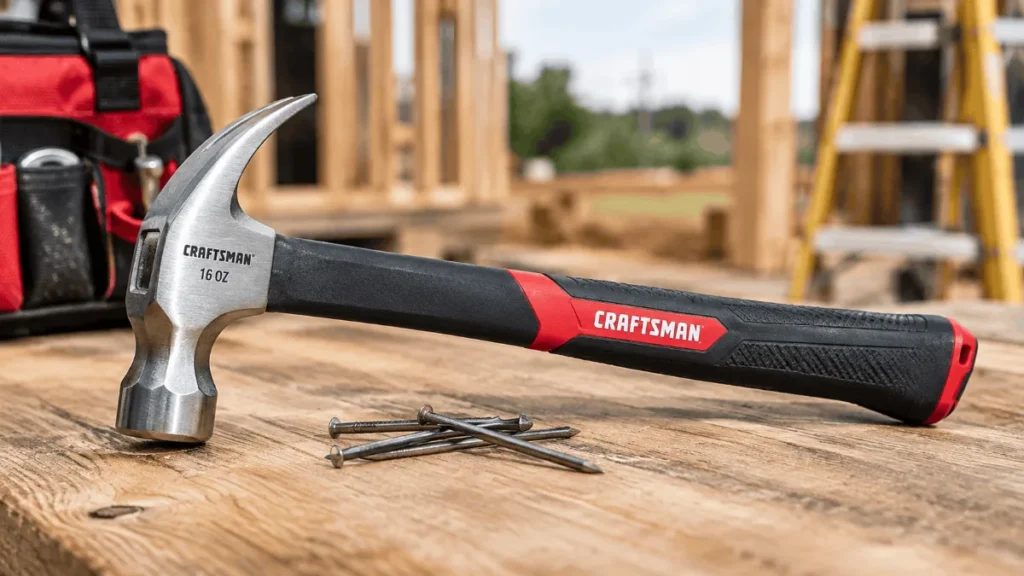

The short answer: the Craftsman 16 oz fiberglass hammer (model CMHT51398) is a good low-cost choice for general household work, but not for daily framing. It suits first toolboxes, repairs, and light carpentry. If you’re building up a toolkit for home improvement projects, it’s an easy first hammer to start with.
Headlinza hasn’t tested this hammer hands-on. This review is based on Craftsman’s published features, retailer listings, and an independent test by Bob Vila.
What the hammer is
Craftsman describes the CMHT51398 as a 16 oz claw hammer with a smooth face, curved claw and overmold grip. The headline feature is overstrike protection, an added section on the handle where fiberglass hammers most often break. A retailer listing also mentions a full lifetime warranty, so read the actual terms before you rely on it.
Craftsman is a Stanley Black & Decker brand, alongside Stanley, DeWalt, and Black+Decker.
Listings disagree on some details. Handle length is given as about 12.75 inches by one retailer and 10.75 inches by another. Ace Hardware’s page also says the hammer is not ANSI certified. For home use, that rarely matters, but it does if your workplace requires certified tools.
What independent testing found
Bob Vila’s reviewers drove 16d and 8d framing nails with a group of popular hammers, then pulled the nails out. Their verdict on this model was best bang for the buck. It performed every task well, felt well balanced for the price, and absorbed shock well. They also liked the red color, which is hard to lose on a job site.
Their one complaint was the handle: it has an exaggerated hatchet-style curve that makes the grip feel smaller. Some people will prefer that, so hold one before you buy if grip size matters to you. This was one test of a small group of hammers, not a long-term durability study.
Is 16 oz the right weight?
For most households, yes. Bob Vila’s general guidance is that 16 to 20 ounces suits most home work, with the lighter end for simple jobs and the heavier end for occasional framing.
Sixteen ounces is less suited to the extremes:
- Heavy framing: a 20 oz or heavier hammer with a longer handle drives big nails in fewer swings. Bob Vila’s heavy-duty pick was the Stanley 20 oz fiberglass hammer.
- Fine trim and small brads: a lighter hammer gives you more control.
Strengths and limitations
Strengths
- Low price. Retailers I checked listed it at roughly $12 to $16, with one marketplace listing higher. Prices change, so confirm with the seller.
- A smooth face that is less likely to mar wood on a missed swing.
- A curved claw, which is easier to use in tight spaces than a rip claw.
- Fiberglass is lighter than steel and, per Bob Vila, absorbs vibration well.
Limitations
- Steel handles are generally tougher for heavy use, and one-piece steel hammers have no handle to break.
- A fiberglass handle isn’t easy to replace. If it cracks, treat the hammer as finished.
- The curved handle may not suit every hand.
- Some specs, including handle length, vary by listing.
Where it fits in your projects
This is a hammer for typical household jobs. Here are some examples:
- Furniture and shelves. It handles light assembly and fastening. If you’re setting up a hallway, our Furniture guides cover what to buy, and a hammer is handy for hanging a mirror or artwork above a console table.
- Outdoor repairs. Fence boards, deck repairs, and similar jobs suit a 16 oz hammer. If you’re adding shade, the awning buying guide explains the types, materials, and installation, and you’ll want basic hand tools for the job.
- Anything with a slope or pitch. If you’re building or repairing a ramp or deck, the slope calculator guide helps you check angles before you start nailing.
Skip it if you frame houses for a living, or if you need a certified tool for work. For those jobs, consider a heavier steel hammer. Bob Vila’s other picks include the Estwing 16 oz rip claw (best overall, one-piece forged steel), the Irwin 16 oz fiberglass hammer (best grip), and a hardwood-handled Stalwart (good for first-time buyers, and it can be re-handled).
A quick buying checklist
- Check the model number. This review covers CMHT51398. Craftsman also sells other 16 oz hammers, including a high-visibility one (CMHT51400).
- Confirm the face and claw. A smooth face and curved claw suit most home use. A milled face grips nails better but marks wood.
- Hold it if you can. Grip shape matters more than a spec sheet.
- Check the head. It should sit tight, with no wobble.
- Buy from a reputable seller to avoid counterfeits.
Care and safety
Wear safety glasses every time. Ohio State University Extension advises safety glasses and inspecting the hammer before use, including checking that the head is tight and undamaged. Strike squarely, never use the handle as a pry bar, and retire any hammer with a cracked handle or loose head.
Related Guides
- Cattle Panel Guide: Sizes, Uses and Buying Tips
- DeWalt DWHT65201 Screwdriver Set: Worth Buying?
- Framework Homeownership Making an Offer Answers Guide
- Hard Coal Anthracite Guide: Uses, Grades and Safety
FAQ
Is a 16 oz hammer good for general use? Yes. It’s the most common all-around weight, and Bob Vila’s reviewers consider it the best general weight.
Smooth or milled face? For most homeowners, smooth. It’s less likely to damage wood. A milled face suits people doing a lot of framing.
Can I replace a broken fiberglass handle? Generally not easily, so treat a cracked handle as the end of the hammer. If re-handling matters to you, a wood-handled hammer is the better choice.
Last updated: October 29, 2026