
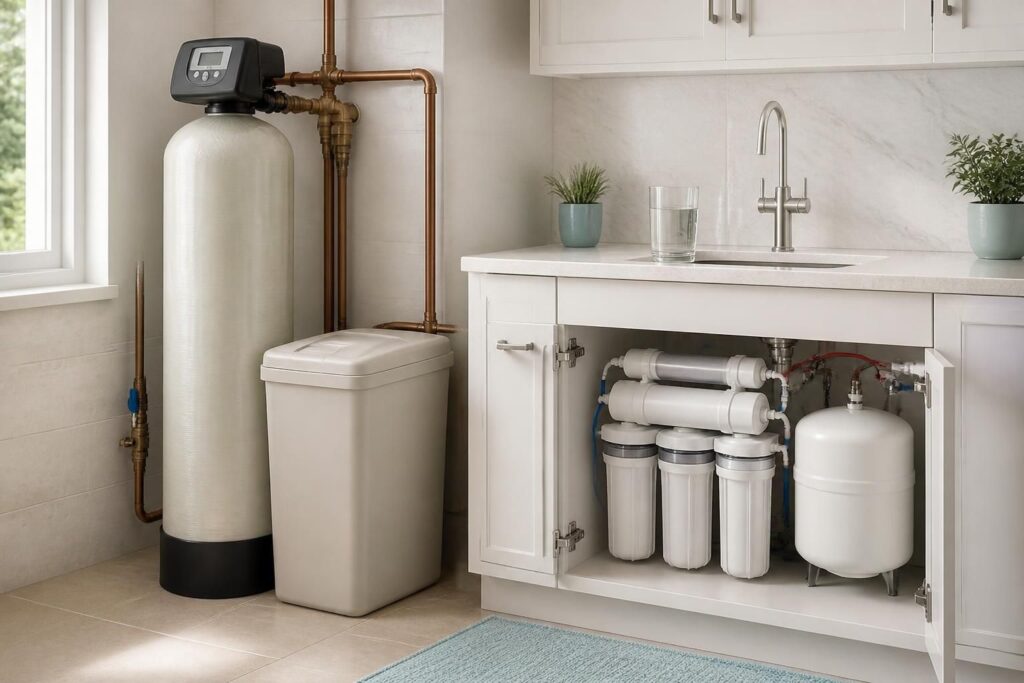

In the water softener vs reverse osmosis question, the two systems don’t compete. They do different jobs. A softener treats all the water in your house to stop hard-water scale. A reverse osmosis (RO) system purifies drinking water at one tap by removing a wide range of dissolved contaminants. If you have hard water and care about what you drink, you may want both.
Which one you need first depends on your actual problem. Is it crusty faucets and spotty dishes, or is it what’s in your glass? Here’s how to tell, what each costs to run, and why the pairing is so common.
This article is general information. Test your water and follow local plumbing rules before you buy or install treatment equipment.
Key Takeaways
- A softener protects pipes, water heaters and appliances. It doesn’t make water safer to drink.
- RO cleans drinking water at one faucet. It can’t protect the rest of your plumbing.
- Softeners don’t remove PFAS, while properly maintained RO systems are effective, according to the Minnesota Department of Health.
- A typical RO unit sends five gallons or more down the drain per gallon it makes, the EPA says. WaterSense-labeled models cap that at 2.3.
- Get a water test first. It tells you whether you have a hardness problem, a contaminant problem, or both.
Water Softener vs Reverse Osmosis at a Glance
| Feature | Water softener | Reverse osmosis |
|---|---|---|
| Main job | Remove hardness (calcium, magnesium) | Purify drinking and cooking water |
| Where it goes | Whole house, where water enters | Usually under one sink |
| Protects plumbing and appliances | Yes | No |
| Removes PFAS, lead, nitrates | No | Many, when certified and maintained |
| Water sent to drain | Brine during regeneration | Reject water every time it makes water |
| Ongoing upkeep | Salt or potassium refills | Filter and membrane changes |
The table hides one big point. These systems treat different amounts of water. A softener handles every shower, toilet flush and laundry load. RO typically handles a few gallons a day of drinking and cooking water.
What a Water Softener Actually Fixes
A softener uses ion exchange resin. The resin grabs calcium and magnesium as water passes through and swaps them for sodium or potassium. When the resin is full, the system flushes it with brine and starts again.
That stops scale in your water heater, dishwasher, washing machine and fixtures. Soap lathers better, and glass shower doors stay clearer. But a softener isn’t a purifier. It does little or nothing for most contaminants people worry about in drinking water. If you’re weighing salt-based softeners against salt-free systems, our water softener vs water conditioner guide explains the trade-offs.
What Reverse Osmosis Actually Fixes
RO pushes water through a very fine membrane that blocks most dissolved substances. Home units usually add a sediment filter and carbon filters before the membrane. Some add a remineralization stage after it to improve taste.
The payoff is very clean drinking water. The Minnesota Department of Health says RO is effective at removing PFAS when it’s installed and maintained properly. It also says whole-house softeners don’t remove PFAS. If you buy RO, look for certification to NSF/ANSI 58, the standard for these systems.
RO is almost always a point-of-use system, meaning one faucet. Whole-house RO exists, but it’s expensive, wastes much more water and usually isn’t needed for bathing or laundry.
The Water Waste Question, With Real Numbers
RO needs to flush away what the membrane rejects, so some water always goes down the drain. According to the EPA’s WaterSense program, a typical point-of-use RO system produces five gallons or more of reject water for every gallon of treated water. Some inefficient units waste up to 10. WaterSense-labeled systems must keep it at 2.3 gallons or less.
Here’s what that looks like for a household that uses three gallons of RO water a day for drinking and cooking:
- Typical unit at 5:1: about 15 gallons a day to the drain, or roughly 5,500 gallons a year.
- WaterSense unit at 2.3:1: about 7 gallons a day, or roughly 2,500 gallons a year.
That’s about 3,000 gallons a year saved, which lines up with the EPA’s own estimate of more than 3,100 gallons. If you’re on a well, a septic system or metered water, the efficient model is worth paying a bit more for. Our list of ways to reduce wastewater at home has more ideas if water use is a concern.
Softeners use water too, mainly during regeneration. Modern demand-initiated models regenerate based on actual use rather than on a timer, which keeps that waste lower.
Why So Many Homes Use Both
Hard water is tough on RO membranes. Calcium and magnesium can scale the membrane and shorten its life. So a softener upstream protects the RO unit as well as the rest of the house.
Then the RO unit removes most of the extra sodium the softener added, plus other dissolved solids in your drinking water. You get soft water for bathing and cleaning, and purified water at the kitchen tap. It’s a common setup in hard-water regions for that reason.
Which One Should You Buy First?
Start with a water test. A basic hardness test strip tells you about scale. A certified lab test tells you about contaminants like lead, nitrates, arsenic or PFAS. Then match the system to the result:
- Hard water, no contaminant concerns: a softener. Our water softener cost guide covers prices and installation.
- Soft or moderate water, contaminant concerns: an under-sink RO system certified to NSF/ANSI 58.
- Hard water and contaminant concerns: both, with the softener first in line.
- On a strict low-sodium diet with a softener: an RO unit at the kitchen tap, or switch the softener to potassium chloride.
If your water softener vs reverse osmosis decision comes down to budget, fix the problem that’s costing you more. Scale damage to a water heater adds up quietly over years. A confirmed health contaminant is more urgent.
Frequently Asked Questions
Does reverse osmosis soften water?
Yes, at the tap it serves. RO removes calcium and magnesium along with other dissolved solids, so the water from that faucet is soft. It doesn’t soften the water going to your showers, water heater or washing machine, which is why it can’t replace a whole-house softener.
Do I need a water softener if I have reverse osmosis?
Only if your water is hard enough to cause scale. RO doesn’t protect your plumbing or appliances. In hard-water areas, a softener also extends the RO membrane’s life. If your water is soft or only slightly hard, an RO system alone is often enough.
Is softened water safe to drink?
For most people, yes. A softener adds some sodium, roughly in proportion to how hard the water was. People on strict low-sodium diets can use potassium chloride instead of salt, or drink from an RO tap. Ask your doctor if sodium intake is a medical concern for you.
How often do RO filters need changing?
It depends on the model and your water, so follow the maker’s schedule. Pre-filters are usually changed more often than the membrane. The Minnesota Department of Health stresses that every treatment unit needs regular maintenance, and units that aren’t maintained lose effectiveness over time.
Can I install reverse osmosis myself?
Many under-sink RO kits are designed for DIY installation if you’re comfortable with basic plumbing. Some states and cities have licensing rules for water treatment installs. Minnesota, for example, generally requires a licensed contractor but lets homeowners install equipment in homes they own and live in.
Headlinza Editorial Team writes practical guides for Headlinza.