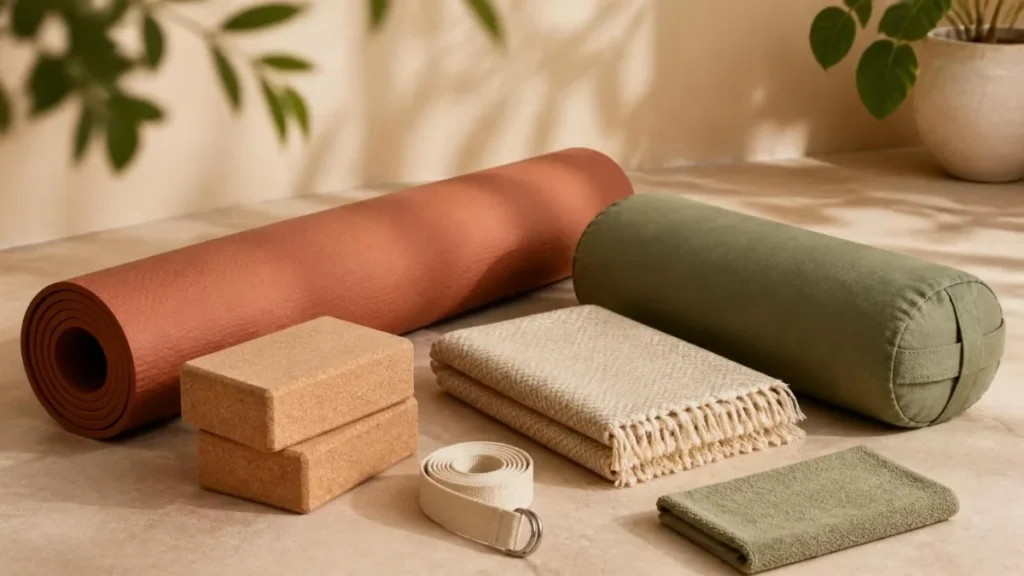

Yoga Equipment List: You can start yoga with a mat and clothes you can move in. Most beginners also benefit from two blocks and a strap, and a folded blanket rounds out the basics. Everything else, including bolsters, wheels, and towels, depends on the style of yoga you end up doing.
Nike’s beginner buying guide lands in the same place: a non-slip mat and stretchy clothing are enough to begin, and blocks and a strap are worth strongly considering. That guide comes from a retailer, so treat it as practical advice rather than independent testing. The rest of this list is organized by how soon you’re likely to need each item.
Yoga Equipment List
A yoga mat
A mat gives you grip in poses like downward dog and a layer of padding between you and the floor. Two choices matter most: thickness and material.
- Thickness: A standard mat runs about 3.3 mm (roughly 1/8 inch). Thinner mats feel steadier in balance poses, while thicker ones cushion knees, hips and wrists. Nike suggests about 6.4 mm (1/4 inch) for therapeutic or restorative practice. Thicker mats are heavier and bulkier to carry.
- Material: Most mats are PVC or natural rubber. Rubber tends to grip well and resist odor, but it behaves differently from PVC when cleaned (more on that below).
If you teach or run classes and need several mats at once, Headlinza’s studio buyer’s guide to bulk yoga mats covers one 5 mm option in detail.
Clothing that moves with you
Pick stretchy, fitted clothes. Loose tops tend to fall over your face in inversions and forward folds. Most people practice barefoot, though grip socks or gloves can help if you’re on a bare floor without a mat.
Two blocks
Blocks bring the floor closer. Placed under your hands in a forward fold, they support you if you can’t reach the ground, and placed under your feet they can make the pose deeper. Nike recommends a block at least about 4 inches wide for stability. Buy a pair, since some poses use two or three.
A strap
A strap with an adjustable buckle works as an arm extender. It lets you hold your feet in a seated forward fold or bring your hands closer together behind your back without straining. Flexibility isn’t a prerequisite for using one, so beginners and experienced practitioners both use straps.
A blanket
A folded blanket cushions knees, lifts the hips in seated poses and adds warmth during final relaxation. A regular throw blanket from home does the job.
Add these when your practice calls for them
| Item | When it’s worth buying | What you can use instead |
|---|---|---|
| Bolster | Restorative, supported or prenatal-style classes | A firm pillow or cushion |
| Yoga towel | Hot yoga or any sweaty class | None for hot yoga; a regular towel can bunch and slip |
| Mat bag or sling | You carry your mat to a studio | Hand-carrying; a sling is the cheaper option |
| Grip socks or gloves | Practicing on bare floors or while traveling | Going barefoot on a mat |
| Yoga wheel | Once you want back-opening support or a harder balance challenge | Nothing needed for most beginners |
| Resistance bands | You want to add strength work | Usually skipped by beginners |
On the towel row, Nike advises a towel designed for yoga, usually microfiber, because ordinary bath towels move around and bunch on the mat.
What you can improvise at home
A yoga teacher’s guide to beginner props notes that sturdy books can stand in for blocks, a belt for a strap, and a folded towel for a blanket. Treat these as stopgaps. Books can slide or topple, so keep them stable and use the real thing once you know which props you reach for.
A sensible approach is to buy the mat first, borrow or improvise the props for a couple of weeks, and then buy the ones you actually used.
Caring for your mat
Nike recommends cleaning your mat at least once a month and wiping down any shared studio mat before and after use. For PVC mats, a drop of soap and a damp cloth works on both sides. Natural rubber is the exception, because soap can break the material down, so use a vinegar or alcohol-based wipe or a cleaner made for yoga mats instead. Don’t soak or hose a mat down, and store it out of direct sunlight.
Nike’s rule of thumb is to replace a mat every six months to a year, depending on use. That’s a retailer’s estimate, not a tested standard, so judge by condition. Replace your mat if it:
- Keeps its odor after cleaning
- Has thin or worn patches
- Is peeling or ripping
- Has gone slick
Before you start: a short safety note
Props make poses more accessible, but they don’t replace guidance. The National Center for Complementary and Integrative Health (NCCIH) recommends older adults start with a gentle or chair-based class to learn correct form, and advises people with medical conditions to talk with both their health care provider and the instructor beforehand (see its yoga research digest). A summary of NCCIH’s guidance in The Nation’s Health also notes that some poses may carry risks for people with conditions such as glaucoma, sciatica or high blood pressure, and that pregnant women should use caution and consider modified poses. For more detail, NCCIH publishes a free Yoga for Health eBook.
The bottom line
Buy a mat you like the feel of, wear clothes you can stretch in, and start. If you want more support after your first few sessions, add two blocks and a strap, then a blanket. Skip the wheel, bolster, and bag until a class or a specific pose gives you a reason to want one. For more practical fitness gear guides, browse Headlinza’s Health & Fitness section.