
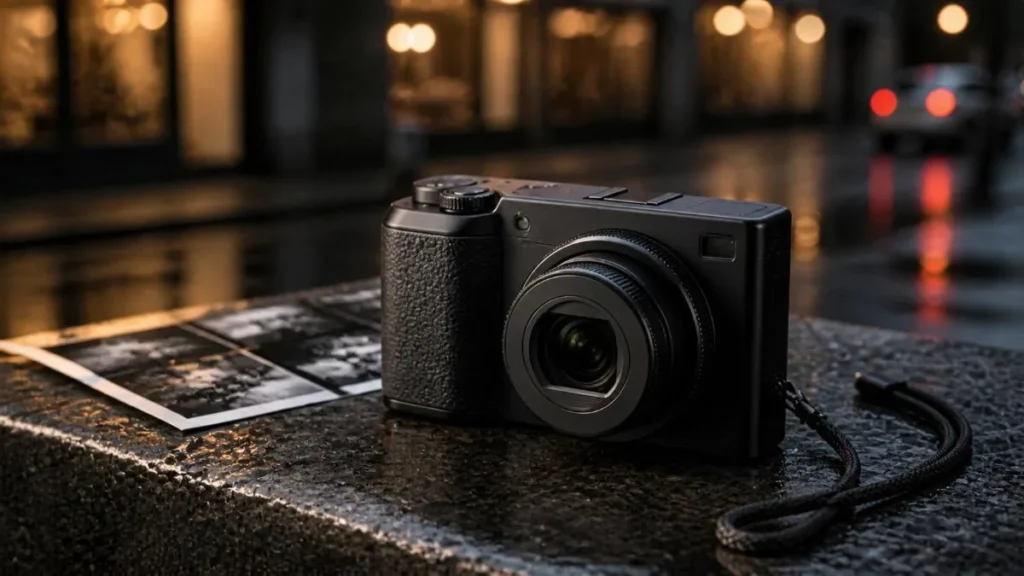

The Ricoh GR 3 is a pocket-sized compact camera with a large APS-C sensor and a fixed 28mm-equivalent lens. It launched in 2019 and remains a favorite for street and travel photography. It’s still worth buying if you want that wide, discreet setup and can find one at a fair price. The harder part today is availability, since sources disagree on whether Ricoh still sells it new.
What the GR III is
Ricoh Imaging Americas announced the GR III in February 2019 at $899.95, with shipping starting that March. It pairs a 24-megapixel APS-C sensor with a newly designed 18.3mm f/2.8 lens, which equals about 28mm on a full-frame camera. The result is a camera that fits in a jeans pocket but has a much larger sensor than a phone or a typical point-and-shoot.
DPReview’s review describes it as a compact 24MP APS-C camera with a 28mm-equivalent f/2.8 lens that updates the GR II in several significant ways. Its main upgrades over the older 16MP GR and GR II were a higher-resolution sensor, 3-axis in-camera stabilization (a first for the GR line, according to B&H’s listing), and on-sensor phase-detection autofocus.
Key specs
| Feature | Ricoh GR III |
|---|---|
| Sensor | 24.24MP APS-C CMOS |
| Lens | 18.3mm f/2.8 to f/16 (28mm equivalent) |
| Stabilization | 3-axis sensor-shift |
| ISO range | 100 to 102,400 |
| Built-in ND filter | Yes (2 stops) |
| Video | Full HD up to 60p, no 4K |
| Battery | DB-110, about 200 shots per charge |
| Charging | USB-C, in-camera |
| Size and weight | 109.4 x 61.9 x 33.2 mm, 257 g with battery and card |
| Storage | About 2GB internal plus SD card |
Specs come from B&H, PB Tech and the Ricoh Presets comparison guide. Ricoh’s own spec pages weren’t directly accessible, so confirm the details there before buying.
What it does well and where it falls short
Strengths: The size is the headline feature. A large sensor, a sharp wide lens and a body this small is a rare combination, and it’s why the GR line has a loyal street-photography following. The built-in ND filter helps when shooting wide open in bright light, and in-camera stabilization helps in dim scenes.
Limits to know before buying:
- There’s no viewfinder, so you compose on the rear screen.
- The lens is fixed, so you can’t zoom. You can crop to roughly 35mm and 50mm equivalents, but that reduces resolution.
- Video tops out at Full HD, so skip it if 4K matters.
- Battery life is about 200 shots, so a spare is sensible.
- Ricoh Presets, summarizing DPReview’s findings on the newer GR IV, notes that neither camera is a tracking-autofocus camera, so it’s a poor choice for fast-moving subjects.
How much does it cost?
The launch price was $899.95. Current pricing is murkier:
- As of October 13, 2026, Ricoh Presets reported a Ricoh US list price of $1,049.95 but said the product page showed the camera out of stock.
- Other 2026 commentary describes the GR III as discontinued or being phased out in favor of the GR IV. One photographer’s mid-2026 write-up reported used copies selling at or above the original launch price because demand is high.
Because those sources conflict, treat availability as unconfirmed. Check Ricoh’s US store and authorized dealers such as B&H first, then compare refurbished and used offers. If you’re buying through a marketplace, Headlinza’s guide on whether Amazon is trustworthy for cameras explains how to check sellers and warranties.
GR III vs GR IIIx vs GR IV
- GR IIIx: Announced in 2021, it uses the same camera platform with a 26.1mm lens (about 40mm equivalent). Pick it if you prefer a tighter, more natural field of view. It launched at about $999.
- GR IV: Launched in 2025 at about $1,499 per DPReview, with a list price of $1,599.95 in recent retailer listings. According to Ricoh Presets’ summary of Ricoh’s specs, it adds a back-illuminated 25.7MP sensor, 5-axis stabilization rated up to six stops (versus four), a battery rated at about 250 shots, and around 53GB of built-in storage. It uses microSD cards, so your GR III’s SD cards won’t carry over.
- HDF versions: These add a Highlight Diffusion Filter for a softer, film-like glow. The GR III HDF launched at $1,069.95. Our explainer on Ricoh HDF cameras covers how that filter works.
Ricoh has also announced a 40mm version of the GR IV, but DPReview reports only that it’s due later, and I couldn’t confirm a release date or price.
Who should buy a GR III
Buy it if you shoot mostly in daylight, want a 28mm perspective and prize pocketability. Used copies in good condition priced near or below the original $899.95 are the best-value scenario.
Consider the GR IV if you shoot handheld at night, travel all day on one battery or care about edge-to-edge sharpness, and the price gap is small. If a used GR III costs about as much as a new GR IV, the newer camera is the safer choice.
Skip both if you need a viewfinder, a zoom, 4K video or reliable tracking autofocus.
The bottom line
The GR III is still a compelling choice for people who want a serious camera that disappears into a pocket. Before you buy, confirm its current price and condition, and compare it with the GR IIIx if 28mm feels too wide. For more camera and gadget guides, browse Headlinza’s Gadgets & Electronics section.