
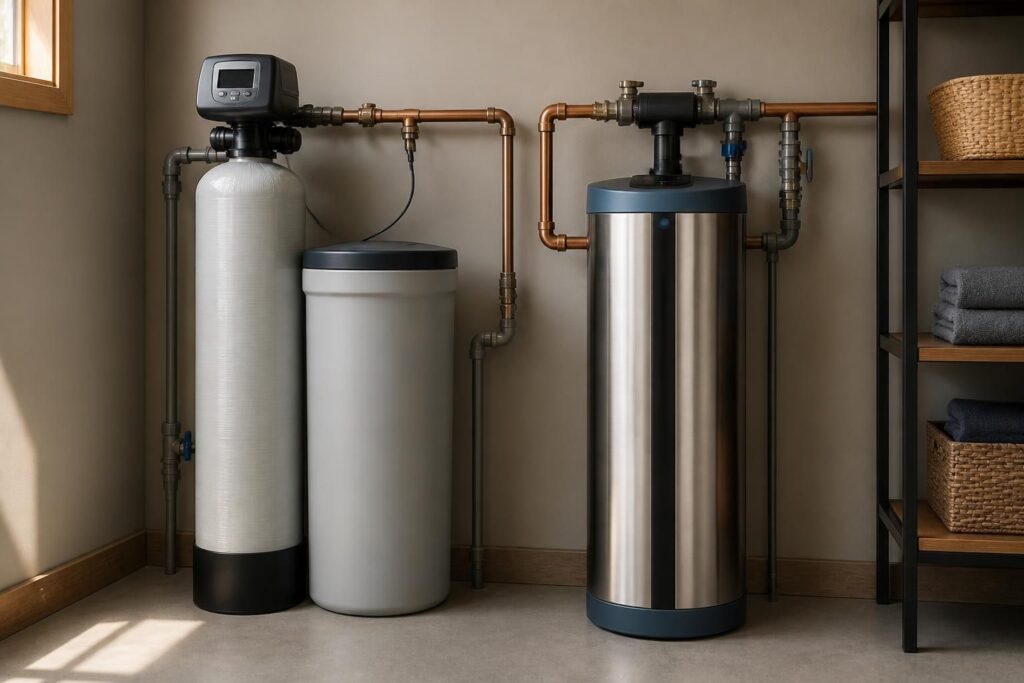

A water softener removes the calcium and magnesium that make water hard, usually by swapping them for sodium or potassium. A water conditioner (also sold as “salt-free softener”) does not remove those minerals. It changes them so they are less likely to stick to pipes and appliances as scale. Pick a softener if you want truly soft water that lathers easily and leaves no spots. Pick a conditioner if your main goal is protecting your water heater and pipes from scale, and you want no salt, no wastewater and less maintenance.
Water Softener vs Water Conditioner at a Glance
| Feature | Salt-based water softener | Salt-free water conditioner (TAC) |
|---|---|---|
| How it works | Ion exchange: resin swaps hardness minerals for sodium or potassium | Template assisted crystallization turns hardness minerals into tiny crystals that stay in the water |
| Removes hardness? | Yes | No |
| Scale prevention | Excellent | Good (studies report large reductions) |
| Soap lather, “slippery” feel, fewer spots | Yes | Little or no change |
| Salt and wastewater | Needs salt; flushes brine during regeneration | No salt, no wastewater |
| Electricity | Usually yes, for the control valve | No |
| Ongoing maintenance | Refill salt; occasional servicing | Replace media every few years |
How a Water Softener Works
A softener passes your water through a tank of resin beads. The beads grab calcium and magnesium ions and release sodium (or potassium) in their place. When the beads are full, the system regenerates by flushing them with salty brine from a separate tank, then rinsing the brine and minerals down the drain.
The result is genuinely soft water. Soap and shampoo lather more easily, dishes and glass shower doors spot less, and water heaters, kettles and fixtures stay free of scale. The trade-offs are buying salt, a small amount of added sodium in the water, wastewater during regeneration and, in a few areas, local restrictions on salt-discharging softeners. Our guide on how much a water softener costs covers prices and installation.
How a Water Conditioner Works
Most quality salt-free conditioners use template assisted crystallization (TAC). The media causes hardness minerals to form microscopic crystals that stay suspended and flow through your plumbing instead of sticking to surfaces as scale. Because the minerals are still in the water, it is not technically softened.
Testing has been encouraging for scale control. A study with Arizona State University and the WateReuse Foundation found TAC reduced scale formation by more than 88%, according to WaterWorld. The same article notes TAC media has an effective life of about three years and is limited by water chemistry such as chlorine, iron, manganese and pH.
Be cautious with magnetic and electronic “descalers.” They are cheaper but have weaker evidence than TAC; the same study reportedly found other non-chemical technologies achieved only around 50% scale reduction.
Which Is Better for Your Home?
Choose a water softener if:
- Your water is very hard and you dislike spotting, soap scum and dry skin or hair.
- You want the best protection for water heaters, dishwashers and tankless heaters.
- You have well water with some iron (many softeners handle small amounts).
- You are fine buying salt and having a drain nearby.
Choose a water conditioner if:
- Your main concern is scale buildup, not soap lather or spots.
- You are on a low-sodium diet or want to avoid salt.
- Your area restricts salt-based softeners, or you have no convenient drain.
- You want a nearly maintenance-free system with no electricity.
Cost Comparison
Both types typically cost from several hundred to a few thousand dollars for whole-house equipment, plus installation. Softeners add ongoing salt costs and some water and electricity use. Conditioners avoid those but need media replacement every few years. Over ten years, the totals are often similar, so the decision usually comes down to whether you want soft water or just scale protection.
Frequently Asked Questions
Is a water conditioner the same as a water softener? No. A softener removes hardness minerals. A conditioner changes their form to reduce scale but leaves them in the water.
Do salt-free water softeners really work? Good TAC conditioners do reduce scale significantly in testing. They do not make water feel soft or stop all spotting.
Does softened water have a lot of sodium? It adds some sodium, roughly in proportion to how hard the water was. People on strict low-sodium diets can use potassium chloride instead of salt or keep one unsoftened tap for drinking.
Can I use both? Most homes need only one. Some combine a softener with a drinking water filter such as reverse osmosis instead.
Which is better for a tankless water heater? Both help. Many tankless makers recommend or require scale protection when water is hard; check your heater’s manual and warranty terms.