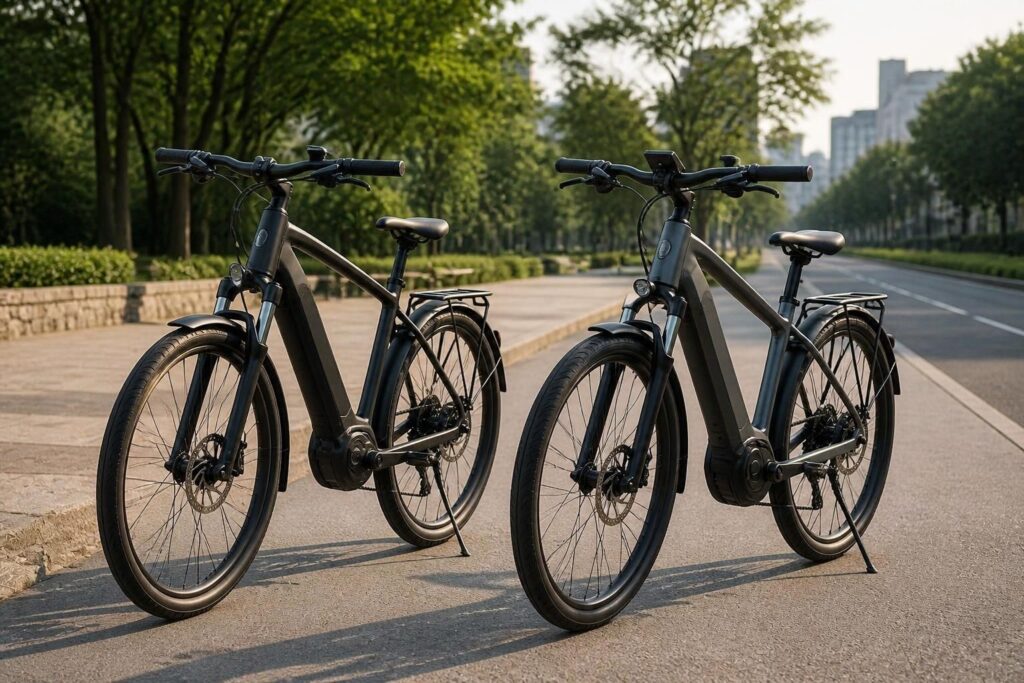

Class 2 vs Class 3 E-Bike: A Class 2 e-bike has a throttle and tops out at 20 mph of motor help. A Class 3 e-bike has no throttle in most states but keeps assisting you while you pedal up to 28 mph. Pick Class 2 if you want easy starts, cargo hauling and the widest access to bike paths. Pick Class 3 if you commute on roads and want to keep up with traffic, and you are old enough and willing to follow the extra rules.
Both classes share the same 750-watt motor limit in most states. The difference is how the motor engages and how fast it keeps helping, and that difference affects where you can ride, how far a charge lasts and what the law expects from you.
Class 2 vs Class 3 at a Glance
| Feature | Class 2 | Class 3 |
|---|---|---|
| Throttle | Yes, moves the bike without pedaling | Usually no (some states allow a throttle limited to 20 mph) |
| Motor assistance stops at | 20 mph | 28 mph |
| Motor power limit | 750 W in most states | 750 W in most states |
| Multi-use paths and greenways | Usually allowed, some local bans | Often banned unless locally allowed |
| Age and helmet rules | Few (helmets under 18 in some states) | Common (e.g. 16+ and helmets for all riders in California) |
| Best for | Errands, cargo, hills, casual riding | Long road commutes, fitness riders |
The Throttle: Class 2’s Big Advantage
The throttle is what sets Class 2 apart. Press a thumb lever or twist the grip and the motor moves you, even if you are not pedaling. That makes a real difference when you are pulling away from a stop sign with groceries or a child seat, climbing a steep driveway, or riding with sore knees.
Most Class 2 bikes also have pedal assist, so you can ride them like a Class 1 bike and save the throttle for when you need it. Our class 2 ebike guide explains throttle rules in detail.
Top Speed: Class 3’s Big Advantage
A Class 3 bike keeps helping until 28 mph. On a Class 2 bike, the motor drops out at 20 mph and you are on your own legs above that. For a 10-mile road commute, the difference between cruising at 18 mph and 24 mph saves around eight minutes each way, and it lets you hold a steadier position in traffic instead of being passed constantly.
You do have to work for it. Because Class 3 is pedal-assist only in most states, the bike only goes fast when you pedal, so it tends to suit riders who enjoy riding and want to arrive quickly rather than effortlessly.
Where You Can Ride
This is where many buyers get caught out. Class 2 bikes are usually allowed on roads, bike lanes and many multi-use paths, though some trails and parks ban throttles. Class 3 bikes are generally limited to roads and on-street bike lanes. Many states and cities keep them off shared-use paths, greenways and natural-surface trails unless a local agency allows them.
For example, Washington keeps Class 3 bikes off most shared-use paths and sets a minimum rider age of 16, according to a 2026 roundup of Class 3 restrictions. If your commute relies on a riverside trail or rail-trail, check whether Class 3 is allowed before you buy.
Age, Helmet and Equipment Rules
Class 3 bikes carry more rules in most states. California, for example, requires a speedometer on Class 3 bikes, requires every Class 3 rider to wear a helmet regardless of age, and sets a minimum age of 16. Class 1 and 2 riders there must wear helmets only if they are under 18, as summarized by the City of Alameda’s e-bike FAQ.
Some states are also tightening rules. New Jersey’s 2026 law requires registration, a driver’s license and liability insurance for every e-bike, Class 1 included, so riders there face the same extra steps whichever class they choose (Atlantic County summary).
Range and Battery Life
Speed costs energy. Air resistance grows quickly as you go faster, so holding 26-28 mph on a Class 3 bike drains a battery much faster than cruising at 15-18 mph. Riders who use the top assist level all the time often see noticeably less range than the brochure promises. A Class 2 rider who leans on the throttle without pedaling also burns through the battery quickly, because the motor is doing all the work.
If range matters, look at the battery capacity in watt-hours rather than the advertised miles, and plan on using a middle assist level for long trips.
Price and Build
Class 3 bikes often cost more because they are built for higher sustained speeds: stronger brakes (usually hydraulic discs), sturdier frames and higher-quality motors and sensors. Class 2 bikes span a wider range, from budget fat-tire cruisers to premium cargo bikes. Many models now let you switch between classes in the settings, for example a Class 3 bike limited to Class 1 behavior on trails, which is a good compromise if you ride in different places.
Which Should You Choose?
- Choose Class 2 if you want effortless starts, carry cargo or kids, ride shorter distances, deal with steep hills, or rely on bike paths.
- Choose Class 3 if you commute 8+ miles on roads, want to replace a car trip, are 16 or older, and do not need multi-use path access.
- Not sure? Look for a bike that can be set to more than one class, and check your state and city rules first.
Frequently Asked Questions
Is a Class 3 e-bike faster than Class 2? Yes. Class 3 motors assist up to 28 mph, while Class 2 motors stop at 20 mph. On a Class 2 bike you can still go faster by pedaling hard or riding downhill, but without motor help.
Can a Class 3 e-bike have a throttle? In most states, no, or only a throttle that stops at 20 mph. A bike with a throttle that works up to 28 mph usually does not meet the legal e-bike definition.
Do I need a license for a Class 3 e-bike? In most states, no. New Jersey is a notable exception, and a few states define only Class 1 and 2, which can push 28 mph bikes into the moped category.
Which is safer, Class 2 or Class 3? Neither class is unsafe on its own, but higher speeds give you less time to react and make crashes more serious. That is why many states require helmets and set a minimum age for Class 3.
Can I convert a Class 2 to a Class 3? Some bikes allow switching modes in their settings within legal limits. Removing speed limiters or adding a faster controller usually means the bike no longer qualifies as an e-bike.