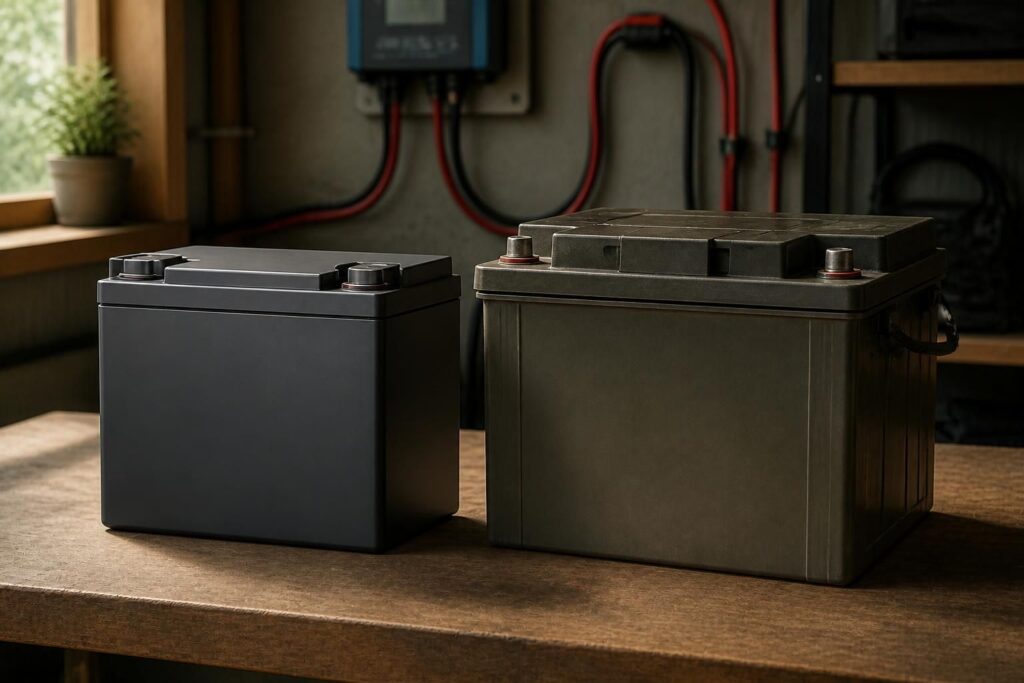

LiFePO4 vs AGM: For most RV, boat, solar and off-grid setups, a LiFePO4 battery is the better buy: it delivers several times the cycle life, lets you use nearly all of its rated capacity, weighs less than half as much and costs far less per kWh over its life. An AGM battery still makes sense when the battery sits on standby most of the time, when you need reliable charging in freezing weather without a heater, or when the upfront budget is tight.
Both are 12-volt deep-cycle options that fit the same battery boxes, so the choice comes down to how often you cycle the battery and how long you plan to keep it.
LiFePO4 vs AGM at a Glance (12V 100Ah)
| Feature | LiFePO4 | AGM |
|---|---|---|
| Typical cycle life | About 3,000-7,000 cycles (80% depth of discharge) | About 300-500 cycles (50% depth of discharge) |
| Recommended usable capacity | 80-100% | About 50% |
| Weight | About 22-31 lb | About 60-70 lb |
| Typical price | About $300-950 (often around $350) | About $180-350 (often around $220) |
| Round-trip efficiency | About 95-98% | About 80-85% |
| Max charge rate | 0.5C-1C (50-100 A) | 0.2-0.3C (20-30 A) |
| Charging below freezing | Blocked by the BMS unless the battery has a heater | Allowed at a reduced rate |
Figures from a May 2026 LiFePO4 vs AGM cost comparison. Exact numbers vary by brand, so check the datasheet of the battery you are considering.
Usable Capacity: The Hidden Difference
A 100Ah AGM battery does not give you 100Ah in practice. To get a reasonable life from it, you should only discharge it to about 50%, which leaves roughly 50Ah of usable energy. A 100Ah LiFePO4 battery can be used to 80-100% routinely. That means one LiFePO4 battery often replaces two AGM batteries of the same rating.
AGM batteries also lose capacity under heavy loads. At a 100-amp draw, a 100Ah AGM may deliver only around 55-65Ah, while LiFePO4 stays close to its rated capacity, according to the same comparison. If you run an inverter for a microwave, coffee maker or air conditioner, this difference matters.
Lifespan and Cost per Cycle
LiFePO4 costs more upfront but far less over time. At 3,000+ cycles against 300-500 for AGM, a LiFePO4 battery can outlast six or more AGM replacements in daily cycling. The comparison above estimates lifetime cost per kWh delivered at roughly $0.05-0.09 for LiFePO4 versus $0.73-1.22 for AGM.
For a battery that is cycled only a few times a year, such as a backup sump pump battery or a seasonal boat used a handful of weekends, the long cycle life matters less and AGM’s lower price can win.
Weight and Size
A 12V 100Ah LiFePO4 battery typically weighs about 22-31 pounds. An AGM of the same rating weighs about 60-70 pounds. Since you need roughly twice the AGM capacity for the same usable energy, a LiFePO4 bank can save 80-100 pounds or more in a camper van, trailer or boat, which improves payload and fuel economy.
Charging Speed and Solar
LiFePO4 accepts charge much faster. A 100Ah LiFePO4 can typically take 50-100 amps, while an AGM tops out around 20-30 amps and slows down sharply near full. LiFePO4 is also more efficient, losing only a few percent of the energy you put in. For solar setups, that means more of each sunny hour ends up stored in the battery.
You do need a charger, solar controller and alternator charging setup with a lithium or LiFePO4 profile. We explain why in our guide on LiFePO4 batteries.
Cold Weather
This is AGM’s main advantage. LiFePO4 batteries should not be charged below 32°F (0°C), and their battery management system usually blocks charging below that. They still discharge in the cold, with reduced capacity. AGM batteries can charge in freezing temperatures, just more slowly. If you winter-camp or keep the battery in an unheated space, choose a LiFePO4 model with a built-in heater or stick with AGM.
Maintenance and Safety
Both types are sealed and do not need watering. AGM batteries suffer if they are left partly discharged, because sulfation slowly reduces capacity, so they should be fully recharged after use. LiFePO4 batteries are happy sitting at partial charge and lose little charge in storage. LiFePO4 is also among the most thermally stable lithium chemistries and includes a BMS that protects against overcharge, over-discharge and short circuits.
Which Should You Buy?
- Choose LiFePO4 for RVs and camper vans, off-grid solar, trolling motors, liveaboard boats and anything cycled weekly or daily.
- Choose AGM for standby or backup use, very cold storage without heating, starter batteries, or when the budget is the deciding factor.
- Upgrading from AGM? Check that your charging equipment has a LiFePO4 profile before you swap.
Frequently Asked Questions
Is LiFePO4 worth the extra cost over AGM? If you cycle the battery regularly, yes. It lasts many times longer and gives about twice the usable capacity per amp-hour rating.
Can I replace an AGM battery with LiFePO4? Usually, yes, since both are 12V and come in common sizes. Make sure your charger, solar controller and alternator setup support LiFePO4 charging.
How long does an AGM battery last? In regular deep cycling, often 300-500 cycles, which can mean two to four years. In standby use, longer.
Can LiFePO4 and AGM be mixed in one battery bank? It is not recommended. They charge at different voltages and age differently.
Which is safer? Both are safe when used correctly. LiFePO4 is very stable for a lithium battery and includes electronic protection, while AGM is a mature, sealed lead-acid design.