
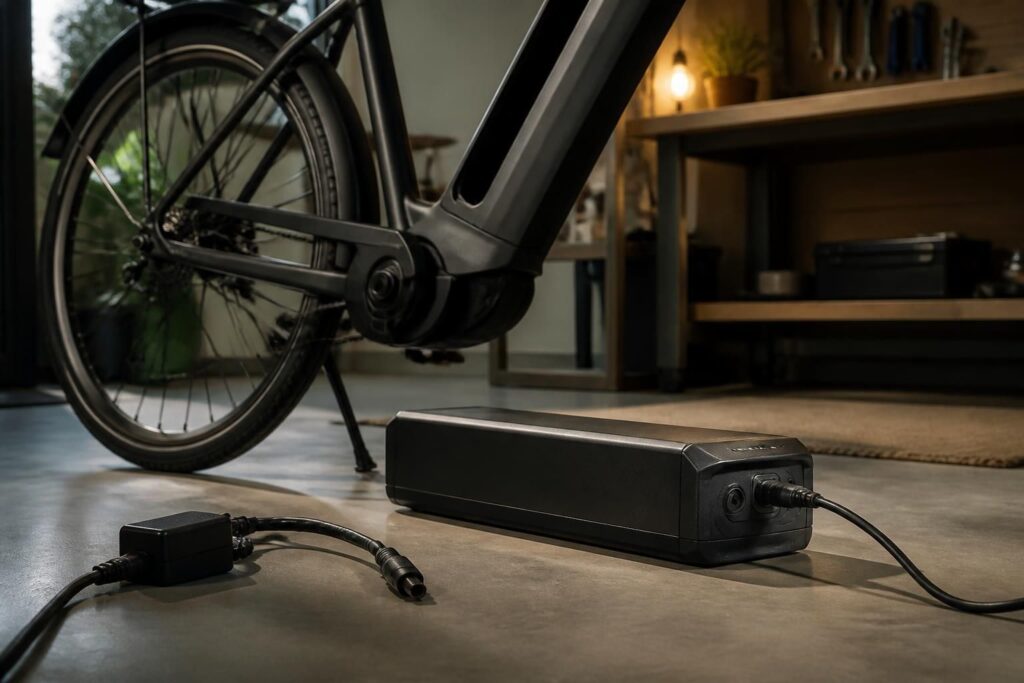

An e-bike battery not charging is usually caused by something small: the battery is switched off, it’s too cold or still warm from a ride, a plug isn’t fully seated, or the pack went into a sleep mode after sitting unused. Start with those. If the battery is swollen, leaking, hot or smells strange, stop and don’t charge it at all.
This guide walks through the checks in the order most likely to find the problem. It also shows what your charger lights are telling you and when it’s time to call the dealer instead of trying again.
This article is general safety and troubleshooting information. Always follow your bike’s owner’s manual, and contact the manufacturer for anything involving damage or internal repairs.
Key Takeaways
- Most “dead” batteries are switched off, in ship mode, or outside their charging temperature range.
- Rad Power Bikes, for example, says to charge between 41°F and 77°F. A battery from a cold garage may refuse to charge until it warms up.
- Never use a “universal” charger. The CPSC has warned they can fit your bike and still start a fire.
- A swollen, leaking or very hot battery is a stop sign, not a troubleshooting step.
- If the basic checks fail, the battery management system may have locked the pack. That’s a dealer job.
Stop First If You See Any of These
Some symptoms mean the battery is damaged and shouldn’t be charged again. Look for swelling or a cracked case, leaking fluid, a sweet or chemical smell, hissing or popping, or a pack that feels hot when it hasn’t been used. A battery that was dropped hard or soaked also belongs in this group.
If you notice any of them, unplug the charger if you can do it safely and move the battery away from anything flammable. If there’s smoke, leave and call 911. Charging problems aren’t a minor risk. The CPSC’s June 2026 proposed battery safety rule counted 227 micromobility battery incidents from 2019 to 2023, and about half of them happened while the product was charging.
Read the Charger Light Before Anything Else
Your charger is a basic diagnostic tool. Plug it into the wall first, without the battery, and note the light. Then connect the battery and watch what changes. Light colors vary by brand, so check your manual, but the patterns below are common.
| What you see | What it usually means | What to try |
|---|---|---|
| No light at all, even unplugged from the battery | Dead outlet or failed charger | Test the outlet with a lamp; try an approved replacement charger |
| Charger shows “ready” but never switches to “charging” | Battery is off, in sleep or ship mode, too cold or too warm | Turn the battery on, wake it, let it reach room temperature |
| Charges for a minute, then shows “full” | Worn cells or a pack that’s already full | Check the battery’s own charge display; compare range to when it was new |
| Charger and battery show no lights at all (on some packs) | A blown fuse on a removable battery | Follow the manual; never open a battery with a built-in fuse |
Work Through the Common Causes in Order
1. The battery isn’t switched on
This catches a lot of people. Many removable packs have a key or power button that must be on before the charge lights work. Rad Power Bikes’ battery troubleshooting page tells owners of its standard battery to turn the key fully to ON first.
2. It’s in ship mode or sleep mode
New bikes often ship with the battery in a low-power storage state. So do some bikes that sat for weeks. Rad says newer packs can be woken by holding the battery button for at least three seconds. Other brands do it differently, so check your manual.
3. It’s too cold, or still warm from a ride
Lithium batteries protect themselves by refusing to charge outside a safe temperature window. Rad lists 41°F to 77°F (5°C to 25°C) as its charging range, and it notes that a battery may wait to cool down before charging right after a ride. That’s normal, not a fault.
So if your bike lives in an unheated garage, bring the battery inside and give it a few hours. Don’t warm it with a hair dryer or heater. Cold charging can permanently damage lithium cells, which is why many battery management systems block it. Our guide to LiFePO4 vs lithium-ion batteries explains how different chemistries handle the cold.
4. A plug isn’t fully seated
Check every link in the chain: wall plug, the connection between the charger brick and its cord, and the plug at the battery. Look for bent pins, dirt or moisture. If the port is wet, let it dry completely before you charge. And on bikes that charge through a port on the frame, make sure the battery is clicked firmly into its mount.
5. The fuse has blown
Some removable batteries have a small replaceable fuse. If neither the charger nor the battery shows any light, a blown fuse is possible. Even so, only replace one if your manual says it’s user-serviceable. Rad specifically warns owners never to replace a fuse on its semi-integrated battery because of the risk of serious injury.
6. The battery management system has locked the pack
Every quality e-bike battery has a battery management system (BMS). It’s a circuit board that cuts power when voltage, current or temperature goes outside safe limits. If a battery sat empty for months, its voltage can drop so low that the BMS won’t allow charging. Our LiFePO4 battery guide covers what a BMS does in more detail.
This is where DIY should stop. Forum advice about “jump-starting” a pack with another charger is common, but it bypasses the safety system for a reason. Take the battery to the dealer with its model and serial number, and tell them how long it sat unused.
When an E-Bike Battery Not Charging Means It’s Worn Out
Sometimes the battery does charge, just not well. Watch for range that’s dropped sharply, a charge that finishes in a fraction of the usual time, or a pack that shows full and then empties within a few miles. Those are signs of aging cells, not a charger fault.
How fast that happens depends on how often you ride, how deeply you drain it and where it’s stored. Riding at top assist all the time also shortens each charge, as our look at e-bike speeds and range explains. If your bike is a few years old and range keeps shrinking, a replacement battery from the original maker is usually the honest fix.
Replacing the Charger or Battery Safely
A lost or broken charger tempts people to grab the cheapest match online. Don’t. In a September 2024 warning, the CPSC urged people not to use “universal” chargers with e-bikes and reported 156 fire and thermal incidents involving them in the first months of that year. A charger can fit the port and still be the wrong match.
Buy the replacement from your bike’s maker, or one the maker approves for your exact model. For batteries, look for certification to UL 2271 (battery packs) or a bike certified to UL 2849 (the full electrical system). Those are the standards the CPSC’s proposed rule would make mandatory.
Charging Habits That Prevent the Next Problem
A few habits cut both breakdowns and fire risk. The CPSC’s charging safety notice recommends staying nearby while the battery charges and never charging while you sleep. Unplug it when it’s done. Also charge on a hard surface, away from exits and anything that burns.
For storage, follow your manual. Many makers suggest keeping the battery partly charged and indoors at room temperature if the bike will sit for weeks. That alone prevents most of the deep-discharge lockouts described above.
What to Do If Nothing Works
If your e-bike battery is not charging after you’ve checked the switch, wake mode, temperature, connections and charger, stop trying. Repeated attempts on a locked or damaged pack won’t fix it and can make it worse. Contact the dealer or manufacturer with your model, serial number and what you’ve already tried. If the bike is under warranty, that record helps your claim.
Frequently Asked Questions
Why does my e-bike battery charge fine indoors but not in the garage?
The garage is probably below the battery’s charging range. Many packs block charging near freezing to protect the cells, and some brands set the floor higher. Rad, for example, lists 41°F. Charge indoors at room temperature, then reinstall the battery before you ride.
Can I leave my e-bike charger plugged in overnight?
No. The CPSC advises never charging micromobility batteries while you sleep and unplugging once charging is complete. Most chargers stop when the battery is full, but an unattended fault overnight is exactly the scenario fire departments warn about. Charge while you’re home and awake.
How long should an e-bike battery take to charge?
It depends on battery size and charger output. Rad Power Bikes says a full charge on its bikes can take seven to eight hours. If yours suddenly finishes much faster than it used to, the cells may be losing capacity rather than charging efficiently.
Is it safe to buy a used e-bike battery?
It’s risky. You can’t see how a used pack was stored, charged or dropped, and the CPSC warns against batteries that were rebuilt by unqualified people or made from repurposed cells. If you buy used, get one from the original maker or an authorized dealer who can test it.
Will my e-bike work without the battery charged?
You can still pedal it, but it’ll feel heavy because the motor and battery add weight. Any class rides like a heavy regular bike, and a Class 2 throttle won’t work either. Our guide to e-bike classes explains how each type delivers power when the battery is working.
Headlinza Editorial Team writes practical guides for Headlinza.