
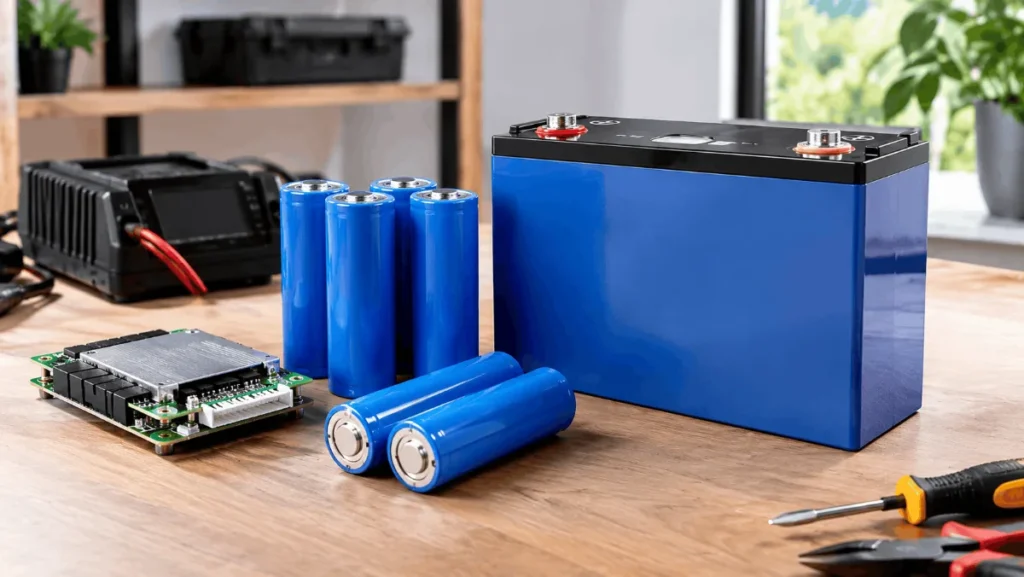

LiFePO4 Battery Guide. LiFePO4 stands for lithium iron phosphate, a lithium-ion chemistry that uses iron phosphate as the cathode material. You’ll also see it written as LFP. Wikipedia’s overview of the lithium iron phosphate battery covers the chemistry in more depth if you like the technical side.
A single cell runs at about 3.2 volts nominal. Stack four in series and you get the familiar 12.8V pack that replaces a standard 12V lead-acid battery. That’s why so many of these are sold as drop-in replacements.
What separates this chemistry from the lithium-ion cells in your phone is stability. Phosphate-based cathodes hold up better under heat and abuse, so they’re far less prone to the kind of failure people picture when they hear “lithium fire.” They also give up some energy density in exchange, which means a LiFePO4 pack is bulkier than a cobalt-based one of the same capacity. For a battery that sits in a van or a shed, I think that’s a trade worth making every time. If you are still choosing a chemistry, our LiFePO4 vs lithium-ion comparison breaks down lifespan, safety and cost side by side.
Why people switch: the real advantages
Cycle life is the headline. Good LiFePO4 cells are commonly rated for thousands of charge cycles, often somewhere between 2,000 and 5,000 or more depending on how deeply you discharge them. A typical deep-cycle lead-acid battery, treated the same way, is done in a few hundred. Spread that over the years you’ll own it and the higher sticker price starts to look different.
Usable capacity is the second big one. Lead-acid batteries are generally best kept above roughly 50% charge if you want them to last, so a 100Ah lead-acid battery gives you about 50Ah you can safely use. A 100Ah lifepo4 battery lets you pull most of it out, often 80% to 100%, without punishing the cell. That means one lithium battery can do the work of two lead-acid ones.
Then there’s weight, which is usually around half for the same usable energy. Voltage stays flatter as the battery drains, too, so lights stay bright and inverters stay happy right up until the end instead of sagging halfway through. Charging is faster and more efficient, and the self-discharge rate is low enough that a battery stored over winter will still be in good shape in spring.
What tends to surprise people is the maintenance. There isn’t any. No watering, no equalizing, no corrosion on the terminals, no worrying about mounting it at an angle.
Where a LiFePO4 battery falls short
Cold is the big weakness. You shouldn’t charge lithium iron phosphate cells below freezing (0°C or 32°F). Do it and you can cause lithium plating inside the cell, which permanently shrinks capacity and can create safety problems. Discharging in the cold is generally fine, but charging isn’t.
If you live somewhere that freezes, look for a battery with built-in low-temperature charge protection, or one with an internal heating pad. In my experience, this is the spec buyers skip and then regret, especially in boats and campers that sit out all winter. It’s a feature worth paying extra for.
Upfront cost is the other obvious sting. A LiFePO4 battery costs noticeably more than a comparable lead-acid unit on day one. Prices shift constantly and vary by brand and capacity, so check current listings from the manufacturer instead of trusting any number you read in an article. The long-run math usually favors lithium, but if you only need a battery for a couple of seasons, lead-acid can still make financial sense.
Charger compatibility catches a few people off guard as well. Old alternators, converters, and solar charge controllers set up for lead-acid profiles may not charge a LiFePO4 pack correctly. A charger without a lithium mode can leave you chronically undercharged. And a high-output alternator feeding a small lithium battery can overload the alternator itself, which is a repair bill nobody expects.
Lead-acid vs lifepo4 battery at a glance
A quick table makes the practical differences easier to see. Numbers are typical ranges, not guarantees, so always check the datasheet for the model you’re considering.
| Feature | Lead-acid (AGM/flooded) | LiFePO4 |
|---|---|---|
| Typical cycle life | A few hundred cycles | Often 2,000 to 5,000+ cycles |
| Recommended usable capacity | Roughly 50% | Roughly 80% to 100% |
| Weight for the same usable energy | Heavy | Around half, give or take |
| Maintenance | Varies, flooded types need watering | None |
| Cold charging | Tolerates it better | Needs protection below freezing |
| Upfront cost | Lower | Higher |
| Best fit | Short-term or low-budget use | Daily cycling and long-term use |
If you want the background on the older chemistry, there’s a solid lead-acid battery explainer on Wikipedia that shows why it’s still everywhere despite its limits.
The BMS matters more than the brand name
Every decent LiFePO4 pack includes a battery management system, or BMS, which is a small circuit board that guards the cells. A battery management system watches voltage, current, and temperature, and it cuts the circuit when something drifts out of range. It also balances the cells so one doesn’t wander off from the others.
Here’s an opinion I’ll stand behind: the BMS is where cheap packs cut corners, and it’s the part you can’t see in a product photo. A pack with a weak BMS can shut off under a heavy load, fail to protect against low temperatures, or let cells drift out of balance until capacity quietly collapses.
Check the continuous discharge rating and make sure it covers your biggest load. An inverter pulling 2,000 watts from a 12V battery draws well over 150 amps, and a BMS rated for 100A will trip. Look for clear specs on overcharge, over-discharge, short-circuit, and temperature protection. If a listing doesn’t tell you, that silence is itself information.
Common misconceptions worth clearing up
“Lithium batteries explode.” Cobalt-based lithium-ion cells have a worse reputation for thermal runaway, and it’s fair to be careful with them. LFP is considerably more stable, which is a big reason it’s trusted in home energy storage. But “safer” doesn’t mean “harmless.” A damaged, overcharged, or badly wired pack can still fail, so good installation and proper fusing matter. The concept of thermal runaway is worth reading about if you plan to build your own bank.
“You can just add more lithium batteries later.” Sort of. Mixing old and new packs, or different brands and capacities, in the same parallel bank is asking for trouble. Plan your capacity up front and buy matching units.
“It never needs a proper charger.” It does. The cells tolerate a wide range, but they like a charger configured for lithium, with a sensible absorption voltage and no desulfation or equalization modes meant for lead-acid.
“Amp-hours tell you everything.” An amp-hour rating without voltage and discharge limits is incomplete. Watt-hours is the better number for comparing batteries across different voltages.
How to buy a lifepo4 battery without getting burned
Start with your actual load. Add up what you run, how long you run it, and what the peak draw is. That gives you the capacity and continuous discharge rating you need, and it stops you from buying something too small because the price looked good.
Next, look for real documentation. A reputable seller publishes a datasheet with cell type, cycle life at a stated depth of discharge, BMS specs, operating temperature ranges, and warranty terms. Warranties in this category vary a lot, so read the fine print on what voids it, such as using it in a series configuration the maker doesn’t support.
Be skeptical of absurdly cheap packs with huge capacity claims. Capacity numbers that look too good often come from optimistic measurement or recycled cells. Independent reviews and long-term owner reports are more reliable than marketing copy.
For anyone designing a larger solar or storage system, the National Renewable Energy Laboratory publishes research on energy storage and solar integration that’s useful for understanding how batteries behave in real systems.
Finally, install it properly. Use correctly sized cables, a fuse close to the battery, and secure terminals. Most “bad battery” stories I hear about trace back to wiring or charging setups, not the cells.
Who should buy one and who should skip it
If you cycle your battery regularly, such as in a solar setup, a van or RV, a trolling motor, or a golf cart, a lifepo4 battery is the better buy. The weight savings and longevity pay you back, and I’d say the decision is easy. It’s also the right move if you’re replacing a lead-acid bank for the second time, because that second replacement cost is usually the point where lithium wins.
Skip it, or at least think harder, if you need a cheap battery for occasional backup use, if you charge in freezing conditions without a way to protect the pack, or if your charging gear can’t be configured for lithium and you don’t want to replace it. A basic AGM can be the smarter choice in those cases, and there’s no shame in that.
My recommendation for most people is simple. Buy a reputable pack from a seller with clear specs and a real warranty, confirm the BMS handles your peak load, and make sure your charger speaks lithium. Do those three things and you’ll likely never think about the battery again, which is exactly the point.
Related Guides
- LiFePO4 vs AGM Battery: Which Is Better for RV, Boat and Solar?
- LiFePO4 vs Lithium-Ion: Which Battery Is Better?
- AG13 Battery Guide: Equivalents, Uses and Safety Tips
- What Is the Charge of Aluminum? A Clear Breakdown
- Neodymium Magnets: Types, Grades, Uses and Safety Tips
- Phone Science: The Tech Behind How Smartphones Work