
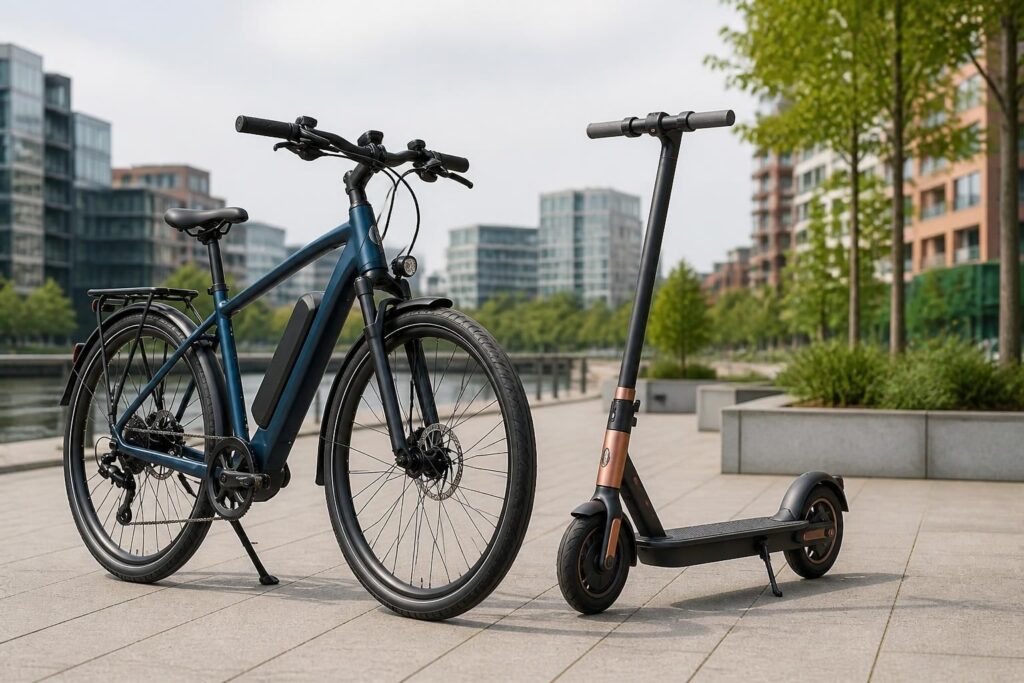

In the e-bike vs electric scooter choice, distance and storage decide most cases. An e-bike is the better pick for rides over a few miles, hills, cargo and rough roads. An electric scooter is better for short hops, the “last mile” from a train or bus, and anyone who has to carry their ride up stairs or into an office.
Both are battery powered, both are cheaper to run than a car, and both are covered by local rules that keep changing. The real differences show up in weight, comfort and how far you want to go. Here’s how they compare in practice.
Key Takeaways
- A popular commuter scooter like the Segway Ninebot Max G30P weighs about 41 lb. A commuter e-bike like the Aventon Level 3 weighs about 67.5 lb.
- E-bikes usually go farther per charge and handle potholes better because of their bigger wheels.
- Scooters fold, fit under a desk and go on trains, which is their biggest advantage.
- E-bike laws follow a clear class system in most states. Scooter rules vary far more by city.
- Whichever you pick, buy a model with recognized battery safety certification and wear a helmet.
Two Real Commuter Models Side by Side
Spec sheets make the trade-off concrete. Here are two widely sold, mid-priced commuter options:
| Spec | Segway Ninebot Max G30P (scooter) | Aventon Level 3 (e-bike) |
|---|---|---|
| Weight | 41.2 lb | 67.5 lb |
| Wheels or tires | 10 in | 27.5 x 2.2 in |
| Battery | 551Wh | 708Wh |
| Claimed range | 40.4 miles | Up to 70 miles |
| Top assisted speed | 18.6 mph | Up to 28 mph (Class 3 setting) |
Specs come from ERideHero’s listings for the Ninebot Max G30P and the Aventon Level 3. Ranges are manufacturer claims, so expect less in hills, cold weather or at full speed.
What the table means in practice: the scooter is about 26 lb lighter, but the e-bike carries a bigger battery, claims much more range and can legally go faster in Class 3 mode. You’re trading portability for distance.
Range and Comfort on Longer Rides
E-bikes let you share the work with your legs, and they carry bigger batteries. That makes a 10-mile commute easy. A seat also matters more than people expect. Standing on a scooter deck for 40 minutes gets tiring, and small wheels pass every crack in the road straight to your knees.
For trips of a mile or two, none of that matters. A scooter gets you there quickly and folds away when you arrive. For anything longer, the e-bike is the more comfortable machine. Our guide to how fast an e-bike goes covers real average speeds and how speed eats into range.
Stability and Safety
Big bike wheels roll over potholes, gravel and curb edges that can catch a 10-inch scooter wheel. E-bikes also have larger brakes and a seated position with a lower center of gravity. So for rough city streets, the bike is the more forgiving choice.
Both carry real risk, though. Federal injury data compiled by USAFacts estimates about 855,000 emergency room visits tied to e-bikes, e-scooters and hoverboards from 2020 through 2025. Wear a helmet, use front and rear lights, and ride as if drivers can’t see you.
Battery safety matters for both too. Look for UL 2849 certification on e-bikes and UL 2272 on scooters. Charge with the original charger, and don’t leave either one charging while you sleep.
Portability and Storage
This is where scooters win clearly. Most fold in seconds and fit in a car trunk, under a desk or in a closet. Many transit systems allow folded scooters on board when full-size bikes aren’t welcome.
E-bikes are bulky. At 60 to 80 lb for many models, carrying one up apartment stairs is hard work. Folding e-bikes exist, but they’re usually still heavier than a scooter. If you live in a walk-up or need to bring your ride inside at work, that alone may decide it.
Cost to Buy and Run
Scooters usually cost less upfront. A solid commuter scooter often sells for around $1,000, while quality e-bikes commonly start in the mid-$1,000s and climb into the thousands. Both are cheap to run: some electricity, tires, brake pads and, after a few years, a replacement battery.
One hidden cost with scooters is wear. Small tires and folding joints take a beating on rough roads. One hidden cost with e-bikes is storage and theft protection, since a heavy bike that lives outside needs a good lock.
Laws and Where You Can Ride
Most US states use a three-class system for e-bikes, and they’re generally allowed where regular bikes are, with some limits for faster Class 3 bikes. Our explainer on e-bike classes breaks down the rules. A few states have gone further: New Jersey, for example, now requires registration, a license and insurance for every e-bike.
Scooter laws are more uneven. Speed caps, minimum ages, helmet rules and whether you can ride on sidewalks or in bike lanes differ widely between states and even between cities. Check your city’s rules before you buy either one.
E-Bike vs Electric Scooter: Which One Fits Your Life?
Think about your most common trip, then pick the tool for that trip:
- Commute of 5 miles or more, hills, or rough roads: e-bike.
- Groceries, kids or cargo: e-bike with a rack or cargo setup.
- Train-plus-ride commute or a short campus hop: scooter.
- Walk-up apartment and no ground-floor storage: scooter, or a lightweight folding e-bike.
- You want some exercise from the ride: e-bike, since pedal assist still asks something of you.
If two of these pull in different directions, weigh storage first. The best e-bike vs electric scooter choice is the one you’ll actually use, and a ride you hate carrying tends to stay parked.
Frequently Asked Questions
Is an e-bike or a scooter better for a 10-mile commute?
An e-bike, for most people. It’s more comfortable over that distance, rides better over bad pavement and usually has range to spare for the trip home. A scooter can cover 10 miles, but standing that long on small wheels is tiring, and range drops quickly at full speed.
Can I take an electric scooter on a bus or train?
Often, if it folds, but rules depend on your transit agency. Many allow folded scooters as carry-on items and ban riding them in stations. Some systems restrict lithium-battery devices at busy times. Check your agency’s current policy before you rely on it for a daily commute.
Do I need a license for an e-bike or scooter?
In most US states, no license is needed for a standard Class 1, 2 or 3 e-bike. New Jersey is a notable exception. Scooter rules vary more, and some places require riders to be a minimum age or to hold a license. Look up your state and city rules.
Which lasts longer, an e-bike or a scooter?
E-bikes generally last longer because they’re built on sturdier bike frames with standard, replaceable parts. Scooters have more proprietary parts and take a beating on small wheels. With either one, the battery is usually the first major part to wear out, often after several years.
Headlinza Editorial Team writes practical guides for Headlinza.