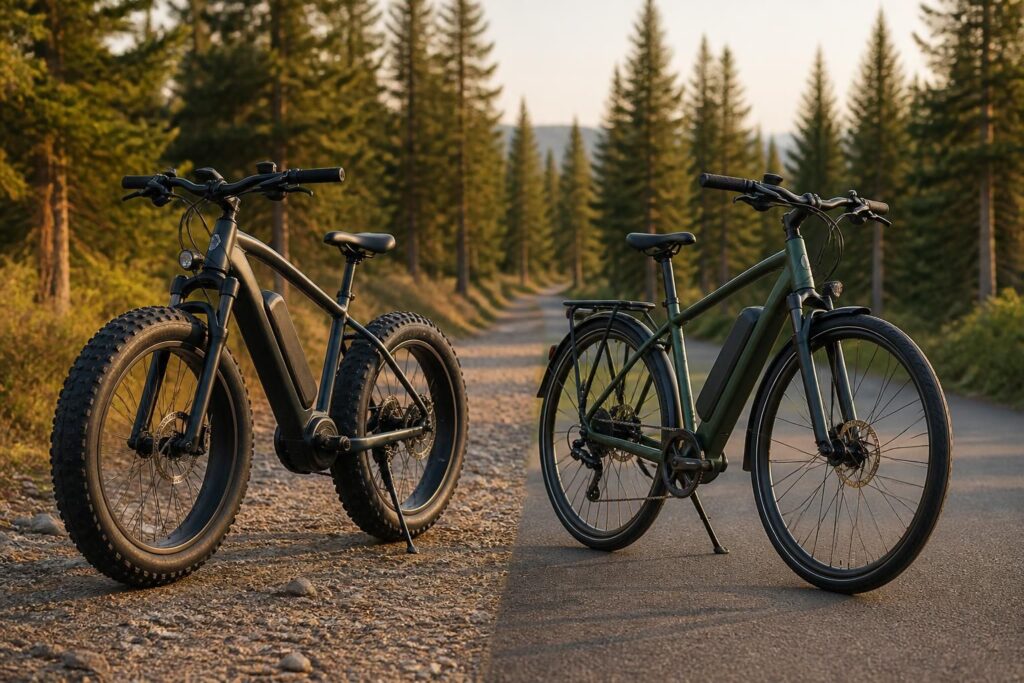

In the fat tire e-bike vs regular e-bike decision, terrain is what settles it. Choose fat tires if you ride on sand, snow, gravel or rough trails, or you want the steadiest, most cushioned ride. Choose a regular e-bike with narrower tires if most of your miles are on pavement, because it’s lighter, quicker to steer and easier to store.
Fat tires are usually about 4 inches wide. Most commuter and hybrid e-bikes run tires closer to 2 inches. That one difference changes comfort, weight, handling and even which car rack fits. Here’s how it plays out in real use.
Key Takeaways
- Fat tires win on loose ground and comfort. Regular tires win on pavement, weight and agility.
- In Aventon’s own lineup, the fat-tire Aventure 3 weighs about 76 lb, while the Level 3 commuter weighs 67.5 lb.
- Tire width doesn’t change the law. Both types fall into the same Class 1, 2 or 3 categories.
- Check rack, storage and stairs before you buy a fat tire bike. Those are the most common regrets.
Fat Tire vs Regular E-Bike at a Glance
| Feature | Fat tire e-bike (about 4 in) | Regular e-bike (about 2 in) |
|---|---|---|
| Best surfaces | Sand, snow, gravel, dirt, broken pavement | Roads, bike lanes, paved paths |
| Ride feel | Very cushioned and stable | Firmer, more responsive |
| Weight | Usually heavier | Usually lighter |
| Steering | Slower, wider feel | Quicker, more agile |
| Racks and storage | Often needs a fat-tire rack | Fits most standard racks |
A Same-Brand Comparison Shows the Real Trade-Off
Comparing bikes from different brands mixes up too many variables. So it helps to look at one company’s fat-tire and commuter models side by side. Aventon makes both, with similar motors and batteries.
- Aventure 3 (fat tire): 26 x 4 inch tires, a 733Wh battery and a listed weight of 76 lb. Aventon claims up to 65 miles of range, according to Electric Bike Review’s spec sheet.
- Level 3 (commuter): 27.5 x 2.2 inch tires, a 708Wh battery and a weight of 67.5 lb. Aventon claims up to 70 miles, per ERideHero’s listing.
So the fat-tire bike carries a slightly bigger battery but still claims less range, and it weighs about 8.5 lb more. That’s the cost of wide, low-pressure tires: more rolling resistance and more mass to move. Claimed ranges are best-case figures, so treat them as a comparison point rather than what you’ll get on every ride. Our Aventon Aventure guide covers the fat-tire model in more depth.
Comfort and Traction: Where Fat Tires Earn Their Weight
Fat tires run at low pressure, so they spread out and grip loose ground. A wide contact patch floats over sand and snow where a narrow tire would dig in. The large air volume also soaks up potholes, cracks and curb drops.
Pressure is the secret. One fat-tire e-bike maker’s tire pressure guide suggests starting around 20 to 24 psi on pavement for 4-inch tires, and dropping to 6 to 8 psi on soft sand. It also says the range printed on your tire’s sidewall always comes first. Commuter tires usually run several times higher than those numbers.
If you’re a nervous rider, or you’re getting back on a bike after years away, that stability can matter more than anything on a spec sheet.
Speed, Effort and Range on Pavement
On smooth roads, wide knobby tires work against you. They create more rolling resistance and catch more wind, so the motor and your legs work harder at the same speed. A regular e-bike feels quicker and gets more miles from each charge.
Fat-tire bikes often make up for it with strong hub motors and big batteries. Even so, if you commute 10 miles each way on bike lanes, the lighter bike will be the easier daily partner. Riding at higher assist levels also drains either battery faster, as our guide to e-bike speeds and range explains.
The Practical Problems Nobody Mentions in the Showroom
Weight shows up the first time you carry the bike. A 76 lb bike up a flight of apartment stairs is a real chore. It’s also hard to lift onto a car rack.
Then there’s the rack itself. Many standard hitch and roof racks don’t fit 4-inch tires, so you may need a fat-tire-specific carrier or wider wheel trays. Indoor bike rooms, wall hooks and train bike racks can be tight too. Folding fat-tire models help with space but are still heavy.
Regular e-bikes fit standard racks, hang on normal hooks and are easier to wheel through doorways. For mixed commutes with a train or bus, that’s a big advantage.
Legal Classes Apply to Both
Tire size doesn’t change how the law treats your bike. Fat-tire and regular e-bikes fall into the same Class 1, 2 or 3 categories based on how the motor works and its assisted top speed. Many fat-tire bikes ship as Class 2 because they include a throttle. The Aventure 3, for example, ships as Class 2 and can be switched to Class 3 in the app. Our explainer on e-bike classes covers where each class can ride.
Fat Tire E-Bike vs Regular E-Bike: Which Should You Buy?
Match the bike to the ground you’ll ride most, not the ride you imagine once a year.
- Beach towns, snowy winters, gravel roads or dirt trails: fat tire.
- Daily commute on pavement, especially with stairs or transit: regular e-bike.
- Bad roads in the city but mostly pavement: a regular e-bike with wider 2.4 to 3 inch tires and front suspension is a good middle ground.
- Balance or confidence concerns: fat tires feel steadier, but test the weight first.
If you’re torn, rent or test-ride both on your actual route. Ten minutes on your own streets will tell you more than any spec table.
Frequently Asked Questions
Are fat tire e-bikes good for commuting?
They can be, especially on rough streets or in snow. The trade-off is weight, slower steering and less range on smooth pavement. For a short commute without stairs, a fat-tire bike works fine. For long daily commutes on bike lanes, a regular e-bike is usually easier to live with.
Do fat tire e-bikes go slower?
Not on paper. Both types share the same legal assist limits of 20 or 28 mph depending on class. In practice, fat tires take more effort and battery to hold top speed on pavement, so riders often cruise a little slower and see less range per charge.
Do fat tires get more flats?
Not necessarily. Lower pressure makes them less prone to pinch flats from potholes, and many come with puncture-resistant casings. When they do flat, though, the big tube and tire are harder to change on the roadside, and replacements cost more than standard sizes.
Can I put fat tires on a regular e-bike?
Usually not. Fat tires need wide rims plus a frame and fork with enough clearance. A regular e-bike frame won’t fit a 4-inch tire. You can often go slightly wider than stock, so check the maximum tire size listed by the manufacturer.
Headlinza Editorial Team writes practical guides for Headlinza.