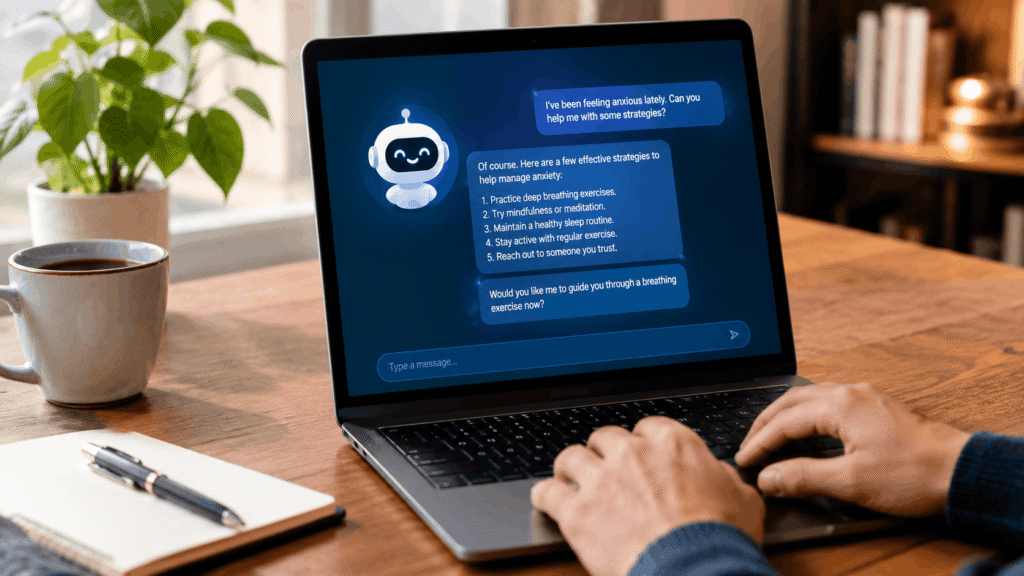

A CBT chatbot is an app that walks you through techniques from cognitive behavioral therapy by text conversation. The research is encouraging but early. Most trials are short, and the strongest result so far came from a purpose-built research system with clinicians watching. The American Psychological Association says these tools should not replace care from a qualified professional. Used as a supplement for everyday stress or low mood, they can be a reasonable way to practice skills. They are not a safe place to manage a crisis.
This article is general information, not medical advice. If you are struggling, a licensed clinician can assess what you need.
What CBT is, and what a chatbot borrows from it
Cognitive behavioral therapy is a form of psychotherapy built on the idea that thoughts, feelings and behaviors are linked. Changing unhelpful thought patterns can improve how you feel and act. A therapist typically works with you over several sessions.
A chatbot can only imitate part of that. It can prompt you to examine a thought, suggest a small activity for the day, or guide a breathing exercise. A review of CBT-based chatbots describes cognitive restructuring and behavioral activation as the techniques they most commonly use. What it can’t do is take responsibility for you the way a clinician does, or notice what you leave unsaid.
Two kinds of CBT chatbot
Scripted (rules-based) bots follow pre-written paths. Woebot worked this way. According to STAT, its responses were pre-scripted even though it felt conversational, and about 1.5 million people used it. Scripted bots are predictable, but they can feel rigid.
Generative AI bots write new responses using a large language model. They feel more natural, and that is also their risk: Dartmouth’s lead researcher notes that a person can say anything to them, and they can say anything back.
General-purpose assistants fall into a third group. The APA points out that chatbots built for general information or productivity were not created to deliver mental health care, even though many people use them that way.
What the research actually shows
An early, small result. A frequently cited 2017 trial found that two weeks with Woebot reduced anxiety and depression symptoms in young adults compared with self-help materials. A later randomized trial of 81 young adults with mild symptoms did not replicate that: both the chatbot group and the comparison group improved. That is a reminder that short-term gains can come from simply doing something structured.
The strongest result so far. In March 2025, Dartmouth researchers published the first randomized trial of a generative AI therapy chatbot, Therabot, in NEJM AI. The study reported average symptom reductions of 51% for depression, 31% for generalized anxiety and 19% for eating-disorder concerns. Participants also rated their working relationship with the bot as comparable to that reported for in-person therapists. The details matter, though:
- The trial involved 210 adults and ran for four weeks of access, with follow-up at eight weeks.
- The comparison group had no access to the bot, which is not the same as being compared with another therapy or app.
- Therabot was developed with ongoing input from psychologists and psychiatrists, and the study team was ready to intervene if a participant raised a safety concern.
- The researchers themselves said no generative AI agent is ready to operate fully on its own in mental health.
That setup is not the same as downloading a consumer app.
The warning signs. A Stanford-led study tested several therapy chatbots in constructed scenarios and found they responded appropriately less than 60% of the time, versus 93% for licensed therapists. The bots also showed more stigma toward some conditions, such as alcohol dependence, than others. The authors stressed that the point is not that AI therapy is simply bad, but that its role needs careful thought.
The professional view. The APA’s November 2025 health advisory says that even tools built with sound psychological science lack enough evidence to show they are effective or safe in mental health care. It also describes the ability of these tools to safely guide someone in crisis as limited and unpredictable.
Where things stand in 2026
Woebot’s founder told STAT that the cost and difficulty of meeting FDA requirements, together with the arrival of large language models that regulators had not yet figured out how to oversee, led the company to close its consumer app. The app shut down on June 30, 2025. Woebot Health shifted toward working through partner organizations.
States are starting to act. Illinois signed a law in August 2025 prohibiting anyone from using AI to provide mental health and therapeutic decision-making, while still allowing AI for administrative support to licensed professionals. Rules differ by state and are changing, so check where you live if that matters to you.
Who might get something out of one
A CBT chatbot is most plausible as a low-stakes practice tool for people dealing with everyday stress, worry or low mood who want to learn coping skills between other forms of support. It can also help people who are on a waitlist for a therapist, or who find it easier to start by typing than by talking.
It is a poor fit if you are in crisis, have thoughts of suicide, have a serious or complex condition, or are a teenager or child without a parent or clinician involved. The APA specifically calls for safeguards for children, teens and other vulnerable people.
How to choose one
- Look for a tool built for mental health. An app designed around CBT is a different thing from a general chatbot asked to “act like a therapist.”
- Check what evidence exists. Look for published trials of that specific product, not just general claims about CBT.
- Test the crisis response. A good app should point you to human help. Wysa, for example, says it screens for signs of distress and guides users toward local and national helplines, and it includes an SOS feature. Read what any app does before you need it.
- Know whether a human is available. Some apps offer optional text sessions with coaches or therapists. Wysa does, and notes the app is not designed for children under 13.
- Read the privacy policy. The APA flags that mental health disclosures may be stored or used in ways people don’t fully understand. Share only what you are comfortable sharing.
- Confirm it is clear that it’s a bot. An app should never pose as a licensed professional.
- Check pricing in the app store. Many have a limited free tier and paid plans, and published prices vary by source and region.
Using one well
Treat it as a practice partner, not a therapist. Do the exercises, but notice whether your mood is actually improving over a few weeks. If you are seeing a clinician, tell them about it. The APA encourages clinicians to ask about chatbot use, and what you practice can feed into your sessions.
If your real aim is steadier days rather than treating a problem, a non-clinical routine may be a better first step. Headlinza’s guide to building a day-at-a-time routine covers that approach. For more on health topics generally, see Headlinza’s Health & Fitness section.
When to talk to a person
Seek help from a licensed professional if symptoms last more than a couple of weeks, interfere with work, school or relationships, or get worse while using an app. If you are thinking about suicide or are in emotional crisis, call or text 988 or chat at 988lifeline.org in the US. It is free, confidential and available 24/7. If you are in immediate danger, call 911.
FAQs
Is a CBT chatbot the same as therapy?
No. It can deliver some CBT-style exercises, but it isn’t a licensed clinician and can’t assess risk the way one can.
Can I use ChatGPT or another general chatbot for CBT?
You can ask it questions, but general chatbots weren’t designed for mental health care, and the APA advises against using them as a substitute for a professional.
Are CBT chatbots private?
It depends on the app. Review the data policy, and avoid sharing details you wouldn’t want stored.
Can a chatbot diagnose me?
No. Diagnosis requires a qualified clinician.
The bottom line
If you try a CBT chatbot, pick one made for mental health, check what it does when you mention self-harm, and use it for skill practice rather than serious problems. If it isn’t helping after a few weeks, or you feel worse, take that as the cue to talk to a professional.