
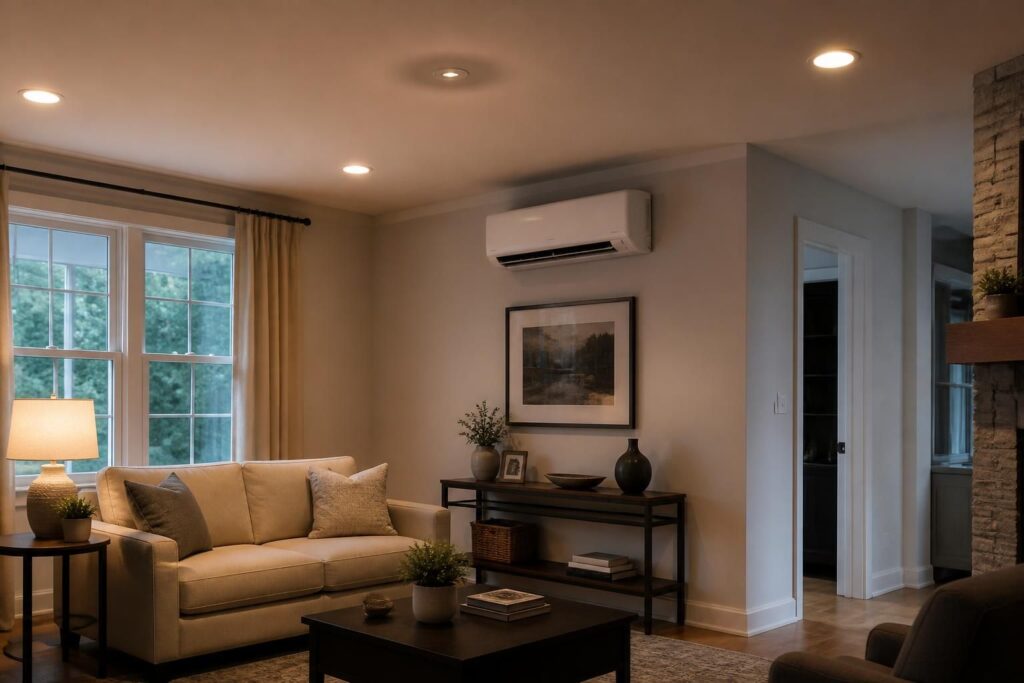

A quick, brief dip in your lights when the air conditioner kicks on is usually normal. The AC’s compressor motor pulls a big surge of current for a fraction of a second as it starts, and that briefly lowers the voltage in your home. It becomes a concern if the dimming is dramatic, lasts more than a second or two, happens across the whole house, or comes with buzzing, a burning smell or tripped breakers. Those signs point to an aging compressor, a weak start capacitor, an overloaded circuit or a loose connection that an HVAC technician or electrician should check.
Normal Dip vs Warning Sign
| What you see | What it likely means | What to do |
|---|---|---|
| Lights dip for less than a second as the AC starts, then return to normal | Normal motor inrush current | Nothing, or consider a soft start kit if it bothers you |
| Dip is getting worse over months, AC hums or struggles to start | Weak start capacitor or aging compressor | HVAC service call |
| Lights in one room flicker whenever a window or portable AC runs | AC shares a circuit with the lights | Move the unit or ask an electrician about a dedicated circuit |
| Lights get brighter in some rooms and dimmer in others | Possible loose neutral at the panel or service | Call an electrician promptly |
| Flicker plus buzzing, burning smell, hot panel or breaker trips | Loose or overheating connection | Turn the AC off and call an electrician |
Why the Lights Dim When the AC Starts
An electric motor draws much more current while starting than while running. In an example from Electrical Contractor magazine written by a retired UL engineering instructor, a 5-horsepower motor that runs at 25 amps draws roughly 65 to 131 amps at startup, depending on its design. That is two and a half to five times its running current.
Every wire, connection and the utility transformer has some resistance. When that surge passes through them, the voltage at your outlets drops briefly, and lights on the same service dim for an instant. LED bulbs can show this as a visible flicker because their drivers respond quickly to voltage changes.
Common Causes of Excessive Dimming
A failing start capacitor
Central AC and heat pump compressors use a capacitor to help the motor start. As it weakens, the compressor struggles and draws high current for longer, which makes the dimming more noticeable. A humming outdoor unit that takes a moment to start is a classic sign. Capacitors are relatively inexpensive parts, but they store a dangerous charge, so replacement is a job for an HVAC technician.
An aging compressor
Older compressors often need more current to start. If the dimming has slowly worsened over years, the compressor may be wearing out.
Shared circuits
Window units and portable air conditioners usually plug into ordinary outlets. If that outlet shares a circuit with the room’s lights, every start cycle causes a dip. Moving the unit to an outlet on another circuit, or having an electrician add a dedicated circuit, usually fixes it.
Undersized or long wiring
Long wire runs or wire that is undersized for the load increase voltage drop. This is more common in older homes and additions.
Loose connections or a loose neutral
Loose connections at the panel, meter or service drop make voltage swings much larger and can overheat. A loose neutral often shows up as lights getting brighter in some rooms while dimming in others. This needs an electrician, and sometimes the utility.
Fixes That Help
- Soft start kit: Reduces the compressor’s startup current. The magazine article notes that soft or hard start kits often fix light dimming caused by motor startup. Soft starters are also popular for running an AC on a generator or inverter.
- Hard start kit: Adds an extra capacitor and relay to help an older compressor start quickly. It can reduce strain but is often a sign the compressor is aging.
- Capacitor replacement: If testing shows a weak capacitor, replacing it can restore normal starting.
- Dedicated circuit: Separates a room AC from the lighting circuit.
- Utility check: If neighbors see the same dips or the problem started after a storm, the utility may need to inspect the transformer or service line.
When to Call a Professional
Call an electrician right away if you notice burning smells, sparking, a hot breaker panel, or lights that get brighter as well as dimmer. Call an HVAC technician if the outdoor unit hums, clicks repeatedly, or takes longer to start than it used to. For a broader look at the causes of flicker, see our guide on how to fix flickering lights.
Frequently Asked Questions
Is it normal for lights to flicker when the AC turns on? A very brief dip is normal. Strong, long or worsening dimming is not and should be checked.
Can a bad capacitor cause lights to dim? Yes. A weak capacitor makes the compressor draw high starting current for longer, which deepens the dip.
Will a soft start kit stop my lights from flickering? Often, yes, when the flicker comes from compressor startup. It will not fix a loose connection or overloaded circuit.
Can lights dimming when the AC starts cause a fire? The brief dip itself is not a fire risk. Loose or overheating connections that make the dip worse can be, which is why burning smells or heat need immediate attention.
Why do my lights flicker when the AC is running, not just starting? Continuous flicker while running suggests a loose connection, failing component or overloaded circuit rather than normal startup surge. Have it inspected.