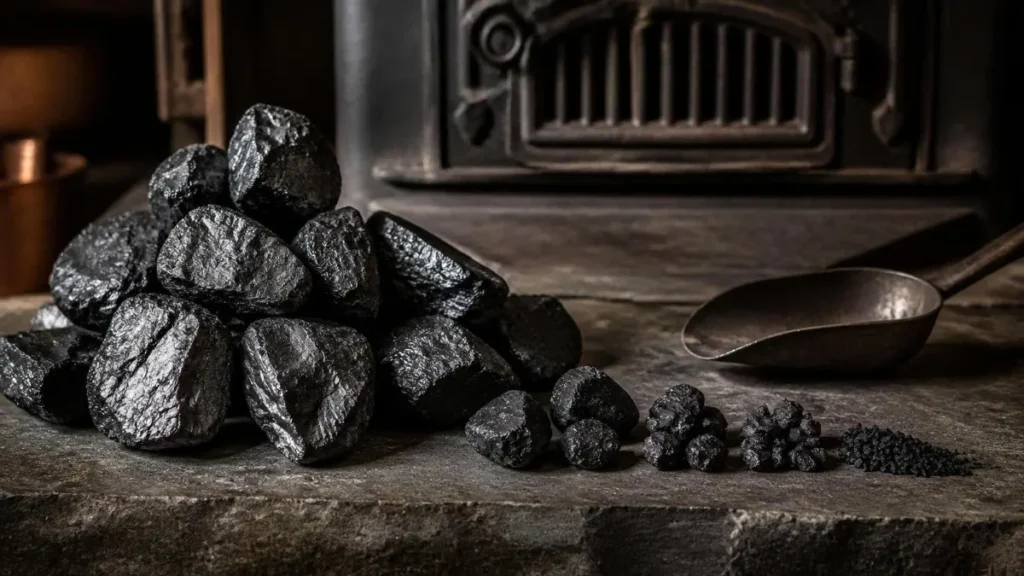

Hard Coal Anthracite Guide: Anthracite is the highest rank of coal. It is hard, shiny, and high in carbon, and it burns with less smoke than softer coals. That is why it has long been called “hard coal,” and why it still suits some home heating setups. It also needs the right appliance, a careful start-up routine, and serious attention to carbon monoxide and local rules.
What makes anthracite different from other coal
The U.S. Energy Information Administration (EIA) sorts coal into four ranks: anthracite, bituminous, subbituminous, and lignite. Rank depends on carbon content and heat energy. Anthracite contains roughly 86% to 97% carbon, while bituminous coal falls between about 45% and 86%.
Anthracite also has low volatile matter. The EIA’s coal glossary describes it as hard, brittle, and lustrous, with fresh-mined moisture generally under 15%. Its heat content runs from 22 to 28 million Btu per ton on a moist, mineral-matter-free basis. Anthracite burned in the U.S. averages about 25 million Btu per ton as received, against about 24 for bituminous. So the energy gap with good bituminous coal is smaller than the “highest rank” label suggests. The real difference is how it burns.
Because most of the volatile compounds are already gone, anthracite gives a short, steady flame and far less visible smoke than bituminous coal. It also feels cleaner in the hand, though it still leaves ash and dust.
Where it comes from and how it is used today
Anthracite is scarce in the United States. The EIA reports that it made up less than 1% of U.S. coal mined in 2022, and that all U.S. anthracite mines are in northeastern Pennsylvania. The same EIA explainer says U.S. anthracite is mainly used by the metals industry. Home heating is a smaller, specialized market, and it is concentrated in the Northeast.
Outside the U.S., significant anthracite is mined in several countries, including China, Russia, and Vietnam. Check your own country’s energy agency for local supply and rules.
Anthracite is also sold for other uses, such as water filtration media and industrial processes. Those products are made to specification. If you are buying for them, ask the supplier for a data sheet and don’t assume a heating-grade bag will do.
How anthracite burns
Anthracite is slow to light and slow to quit. You don’t usually ignite it with a match and a few sticks. A common approach is to build a bed of hot embers with kindling or wood first, then add coal in stages. Follow your stove or boiler manual for the exact start-up routine, because it varies by design.
Airflow matters just as much. Anthracite generally burns best on a grate with controlled air coming from below. Too little air and the fire dies. Too much and it burns fast and wastes fuel.
Ash needs regular attention. Poorly managed fires can form clinkers, which are fused lumps of ash and impurities that block airflow. A steady shaking or clearing routine, and coal sized correctly for your appliance, help prevent them.
Anthracite sizes and which one fits your appliance
Anthracite is screened into sizes with traditional names. Those names come from Pennsylvania’s standard anthracite classifications. In those, “rice” is Buckwheat No. 2 and “barley” is Buckwheat No. 3. Exact screen openings vary by supplier, so treat the figures below as commonly cited approximations and confirm with your dealer.
| Size | Approximate piece size (inches) | Typically used in |
|---|---|---|
| Chestnut | about 7/8 to 1½ | Hand-fed stoves and furnaces |
| Pea | about 9/16 to 7/8 | Hand-fed stoves, some small boilers |
| Buckwheat | about 3/8 to 9/16 | Stoker-fed systems |
| Rice | about 3/16 to 3/8 | Stoker-fed systems |
Larger sizes such as stove and egg exist, but they are harder to find. Your appliance manual should say which size it was designed for. The wrong size can choke airflow, burn poorly, or jam a feed mechanism.
Is anthracite good for home heating?
What works in its favor
- Steady, long-lasting heat once the fire is established.
- Low smoke compared with softer coals.
- Easy storage, as long as it stays dry.
- No creosote from wet wood, though flues still need cleaning.
What counts against it
- You need an appliance designed to burn coal. A standard wood stove is not a safe substitute, because coal and wood demand different grates, airflow, and heat tolerance.
- It’s heavy to haul, and ash disposal is a regular chore.
- It’s harder to light than wood.
- It’s a fossil fuel, so burning it releases carbon dioxide and other pollutants.
Rules and environmental questions to settle first
Anthracite’s lower smoke does not make it emissions-free. Emissions depend on the appliance, how you run it, and the coal’s sulfur and ash content.
Rules differ widely by country, state, and city. Some areas restrict or prohibit residential coal burning, and installation or permit requirements can apply even where it’s legal. Check with your local air-quality agency and building department before you buy a stove or a load of coal.
One thing to watch for: the EPA’s Burn Wise program, which many older guides point to, ran from 2009 to 2025 and is no longer updated. It was also focused on wood, not coal. Don’t rely on it for current coal guidance.
If lowering emissions is your main goal, anthracite is probably not the best choice. A heat pump or another lower-carbon system may fit better, depending on your climate, budget, and local energy prices.
Safety: carbon monoxide, flues, and ash
Burning any fuel can produce carbon monoxide (CO), a colorless, odorless gas. The CDC’s prevention guidelines recommend that a qualified technician service coal-burning appliances every year. They also call for a battery-operated or battery-backup CO detector in the home, and say never to burn anything in a stove or fireplace that isn’t vented. If a detector sounds, or you have symptoms like dizziness or nausea, leave the home and call 911.
A few practical points:
- Put CO detectors near sleeping areas and on each level, and test them regularly.
- Have the chimney or flue inspected and cleaned by a qualified professional. Less creosote does not mean less risk from soot, ash, or blockage.
- Keep ash in a covered metal container, away from anything combustible. Ash can hold heat for a long time.
- Keep children and pets away from the stove, and keep a fire extinguisher nearby.
Buying anthracite
Buy from a dealer who can tell you the size, source, and ash content of what you’re getting. Ask whether the coal is clean, with little dust or slate.
Bagged coal is easier to store and handle. Bulk delivery usually costs less per ton, but you need dry storage and a way to move it. Wet coal burns poorly. Prices vary by region, season, and delivery distance, so compare written quotes. If you’re new to it, test a small amount in your own appliance before committing to a season’s supply.
Who anthracite suits
Anthracite makes sense if you live in a cold area where it’s legal and available, and you have (or can properly install) a coal-rated stove or boiler. It also suits you if you want steady, low-smoke heat. It’s a poor fit if your area restricts coal, you can’t install the right appliance, or lowest-carbon heating is your priority. For an occasional cozy fire, wood is simpler.
If you’re weighing home projects, our Home Improvement guides cover related topics. Before you commit to any solid-fuel setup, get the appliance, flue, and local rules confirmed by a qualified installer.
Last updated: October 26, 2026