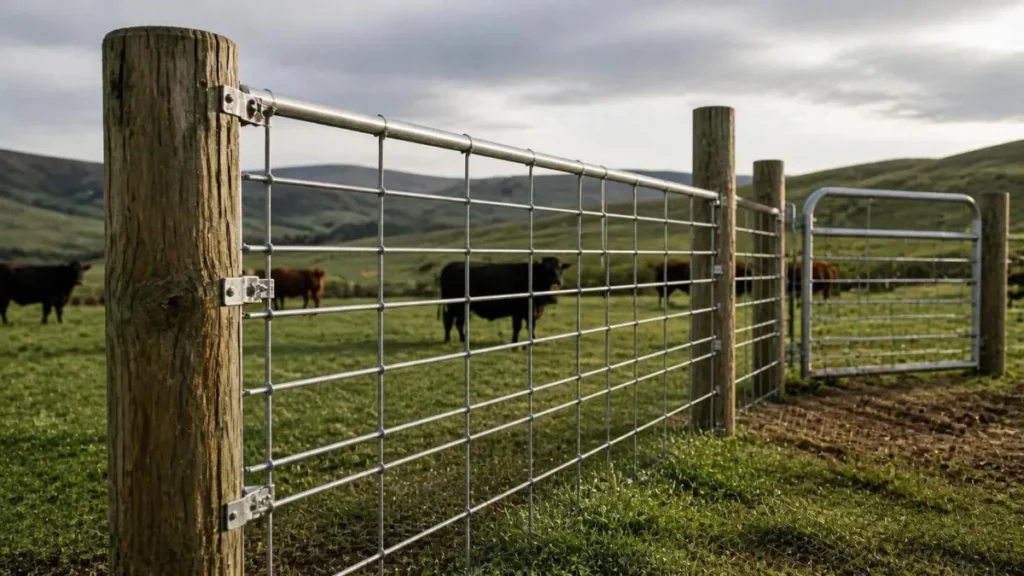

A cattle panel is a rigid, welded steel wire sheet made to contain large livestock. The standard version is 16 feet long and 50 inches tall, made from 4-gauge galvanized wire. Hutchison lists a 50-inch cattle panel built from 4-gauge wire in 8-foot or 16-foot lengths. Tractor Supply’s 50-inch feedlot panel is also 4 gauge, galvanized before welding, with graduated mesh that is tighter near the bottom.
Gardeners have adopted the same cattle panel as an inexpensive, very sturdy trellis. Whichever use you have in mind, buy by the specifications, not the label. Retailers use “feedlot panel,” “livestock panel,” and “cattle panel” loosely, and lighter look-alikes exist.
Sizes, Gauge, and Spacing
Three specifications matter most.
Height and length. The common cattle panel is 50 inches by 16 feet, and shorter 8-foot lengths are also made. A hog panel is a different product. Hutchison’s hog panel is 34 inches tall and 16 feet long, with 11 horizontal lines.
Wire gauge. A lower gauge number means thicker wire. A cattle panel for large animals is typically 4 gauge, and thinner look-alikes can bend under a leaning animal. Gauge alone doesn’t separate a cattle panel from a hog panel, since the Hutchison hog panel is also 4 gauge.
Mesh spacing. On the Tractor Supply panel, vertical wires sit 8 inches apart, and horizontal spacing grows from about 4 inches at the bottom to about 6 inches at the top. Hutchison also lists a 48-inch combination panel with 4-inch by 4-inch openings, which suits some uses better than the standard pattern.
Price. Listings checked on October 28, 2026 showed roughly $34 to $38 for a 50-inch by 16-foot panel at Tractor Supply. Sale pricing and stock varied by store, so check your local supplier before budgeting.
Is a Cattle Panel Right for Your Animals?
Cattle. This is what the cattle panel is built for. It suits corrals, feedlots, loafing areas, and temporary pens, and it goes up faster than a wood fence.
Goats and sheep. The openings deserve a close look. Large openings can let a horned goat push its head through and then get stuck. An Extension answer on goat fencing says fencing should either stop horned goats from putting their heads through or have openings large enough for the head to pass through and back. A standard cattle panel fits neither description, so keepers of small or horned goats often choose smaller-mesh fencing or a panel designed for them.
Horses. Horses are the most delicate case. University of Georgia Extension notes that horses injure themselves in fences more than most other livestock, and that rail fences are less likely than standard farm wire to catch a hoof or cut a horse on wire ends. Some manufacturers sell panels designed specifically for horses. If you plan to keep horses, ask your vet or local Extension office before choosing a design.
Setting Up a Cattle Panel Fence
Panels attach to T-posts or wooden posts with clips, wire, or staples. A few habits make the fence last:
- Set corner and end posts deeper and brace them. They carry most of the tension.
- Overlap panel ends by a few inches and fasten them at several points. One loose connection becomes the weak spot an animal finds.
- Drive posts straight and tight so the line stays even.
- Wear gloves and eye protection when cutting. Smooth or cap any exposed cut ends.
Post spacing depends on the panel length, the animals, and the ground, so follow the manufacturer’s installation guidance.
The Garden Arch and Trellis
Gardeners bend a 16-foot cattle panel into an arch over a path or between two raised beds. The curved panel becomes a tunnel for cucumbers, beans, squash, and small melons. Typical builds use four posts or pieces of rebar, one at each corner, with the panel fastened to them.
How tall and wide the arch ends up depends on how far you bend it. One gardener reports an arch about 6 feet tall, so test-fit your own panel before committing to a spot. You can also stand a cattle panel upright as a flat trellis or lean two together in an A-frame.
Some practical points:
- Moving it. Panels are heavy and awkward. One garden writer advises that two people are needed to load a panel into a pickup bed and again to carry it to the site. Plan how it will reach your yard.
- Anchoring. Secure each end firmly. A trellis loaded with vines acts like a sail in wind.
- Shade. A covered arch shades what’s underneath, so choose shade-tolerant crops there or keep sun-hungry plants outside it.
- Mulch. If you’re mulching the beds beneath an arch, Headlinza’s black mulch guide covers depth, sourcing, and what to avoid in edible beds.
For more planting ideas, browse Headlinza’s Gardening section.
Other Uses Around the Property
A cattle panel also works as a barn divider, gate infill on a frame, compost bin wall, raised-bed guard, or temporary animal yard. Bent over hoops and covered with plastic, it can form the frame of a simple hoop house.
Match the panel to the job. For a dog run, check that the openings are too small for the dog to push through and consider a top. A cattle panel is also not a security fence, since bolt cutters defeat it and the horizontal wires make it climbable.
Galvanizing and Rust
Most panels are galvanized, meaning the steel carries a protective zinc coating. Some makers galvanize before welding, as Tractor Supply says its panel does. Others coat afterward, and quality varies by brand.
No coating lasts forever. Constant soil contact, standing water, and coastal air will eventually start rust. Touching up cut ends and weld points with rust-inhibiting paint helps, and near the coast you should expect a shorter service life.
What to Check Before You Buy a Cattle Panel
- Wire gauge. Confirm it is 4 gauge for large animals.
- Dimensions. Check height, length, and line count against the spec sheet.
- Finish. Confirm it is galvanized and look for clean welds. Skip a panel with visibly weak or cracked joints.
- Length. The 16-foot size is standard and usually the best value per foot. An 8-foot panel is easier to carry and fits smaller vehicles.
- Where to look. Farm supply stores and hardware chains carry them, and stock varies by location.
Common Mistakes
- Buying thin-wire panels for large animals.
- Using standard-opening panels for goats or horses without checking head and hoof entrapment risks.
- Skipping a plan for transport. A 16-foot panel does not fit in a hatchback, and rules for loads hanging out of a vehicle vary by state, so check yours.
- Working without gloves.
- Leaving garden arches unanchored.
Related Guides
- Smart Plant Pot Guide: How They Work and Who Needs One
- Awning Buying Guide: Types, Materials and Installation
- Best Reusable Products to Reduce Wastewater at Home
Frequently Asked Questions
What size is a standard cattle panel?
Most are 50 inches tall and 16 feet long, made from 4 gauge wire. Some makers also sell 8-foot lengths.
What is the difference between a cattle panel and a hog panel?
Height and spacing, mainly. Hutchison’s hog panel is 34 inches tall versus 50 inches for its cattle panel, and both are 4 gauge.
Is a cattle panel safe for horses?
Not automatically. Extension guidance notes horses are especially prone to fence injuries, so ask your vet or local Extension service about a design suited to your animals.
Can I use a cattle panel as a garden trellis?
Yes. Bent into an arch and anchored at four corners, it is a popular support for climbing vegetables and flowers.
The Takeaway
Choose a cattle panel by its specifications: 4 gauge wire, galvanized finish, clean welds, and a length you can realistically transport. It is a strong, fast option for livestock pens and a sturdy trellis for the garden, but verify the opening size before using it with goats or horses.
Last updated: October 28, 2026