
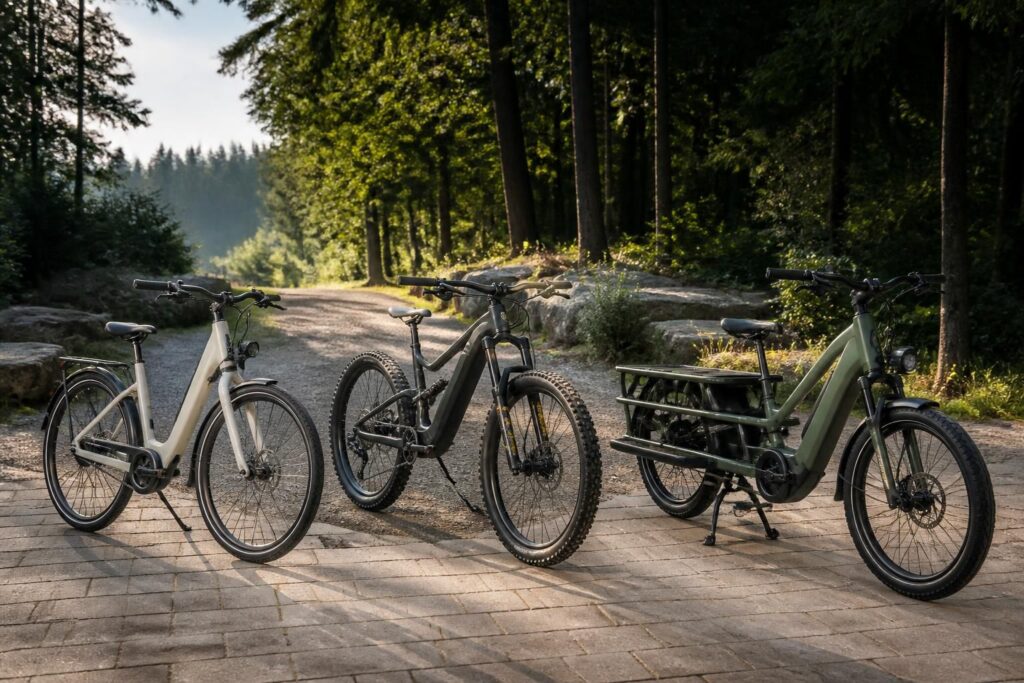

E-Bike Classes in the US are sorted into three classes. Class 1 bikes give motor assistance only while you pedal and stop helping at 20 mph. Class 2 bikes add a throttle, so the motor can move you without pedaling, also up to 20 mph. And Class 3 bikes are pedal-assist only but keep helping up to 28 mph. All three are capped at 750 watts of motor power.
The class matters more than most buyers expect. It decides where you can legally ride, whether you need a helmet, how old you must be, and, in a growing number of states, whether you need a license or registration. This guide explains each class, how they compare, and what to check before you buy.
E-Bike Classes at a Glance
| Class | How the motor works | Assist stops at | Throttle | Typical rules |
|---|---|---|---|---|
| Class 1 | Pedal assist only | 20 mph | No | Allowed almost anywhere a regular bike is |
| Class 2 | Pedal assist and/or throttle | 20 mph | Yes | Usually allowed on roads and bike lanes; some trails restrict it |
| Class 3 | Pedal assist only (speedometer often required) | 28 mph | No (in most state definitions) | Roads and on-street bike lanes; often banned from multi-use paths; age and helmet rules common |
Where the Three-Class System Comes From
There is no single federal e-bike class law. The federal rule that applies to all of them is the Consumer Product Safety Act definition of a “low-speed electric bicycle”: fully operable pedals, a motor under 750 watts, and a top speed under 20 mph on motor power alone for a 170-pound rider (15 U.S.C. § 2085). That definition covers product safety, not where you can ride.
The three classes come from model legislation promoted by the bike industry and first adopted by California in 2015. Most states have since copied some version of it. As of early 2026, about 36 states plus Washington, D.C. use the framework, though the details differ from state to state. Manufacturers are expected to put a label on the frame that shows the class, motor wattage and top assisted speed, so check for that sticker on any bike you buy.
Class 1: Pedal Assist up to 20 MPH
A Class 1 e-bike only adds power while you are pedaling. Stop pedaling and the motor stops. Above 20 mph you are on your own legs.
This is the most widely accepted class. Because it behaves like a regular bicycle with a boost, it is generally allowed on roads, bike lanes, multi-use paths and many trails where traditional bikes are allowed. Most electric mountain bikes are Class 1 for this reason, since trail systems that allow e-bikes at all usually allow Class 1 first.
Best for: commuters who want to arrive less sweaty, riders who want the widest trail access, and anyone who still wants exercise from the ride.
Class 2: Throttle up to 20 MPH
A Class 2 e-bike has a throttle, usually a thumb lever or twist grip, that powers the bike without pedaling. Most Class 2 bikes also have pedal assist, so you can use either. The motor still stops helping at 20 mph.
The throttle is useful when starting from a stop, climbing a steep hill, riding with a heavy cargo load, or when knee or joint problems make pedaling hard. It is also the reason Class 2 bikes face more restrictions on natural-surface trails, where land managers worry about speed and erosion. Our full guide to the class 2 ebike covers throttle rules and laws in more detail.
Best for: errands and cargo hauling, casual riders, riders with mobility limits, and fat-tire cruisers like the Aventon Aventure.
Class 3: Pedal Assist up to 28 MPH
A Class 3 e-bike is a faster pedal-assist bike. The motor keeps helping until 28 mph, which lets a fit rider keep pace with city traffic. In most state definitions Class 3 bikes have no throttle, or only a throttle limited to 20 mph.
That extra speed brings extra rules. California, for example, requires Class 3 bikes to have a speedometer, requires every rider to wear a helmet, and sets a minimum rider age of 16 (as summarized in the City of Alameda’s e-bike FAQ, citing California Vehicle Code sections 312.5 and 21213). Washington also sets a minimum age of 16 and keeps Class 3 bikes off most shared-use paths, while Michigan sets the minimum at 14, according to a 2026 roundup of Class 3 restrictions.
Best for: longer commutes on roads, riders who want to replace car trips, and people comfortable riding in traffic.
Is There a Class 4 E-Bike?
No. “Class 4” is a marketing term, not a legal class. Bikes sold this way usually have motors above 750 watts or can go faster than 28 mph, and most states treat them as mopeds or motorcycles. That can mean a driver’s license, registration and insurance. Some states are now writing this into law: Illinois lawmakers approved a separate high-speed category for devices over 28 mph that would be regulated like motorcycles.
If a seller says a bike can be “unlocked” to go faster than its class allows, treat that as a warning. Modifying the speed limit usually means the bike no longer counts as an e-bike under state law.
How the Rules Are Changing in 2026
The three-class system is under pressure as faster electric motorbikes get sold as e-bikes. A few examples from this year:
- New Jersey passed a law in January 2026 that covers every e-bike, Class 1 included: the bike must be registered with the state Motor Vehicle Commission, and the rider needs a driver’s license (or a motorized bicycle license at age 15 or 16) and liability insurance, according to Atlantic County’s summary of the law.
- Washington kept the three classes but narrowed the definition so that devices able to exceed 20 mph on motor power alone no longer count as e-bikes.
- California lawmakers have debated requiring registration for Class 2 and Class 3 bikes, though that bill stalled in committee.
These changes are summarized in this overview of 2026 e-bike law changes. Because rules move quickly, check your state DMV or transportation department and your city’s rules before you buy.
Which E-Bike Class Should You Buy?
Start with where you will ride, not with top speed.
- Mostly trails and park paths: choose Class 1. It has the widest access.
- Short trips, errands, hills or cargo: choose Class 2 for the throttle, as long as your local paths allow it.
- Long road commutes: choose Class 3, but check your state’s age, helmet and path rules first.
- Riding with kids or teens: stick to Class 1 or Class 2. Several states bar riders under 16 from Class 3.
Many bikes let you switch modes in the settings, for example a Class 3 bike that can be limited to Class 1 behavior. That flexibility is useful if you ride in different places, but the label on the frame is what police and park rangers will look at.
Frequently Asked Questions
Do I need a license for an e-bike? In most states, no license is needed for Class 1, 2 or 3 bikes that meet the state definition. New Jersey is a notable exception: since 2026 it requires registration, a license and insurance for all e-bikes, including Class 1. Elsewhere, any bike above 750 watts or 28 mph is usually treated as a moped or motorcycle.
Can a Class 2 e-bike go faster than 20 mph? Yes, but only with your own pedaling or going downhill. The motor must stop assisting at 20 mph.
Which class is best for mountain biking? Class 1. Most trail systems that allow e-bikes limit access to Class 1, and some ban throttles entirely.
Does wattage decide the class? Not directly. All three classes share the 750-watt limit. The class is decided by how the motor engages (pedal or throttle) and the speed at which it stops helping.
Are e-bike classes the same in every state? No. Most states use the three-class model, but some define only Class 1 and Class 2, and age, helmet and path rules vary. Always check local law.
Related Guides
- How Fast Is an E-Bike? Top Speed by Class and Real Averages
- Class 2 vs Class 3 E-Bike: Which Should You Buy?
- Class 2 Ebike: Throttle, 20 MPH Limit and Laws Explained
- Aventon Aventure E-Bike: Aventure 3 vs Aventure M Guide
- What You Get With a Mercedes-Benz E-Bike
- LiFePO4 Battery Guide: Is It Worth Buying in 2026?