
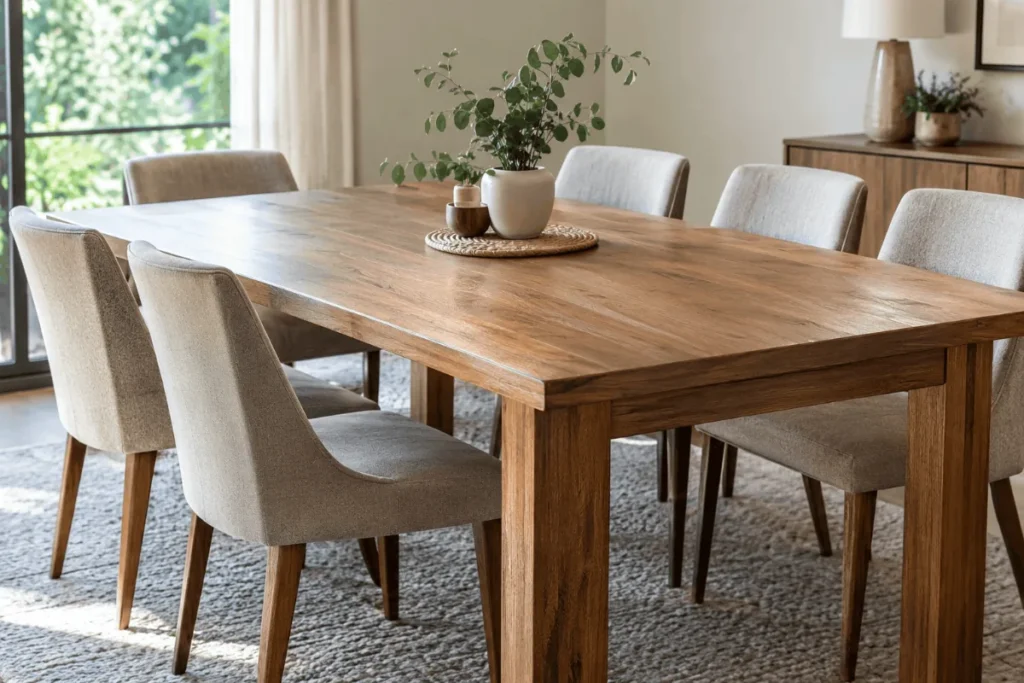

Table Buying Guide. In everyday life, it’s a piece of furniture with a flat top held up by legs or a base, used for eating, working, displaying things, or holding drinks. The Wikipedia article on tables as furniture traces the design back thousands of years, which says something about how basic the idea is.
In writing and computing, the word means a grid of rows and columns that organizes information, as in a spreadsheet or a report. The overview of tables as information explains how they’re used in documents and databases. In science, you’ll meet the periodic table, the chart that arranges chemical elements by atomic number. And in school, there’s the multiplication one you probably memorized.
If you searched for a data grid, this guide won’t help with formatting, but the principle carries over: choose the layout that makes the content easy to use. If you’re buying furniture, keep reading.
Start With the Job, Not the Style
Before you look at photos, decide what the piece has to do. A dining one has to seat people comfortably. A coffee one has to sit at the right height beside a sofa. A desk-style one needs knee clearance and cable management. Trying to make a single piece do all of that usually ends up doing none of it well.
What tends to surprise people is how often they buy for the room they imagine instead of the one they have. A big farmhouse piece looks great in a showroom with 15-foot ceilings and feels like a barricade in a 10-by-10 dining nook.
Write down the main use, how many people will sit there on a typical day, and how many on your busiest one. That tells you more than any style guide.
Getting the Size Right
For dining, a commonly used guideline is about 24 inches of width per person so elbows don’t collide. A rectangular top around 36 inches wide and 60 inches long usually seats four comfortably, while 72 inches suits six. Treat these as starting points, not laws.
Leave breathing room around the piece. Many designers recommend roughly 36 inches between the edge and the nearest wall or furniture so chairs can slide out and people can walk behind them. In tighter rooms, 30 inches can work, but you’ll feel it.
Standard dining height is often around 28 to 30 inches, with chairs sized to match. Coffee ones usually run about 16 to 18 inches, and a good rule is to keep the top close to the height of your sofa’s seat cushion, or slightly below.
Always tape the footprint on the floor before ordering. Walk around it for a day. It’s the cheapest way to catch a mistake.
Which Table Shape Fits Your Room
Rectangles are the default because they seat the most people and fit against walls. They suit long, narrow rooms and families who host often.
Round ones encourage conversation and have no corners, which is great for small spaces and for homes with toddlers. They do waste some floor area, and seating more than six gets awkward because people end up far from the center.
Square ones work for four people and look neat in square rooms, though they’re less flexible when guests arrive. Oval shapes soften a room and give you rectangular seating without sharp corners, which is handy in narrower dining areas.
If you entertain a lot, think about extension leaves. A top that stretches from four seats to eight earns its keep, but check how the mechanism feels. Sticky or wobbly extensions are one of the most common complaints in reviews.
Choosing a Table Material
Solid hardwood, such as oak, walnut, or maple, is the long-term pick. It can be sanded and refinished, it handles decades of use, and it ages well. It’s also heavy and costs more. If you want to buy responsibly, look for wood certified by the Forest Stewardship Council.
Veneer, a thin layer of real wood over a core, gives you the look at a lower price. Quality varies a lot, and a thin veneer can chip or peel if it’s poorly made. Check the edges.
Engineered options use composites such as medium-density fiberboard wrapped in laminate or veneer. They’re budget-friendly and stable, but they don’t tolerate water or repairs well. Glass looks light and airy and shows every fingerprint. Stone and quartz look impressive and resist heat and scratches, though they’re heavy and expensive.
In my experience, the most common regret is a glossy finish that looked perfect online and shows every crumb and scratch in real life. A matte or lightly textured surface is more forgiving, especially with kids.
Legs, Bases and Comfort
The base affects comfort more than people expect. Four corner legs are simple and sturdy but can bump knees at the ends. Trestle bases and pedestals free up legroom and let you squeeze in an extra chair, and a pedestal suits round tops well.
Check how the legs attach. Bolts and brackets are a good sign, while a wobbly joint at the showroom tends to get worse at home. Rock the piece gently and listen for creaks.
Think about the floor too. Felt pads stop scratches, and a wobble on an uneven floor can sometimes be fixed with adjustable feet.
Small Spaces and Multi-Use Setups
If you’re short on room, look at drop-leaf styles, gateleg designs, nesting sets and wall-mounted fold-down versions. A narrow console that expands for dinner is a great fit for apartments.
For a home office, make sure the surface depth is at least 24 to 30 inches so a monitor and keyboard fit without crowding. Leave room for knees, and consider a slightly lower height if you sit a lot.
I’d also think about visual weight. Glass tops and slim legs make a small room feel bigger, while chunky bases make it feel crowded.
Care and Maintenance
Use coasters and trivets. It’s the single most useful habit for any surface, and it prevents most of the damage furniture suffers.
Wipe spills quickly, avoid harsh cleaners on wood finishes, and keep pieces out of direct sunlight, which fades and warps over time. For solid wood, a bit of occasional oil or wax keeps it looking good.
If you have an extension leaf, store the spare one flat and dry. Warped leaves are a headache to fix.
Mistakes to Avoid
The big one is ignoring scale. A beautiful piece that overwhelms the room won’t get better with time. Measure doors, hallways, and stairs too, since a large top has to get through them.
Another is skipping the chair test. Always sit at the piece with the chairs you plan to use, and check that your legs fit under the apron.
People also underestimate delivery details. Ask whether assembly is included, how long the lead time is and what the return policy says. Prices and availability change often, so compare current listings from a few retailers before you commit.
My Recommendation
For most households, a solid wood or high-quality veneer rectangular or oval top around 60 inches long, with a pedestal or trestle base and a matte finish, is the safest long-term choice. If space is tight, go round. If budget matters most, a well-made laminate or engineered model is fine as long as you accept its limits.
Whatever you pick, measure first, sit before you buy, and plan for the way you really live, not the way a catalog suggests.