
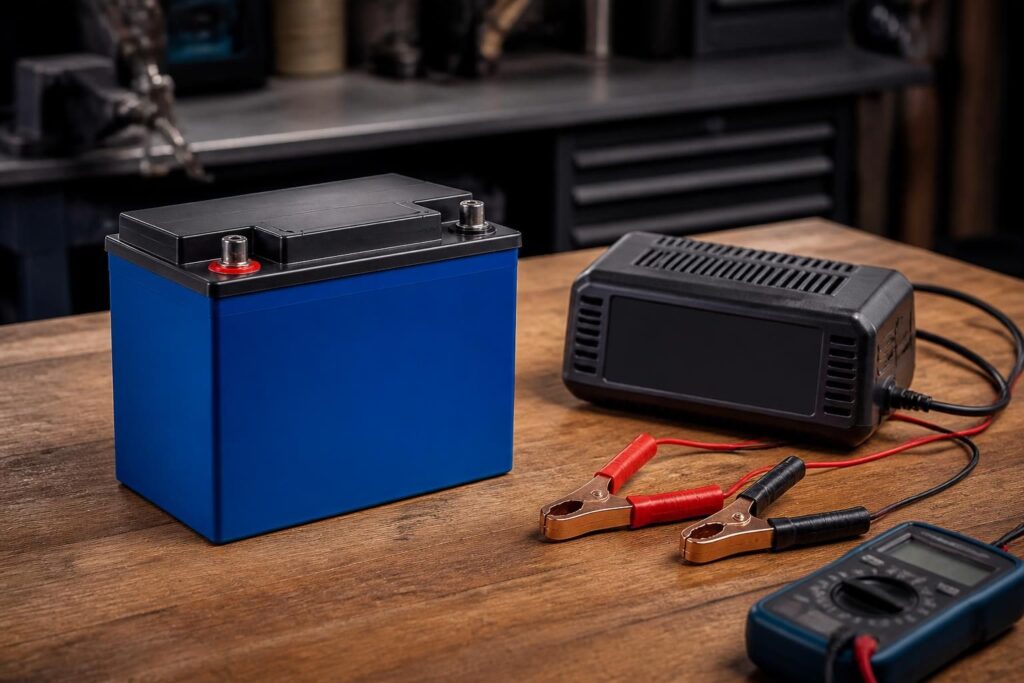

Yes, you can sometimes charge LiFePO4 with a lead-acid charger, but only if its voltage stays within the battery maker’s range and it never runs an equalize or desulfation cycle. For most 12V LiFePO4 batteries, that means a bulk voltage of about 14.2 to 14.6 volts. If your charger can’t promise that, buy one with a lithium setting.
The answer depends less on the label on your charger and more on what it actually does. Here’s how to check yours, what can go wrong, and when a quick top-up with an old charger is fine.
This article is general information. Always follow your battery and charger manuals, since limits vary by brand.
Key Takeaways
- Battle Born, a major LiFePO4 maker, recommends 14.4V for bulk and absorption, and accepts anything from 14.2V to 14.6V.
- Equalization and “repair” modes are the real danger. They push voltage well above what lithium cells want.
- Float charging isn’t needed for LiFePO4. A float under 13.6V is acceptable but not required.
- The battery’s BMS is a safety net, not a charger. Don’t rely on it to stop a bad charger every time.
Check What Your Charger Actually Does
“Lead-acid charger” covers a lot of different machines. A modern smart charger with an AGM mode behaves very differently from a 20-year-old trickle charger. So before you connect anything, find the manual or the spec sheet and look for three numbers: the bulk or absorption voltage, the float voltage, and whether any equalize or desulfation stage runs on its own.
Battle Born makes the same point in its guide to charging LiFePO4 batteries. It says you don’t need a special charger, just one whose settings fall inside the battery’s range. It also warns that many lead-acid chargers offer several modes, such as AGM, gel and flooded, and each one uses different voltages.
| Charger type | Can it charge LiFePO4? | What to watch |
|---|---|---|
| Charger with a lithium or LiFePO4 mode | Yes | Select the lithium profile every time |
| Programmable charger | Yes, if set correctly | Set bulk around 14.4V, turn equalization off |
| AGM or gel smart charger, no auto-equalize | Often, for occasional use | Confirm bulk stays at or below 14.6V |
| Charger with automatic equalize or desulfation | No | High-voltage pulses can damage cells |
| Old unregulated trickle charger | No | No voltage control at all |
What Can Go Wrong With a Lead-Acid Charger
Equalization and desulfation modes
Lead-acid batteries benefit from an occasional deliberate overcharge called equalization. It balances the cells and breaks up sulfate buildup. Some chargers also have a “repair” or desulfation mode that pulses higher voltages. LiFePO4 has no sulfation, so neither stage helps. Instead, both can push the voltage past what lithium cells are built for. If your charger runs these automatically and you can’t switch them off, don’t use it on a LiFePO4 battery.
Voltage that’s a little too high
A 12V LiFePO4 battery is basically full around 14.2 to 14.6 volts. Many flooded lead-acid profiles sit near or above the top of that window. A small overshoot won’t destroy a battery in one charge. But repeated charging at the edge adds stress for almost no extra capacity. That’s why Battle Born suggests 14.4V as the sweet spot.
Float charging that never ends
Lead-acid batteries like being held on float for weeks. LiFePO4 doesn’t need it. Battle Born says a float under 13.6V is acceptable, but float isn’t required. If your charger floats higher than that and you plan to leave it connected for long periods, unplug it once the battery is full instead.
A battery the charger won’t recognize
If a LiFePO4 battery’s BMS has shut it off after a deep discharge, the terminals can read close to zero volts. Many smart lead-acid chargers see that as a dead or faulty battery and refuse to start. A lithium charger with a wake-up or “0V charging” function is built for exactly this case.
Charging a battery that’s too cold
Lithium cells shouldn’t be charged below freezing. A lead-acid charger won’t know that, and some even raise voltage in the cold through temperature compensation, which is the opposite of what LiFePO4 needs. Battle Born’s guide says to keep the battery above 35°F to avoid damage. If you camp in winter, choose a battery with a built-in heater. Our LiFePO4 vs lithium-ion comparison explains why cold charging is a limit for both chemistries.
Why the BMS Isn’t Enough
Every quality LiFePO4 battery has a battery management system (BMS). It disconnects the battery if voltage, current or temperature goes out of range. That’s a last line of defense. It doesn’t regulate the charge the way a proper charger does. So if a lead-acid charger keeps overshooting, the BMS keeps tripping, and you’re wearing out a safety part instead of charging correctly. Our LiFePO4 battery guide goes deeper into what a BMS does.
A Realistic Example
Say you’ve just swapped the AGM battery in a small camper for a 100Ah LiFePO4 pack. Your old charger has AGM, gel and flooded modes, plus an automatic “recondition” cycle. The AGM mode tops out at 14.4V and floats at 13.6V, which fits Battle Born’s numbers. The recondition cycle doesn’t.
In that case, the AGM mode is fine for the occasional charge at home, as long as you disable reconditioning or unplug before it starts. For daily solar or shore power use, set the camper’s converter and solar controller to a lithium profile instead. That’s the usual upgrade path for people moving from AGM, which our LiFePO4 vs AGM guide covers in detail.
How to Charge LiFePO4 With a Lead-Acid Charger Safely
If you’ve checked your charger and it fits, follow these steps:
- Choose the AGM or gel mode, which usually has the lowest voltage. Avoid flooded or “wet” modes.
- Turn off equalize, recondition and desulfation, or don’t use the charger if you can’t.
- Disconnect any temperature sensor that would raise voltage in the cold.
- Charge only when the battery is above freezing.
- Stay nearby the first time, and check the voltage at the end with a multimeter.
- Unplug once it’s full if the float voltage is above 13.6V.
Should You Buy a Lithium Charger?
For a battery you use often, yes. A charger with a proper LiFePO4 profile charges fully, skips stages the battery doesn’t need, and can wake a pack the BMS has shut off. It also removes the guesswork every time you plug in. So the best way to charge LiFePO4 with a lead-acid charger is to treat it as a backup, not the plan. If you only top up a seasonal battery a few times a year, a compatible AGM smart charger can do the job.
Frequently Asked Questions
Will a lead-acid charger damage a LiFePO4 battery?
It can, but not always. The main risks are automatic equalization or desulfation cycles and bulk voltages above about 14.6V. A smart AGM charger that stays within the battery maker’s range usually won’t cause harm. An old unregulated charger, or one with a forced repair mode, is the type to avoid entirely.
Can I use my RV converter to charge a LiFePO4 battery?
Often yes, if the converter has a lithium mode or its voltages fit the battery’s range. Many older converters were built for lead-acid and charge LiFePO4 slowly or incompletely. Check the converter’s spec sheet, and look for a lithium-compatible model or a charge-profile upgrade from the maker.
Can I charge LiFePO4 with a car alternator?
Yes, but usually through a DC-to-DC charger. LiFePO4 accepts current quickly and can make an alternator work hard for long periods. A DC-to-DC charger limits that current and applies a proper lithium charging profile, which protects both the battery and the alternator.
What voltage should a 12V LiFePO4 battery be charged to?
Most makers recommend about 14.2 to 14.6 volts for bulk and absorption. Battle Born suggests 14.4V. Resting voltage after charging settles lower, often in the mid-13V range, so don’t worry if the reading drops after you unplug.
Headlinza Editorial Team writes practical guides for Headlinza.