






Zero Breeze Mark 3 Review: Is This Portable AC Worth It?
Title: Zero Breeze Mark 3 Review: Is This Portable AC Worth It?
Meta Description: A hands-on look at the zero breeze mark 3 portable AC: cooling power, battery life, noise, price, and who should actually buy one.
Article:
If you’ve spent even one sweaty night in a van, tent, or boat cabin, you already understand the appeal of the zero breeze mark 3. It promises real, compressor-based cooling with no shore power, no generator, and no drilling into your roof. That’s a big claim for a 22-pound box, so let’s get into whether it holds up.
What the Mark 3 Actually Is
The Zero Breeze Mark 3 is a battery-powered, compressor-based portable air conditioner built for camping, van life, boats, and off-grid work. It’s not a swamp cooler or an evaporative gimmick. It uses real refrigerant, specifically R290, and pulls 5,280 BTU of cooling capacity out of a body about the size of a small toolbox. That figure roughly doubles what the older Mark 2 offered, which is a meaningful jump for anyone who’s used the previous generation and found it a bit weak on hot afternoons.
What makes it stand out isn’t the BTU number by itself. Plenty of window units beat that spec. It’s the combination of portability, battery operation, and the fact that setup takes about five minutes with no permanent installation. You’re not cutting a hole in your van roof or bolting anything down.
Design and Build Quality
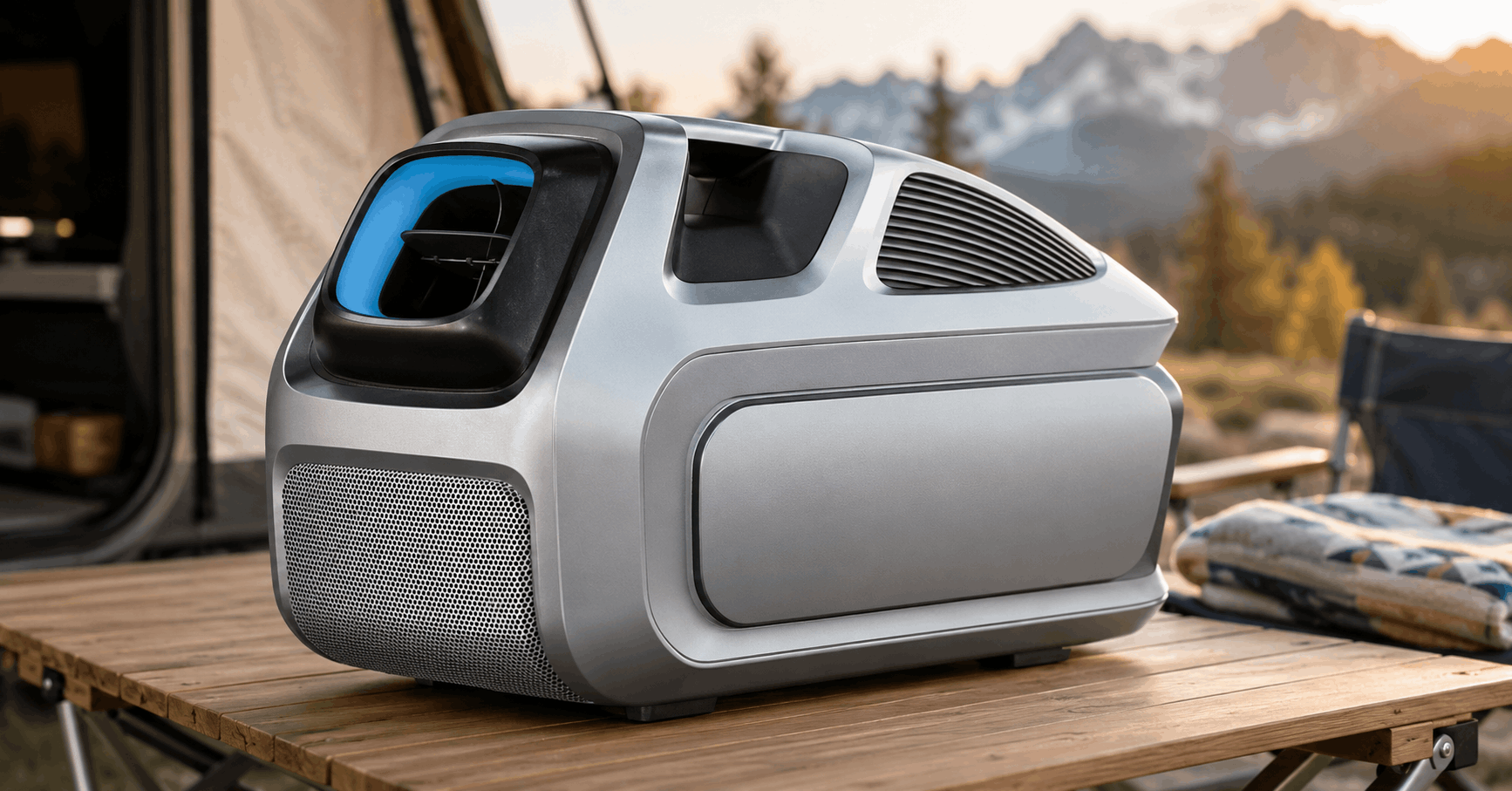
At just under 22 pounds, the Mark 3 sits in a suitcase-style shell with a carry handle, dual duct ports, and a control panel on top. It feels solidly built rather than flimsy, which matters given how much this thing gets tossed in and out of trucks and boat lockers.
The dual-duct design is worth calling out specifically. Cheaper single-hose portable ACs pull room air through the unit and vent hot air outside, which creates negative pressure and pulls hot outside air back in through every gap in your space. The Mark 3 avoids that by drawing in fresh air separately from the air it cools, so you’re not fighting the same inefficiency that plagues budget units.
One thing worth flagging is the weight distribution. It’s not heavy in absolute terms, but at 22 lbs with a battery clipped underneath, it’s not something you casually toss on a shelf either. Plan for a stable spot near your bunk or seating area.
Cooling Performance in the Real World
Zero Breeze claims a 20°F temperature drop within five minutes, and based on independent testing from outdoor and van-life reviewers, that number tracks for spot cooling rather than whole-room cooling. One reviewer who tested the Mark 3 for two weeks in a campervan found it delivers real cooling within limits: excellent for personal or bunk-area comfort, but it won’t turn a full-size van into a walk-in cooler on a 100°F day.
That distinction matters a lot when you’re deciding whether this is right for you. In my experience, portable spot coolers in this category are almost always sold with cooling area numbers that assume ideal insulation and a sealed space. Zero Breeze rates the Mark 3 for 100 to 150 square feet, and that’s realistic only in a well-insulated, low-ceiling environment like a van bunk or small cabin. Throw it into an open-plan RV with big windows and you’ll be cooling yourself, not the room.
The thermostat range runs from 61°F to 88°F, and the seven operating modes (Rocket, Cool, Sleep, Fan, Dry, Care, and Heating) give you a fair amount of control. Rocket mode is the fast-cool setting for when you first climb into a hot space. Sleep mode trades some power for near-silent operation, which is where most owners end up spending the bulk of their runtime.
Battery Life and Power Flexibility
This is where the Mark 3 separates itself from a standard plug-in AC. It runs on a detachable 1,022Wh lithium battery that clips underneath the unit, and it also accepts AC power, car charging, and solar input up to 500W, which Zero Breeze markets as the first solar-powered portable AC on the market. Whether that “first” claim holds up against every competitor is hard to verify with certainty, but it’s a genuinely useful feature set regardless of who got there first.
Runtime depends heavily on the mode. In Sleep mode, expect somewhere around 6 to 7 hours per battery, which covers most of a night. On Rocket or full Cool settings, that drops to a few hours. Reviewers running long-term tests report 2 to 7 hours of runtime per battery depending on settings, which lines up with Zero Breeze’s own guidance. The batteries chain together too, so stacking two or three extends your off-grid window considerably, and the system automatically switches to the next battery when one depletes.
What tends to surprise people is how much Fan mode changes the math. At just 12 to 17 watts of draw, one battery can run the fan alone for well over 60 hours. A smart pattern that several owners land on is starting the day in Fan mode when it’s still tolerable, then switching to Cool or Sleep once the afternoon heat builds. It stretches your battery budget without sacrificing comfort when it counts.
Noise Levels
Rated around 46 to 48 decibels in lower power settings, the Mark 3 is quiet enough for sleeping next to, though it’s not silent. Full-power Rocket mode is noticeably louder than Sleep mode, which is by design since more airflow and compressor work naturally generate more noise. If quiet operation is a priority for you, plan to run it in Sleep mode overnight and reserve the higher settings for quick pre-bed cooldowns.
Setup, Ducting, and Daily Use
Setup genuinely takes about five minutes once you know your ducting plan. You need two ducts routed into the space you’re cooling: one intake and one outlet, since the unit conditions air pulled from the room rather than outside air. The rear vents expel hot air and don’t need to enter your living space at all.
This is the part that trips people up. Vanlifers commonly route ducts through a cracked window or a dedicated window kit, while boat owners have adapted ceiling fan openings and other existing vents. It’s flexible, but it does require some planning before your first trip rather than winging it on arrival. Zero Breeze sells window and tent kit accessories separately, and they’re worth budgeting for if your setup doesn’t already have a clean pass-through.
Drainage is automatic. A built-in sensor and pump handle condensation, so there’s no tray to empty manually, which is a small detail but one that matters a lot when you’re using this daily in humid conditions.
Price and What’s Included
Pricing on the Mark 3 unit alone has been referenced by owners and retailers at around $1,299, though the battery is sold separately in most configurations, and bundles with one or two batteries push the total meaningfully higher. Because pricing on gear like this shifts with promotions and bundle changes, check the official Zero Breeze store for current numbers before you buy, especially if you’re comparing unit-only versus unit-plus-battery options.
A standard bundle typically includes the AC unit, a wall power adapter, a wireless remote, drainage and duct accessories, and a welcome kit with hoses and adapters. Car charging cables and solar charging cables are usually sold separately, which is worth factoring into your total budget if off-grid use is the whole point of buying this thing.
Zero Breeze Mark 3 Pros and Cons
The strengths are real: genuine compressor-based cooling in a battery-powered, portable form factor, solid build quality, flexible charging options including solar, and a dual-duct design that actually improves on the single-hose units flooding the market. Setup without drilling or permanent installation is a big deal for renters or anyone who doesn’t want to modify a vehicle.
The downsides are worth taking seriously too. It’s expensive relative to basic camping fans or evaporative coolers, the battery is a separate purchase that adds real cost, and it’s a spot cooler rather than a whole-room solution for larger RVs or open spaces. Runtime, while decent, still requires planning around battery count if you want all-night cooling without interruption.
How It Compares to Alternatives
Against the older Mark 2, the Mark 3 roughly doubles cooling capacity while improving battery efficiency and duct design, according to long-term Mark 2 owners who upgraded. Compared to competitors like EcoFlow’s Wave series or newer entrants such as BougeRV and Cybertake, the Mark 3 holds its own on portability and weight, though direct BTU-for-BTU and price comparisons are worth checking against current listings since this category moves fast.
If your budget is tight and you only need airflow rather than true refrigerant cooling, a 12V camping fan will save you a lot of money. But if you want actual temperature drops on hot nights without hauling a generator, the Mark 3 sits in a fairly small group of products that can deliver that.
Who Should Buy the Zero Breeze Mark 3
Vanlifers, overlanders, boat owners, and tent campers who spend real time off-grid in hot climates are the clear target audience here. Anyone building a lightweight electrical system who doesn’t want to cut a roof vent for a fixed rooftop AC will find this fits a genuine gap in the market.
If you camp occasionally in mild weather, or you’re cooling a large open RV rather than a bunk or small cabin, the price is harder to justify. In that case, a fixed rooftop AC or a simpler evaporative cooler will likely serve you better for less money.
FAQs
Does the zero breeze mark 3 come with a battery? No. Most listings sell the AC unit and battery separately, so factor that into your total cost before buying.
How loud is it? Around 46 to 48 decibels on lower settings, quiet enough for sleeping next to, louder on Rocket mode.
Can it run on solar power? Yes, the detachable battery supports up to 500W of solar input alongside AC, car, and standard DC charging.
How long does one battery last? Roughly 6 to 7 hours in Sleep mode, less on higher power settings, and well over 60 hours in Fan-only mode.
Will it cool an entire RV? Not reliably. It’s built for spot cooling in spaces around 100 to 150 square feet, best suited to a bunk area or small cabin rather than an open floor plan.
Also Read: Best Pixel 10 Case Options: What Actually Fits and Works