





Best Humidifier for Large Room: 7 Top Picks for 2026
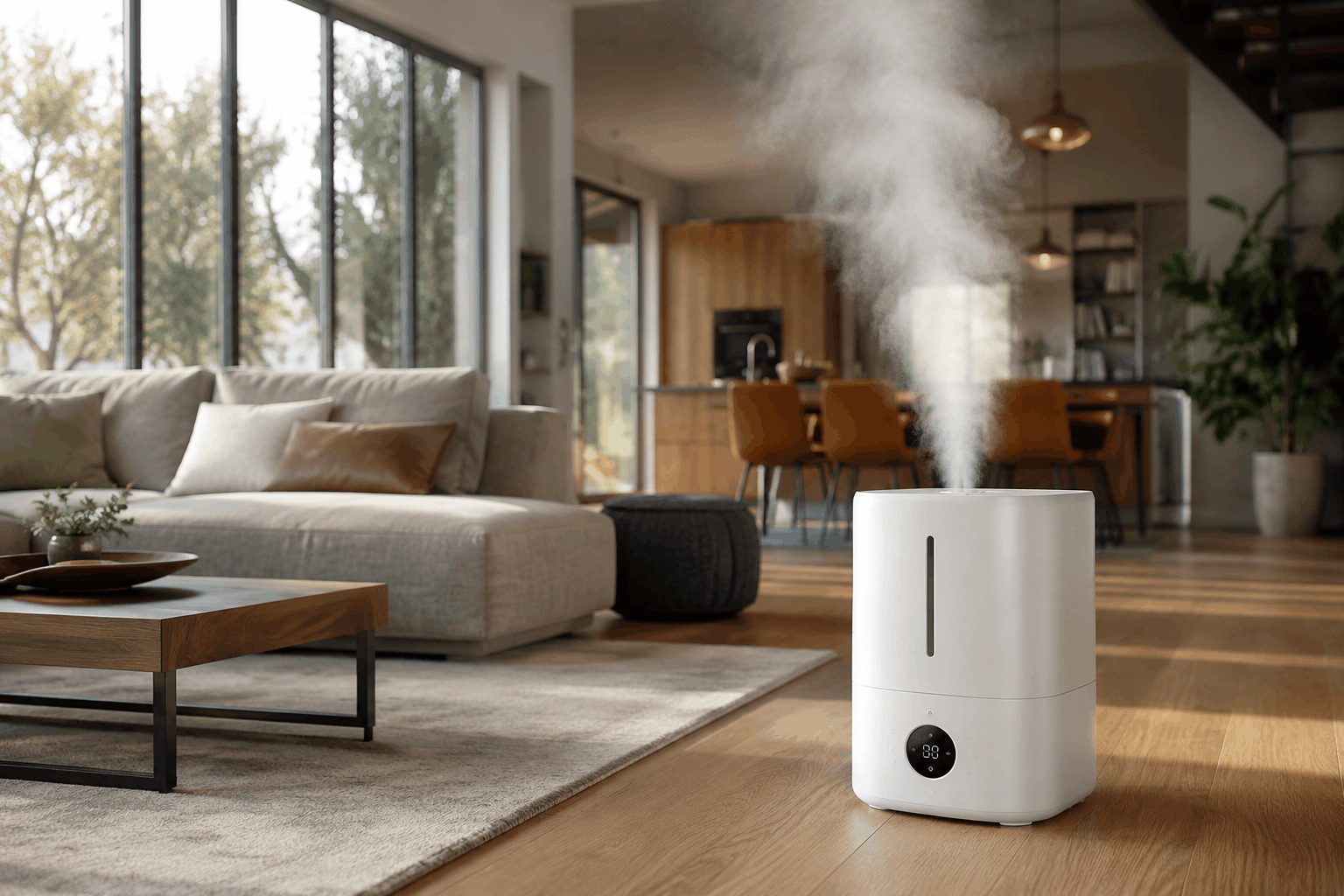
If your living room feels like the Sahara by January and your regular tabletop humidifier taps out by lunchtime, you don’t have a humidifier problem. You have a coverage problem. Most compact units are built for a 150 to 300 square foot bedroom, and once you put them in an open-plan living space or a room over 500 square feet, they just can’t keep up. Finding the best humidifier for large room use means looking past cute design and checking three things first: tank size, mist output, and how honestly the manufacturer rates square footage.
I’ve spent enough time around these machines, testing a few myself and comparing notes with other reviewers, to know that “large room” claims on packaging are often optimistic. A unit rated for 750 square feet in a still, closed room might struggle in a drafty open-concept space with vaulted ceilings. So below, I’ll walk through seven humidifiers that genuinely hold up in bigger spaces, plus how to think about sizing so you don’t end up refilling a tank every four hours.
Quick Verdict
If you want the simplest answer: the Levoit OasisMist 1000S is the best all-around pick for most large bedrooms and living rooms, thanks to its 10-liter tank and roughly 100-hour runtime. If you’re humidifying a genuinely huge space, like an open-plan main floor or a finished basement over 1,500 square feet, a console-style evaporative unit like the AIRCARE Space Saver MA1201 will outperform anything ultrasonic. And if budget matters more than smart features, a Dreo large-room model gets you most of the performance for less money.
Comparison Table
| Model | Coverage | Tank Size | Type | Smart Features | Best For |
|---|---|---|---|---|---|
| Levoit OasisMist 1000S | ~500 sq ft | 10L | Ultrasonic | App, voice control | Large bedrooms |
| Levoit Superior 6000S | Up to 1,000+ sq ft | Large dual tank | Ultrasonic | App control | Open-plan living rooms |
| AIRCARE Space Saver MA1201 | Up to 2,700+ sq ft | 6 gallon | Evaporative console | Digital humidistat | Whole-floor coverage |
| Blueair InvisibleMist | 500+ sq ft | Top-fill tank | Ultrasonic | App, filter tracking | Convenience, easy cleaning |
| Honeywell HCM-350 | ~390 sq ft | 1.1 gallon (3 tanks) | Evaporative | Manual dial | No mineral dust |
| Dreo HM755S | ~1,000 sq ft | 16L | Ultrasonic | App, remote, voice | Budget large-room pick |
| Crane Drop | ~500 sq ft | Large single tank | Ultrasonic | Basic knob control | Simplicity |
Coverage numbers come from manufacturer listings and can shift with firmware updates or new model years, so it’s worth double-checking the current spec sheet before you buy.
Levoit OasisMist 1000S: The One I’d Buy for Most Large Bedrooms
This is the model that keeps showing up at the top of large-room lists, and for good reason. The 10-liter top-fill tank means you’re not lugging a heavy tank to the sink every day, and in my experience, that top-fill design is the single biggest quality-of-life upgrade over older bottom-fill humidifiers. You just pop the lid and pour water straight in.
On auto mode, it ramps mist output up when the air is dry and eases off once it hits your target humidity, which matters more than people expect. Running a humidifier flat-out all night in a large room can overshoot 60% relative humidity fast, and that invites mold and dust mites rather than solving dryness. One thing worth flagging: the built-in humidity sensor on ultrasonic models like this one can read a bit off from a standalone hygrometer, so if precision matters to you, it’s smart to keep a cheap separate hygrometer in the room too.
Levoit Superior 6000S: For Open-Plan Living Spaces
Where the OasisMist 1000S covers a large bedroom well, the Superior 6000S is built for something bigger, like a combined living and dining area. It uses a dual-tank system so you can top off one side without draining the whole unit, and it connects to the same VeSync app Levoit uses across its lineup.
What tends to surprise people is how much water a room this size actually pulls through the air over a few weeks of continuous dry-season use. If your water is hard, expect to replace the wick filter more often than the manual suggests. It’s not a dealbreaker, just a real cost-of-ownership detail that’s easy to overlook when you’re comparing sticker prices.
AIRCARE Space Saver MA1201: The Whole-Floor Option
If your “large room” is really an entire open floor, portable ultrasonic units start to feel undersized no matter how good their specs look on paper. The AIRCARE Space Saver MA1201 is a floor-standing evaporative console rated for several thousand square feet, which puts it in a different category entirely from bedroom humidifiers.
Evaporative technology also has a practical advantage here: it doesn’t produce the white mineral dust that ultrasonic units can leave on furniture when you use tap water. The trade-off is size. This is a genuine appliance, not a bedside gadget, and it needs a dedicated spot near an outlet. But for basements, open-concept main floors, or converted lofts, it’s hard to match on raw coverage.
Blueair InvisibleMist: Best for Easy Maintenance
Blueair built its name on air purifiers, and that engineering background shows in the InvisibleMist’s cleaning design. The tank is dishwasher-safe, which sounds minor until you’ve spent a Sunday afternoon scrubbing mineral buildup out of a narrow humidifier tank by hand. It’s priced higher than most large-room competitors, but the convenience and moisture output justify it for people who’d rather pay more upfront than deal with weekly deep cleans.
App control lets you set schedules and monitor filter life remotely, and the auto and night modes are genuinely useful if you’re sensitive to the hum of a fan while sleeping. It’s not the cheapest option on this list, and I wouldn’t recommend it if budget is your main constraint. But if convenience and long-term maintenance ease matter more to you than sticker price, it earns its spot.
Honeywell HCM-350: The No-Mist Option
Every model above uses ultrasonic or evaporative-with-fan technology. The Honeywell HCM-350 is a straightforward evaporative humidifier with a simpler design and no risk of the mineral dust some ultrasonic units produce. It uses three separate 1.1-gallon tanks rather than one large one, which actually makes refilling easier since you’re not hauling a full 10-liter tank to the sink.
Coverage tops out around 390 square feet, so it’s on the smaller end of what I’d call “large room” territory. But for anyone who’s tried an ultrasonic humidifier and ended up with a fine white film on their TV screen or dark furniture, switching to an evaporative model like this one solves that problem outright.
Dreo HM755S: The Budget Large-Room Pick
Dreo has carved out a real niche in the large-room space by undercutting Levoit and Blueair on price while still hitting similar coverage numbers. The HM755S is rated around 1,000 square feet with a 16-liter tank, self-cleaning tank technology, and app plus voice control through Alexa and Google Assistant.
It won’t have quite the same brand reputation or long-term track record as Levoit, and reviews on filter longevity are more mixed. Still, if you want large-room coverage without paying premium prices, this is where I’d start looking.
Crane Drop: Simple, Reliable, and Good Enough for Many Rooms
Not every large room needs a smart humidifier with an app. The Crane Drop keeps things simple: one knob for mist settings, a light that tells you when to refill, and a tank rated for around 500 square feet. It won’t handle a genuinely oversized open floor plan, but for a large bedroom or a modestly sized living room, it’s a dependable, low-fuss option that costs far less than the smart models above.
How to Actually Size a Humidifier for a Large Room
Manufacturer square footage ratings assume a closed room with no unusual airflow. Open floor plans, high or vaulted ceilings, and drafty older windows all reduce real-world coverage, sometimes significantly. According to the Wikipedia entry on humidifiers, output is generally measured by how much moisture a unit adds to the air per hour, and that number matters more than the coverage claim printed on the box.
A rough rule that holds up in practice: buy a unit rated for at least 25 to 50% more square footage than your actual room, especially if the space has an open doorway into another room or unusually high ceilings. Undersizing is the single biggest reason people end up disappointed with a “large room” humidifier that never quite gets the air comfortable.
Common Mistakes When Humidifying a Big Space
One mistake I see constantly is running a humidifier at max output around the clock instead of using auto mode with a target humidity. That leads to condensation on windows and, eventually, mold risk. According to guidance summarized by the Mayo Clinic, indoor humidity between 30 and 50 percent is generally the healthy range, and going much above that invites dust mites and mold growth rather than comfort.
Another common issue is using regular tap water in an ultrasonic humidifier and then wondering why there’s white dust on nearby surfaces. Distilled or demineralized water solves this almost entirely. And skipping regular tank cleaning is its own hazard, since a humidifier is essentially a small reservoir of standing water, which is exactly the kind of environment mold and bacteria like.
FAQs
How big of a humidifier do I need for a 500 square foot room? Look for a unit rated for at least 500 to 750 square feet to account for real-world airflow loss, and prefer one with a built-in humidistat so it doesn’t overshoot your target humidity.
Is evaporative or ultrasonic better for a large room? Evaporative units tend to avoid the mineral dust problem and often handle bigger spaces more efficiently, but they can be noisier since they rely on a fan. Ultrasonic units are quieter and often cheaper, but need distilled water to avoid white dust.
How often should I clean a large-room humidifier? Most manufacturers recommend cleaning the tank every three days during regular use, with a deeper descale weekly if you’re using tap water. Skipping this is one of the fastest ways to shorten a unit’s lifespan.
Can a humidifier be too big for a room? Yes. Oversized output in a smaller space can push humidity above 60%, which creates ideal conditions for mold and dust mites rather than solving dryness.