







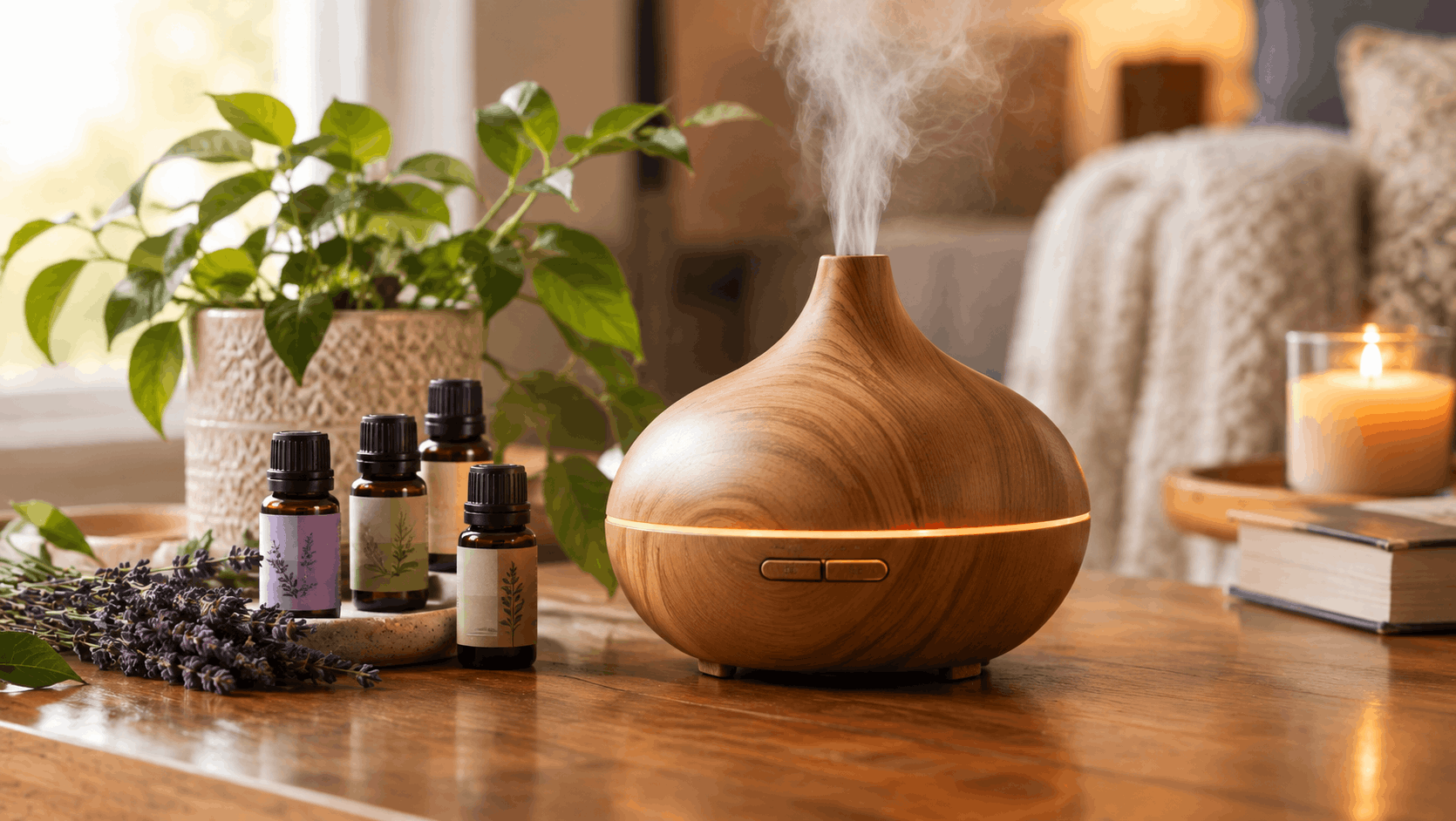
Diffuser Guide: How They Work and Which to Buy
Diffuser Guide: Most diffusers fall into four categories, and they don’t all do the same job.
Ultrasonic diffusers are the most common and usually the cheapest. A small disc inside the water reservoir vibrates at an ultrasonic frequency, breaking a mix of water and essential oil into a fine, cool mist that gets pushed into the room. Since they run on water, they also add a bit of humidity to the air, which is a nice side effect in a dry bedroom but something to keep in mind if your space is already humid.
Nebulizing diffusers skip the water entirely. They use an air pump to pull pure essential oil up through a small tube, and fast-moving air breaks it into an ultra-fine mist as it exits. Because there’s no dilution, the scent is noticeably stronger and more concentrated per session, and the therapeutic compounds in the oil aren’t affected by heat or water. They tend to go through oil faster and cost more than ultrasonic models, but if you want a strong, undiluted scent throw in a larger room, this is the type built for it.
Heat diffusers warm the oil gently to help it evaporate into the air. They’re simple and usually inexpensive, but heat can break down some of the more delicate aromatic compounds in an oil over time, which is why serious aromatherapy users tend to steer away from this style for anything they want to smell true to the bottle.
Evaporative diffusers rely on a fan blowing air across an absorbent pad soaked in oil, or in the simplest versions, just ambient air movement. They’re quiet, low-maintenance, and generally the least intense option, which makes them a decent pick for a small space where you just want a light background scent.
Which Type Should You Actually Buy
If you want one for a bedroom and mostly care about a gentle, steady scent while you sleep, an ultrasonic model is the easy default. They’re quiet, affordable, and the added humidity is often a bonus in a dry climate. In my experience, this is the type most people end up with simply because it’s the most widely available and the easiest to find replacement parts for.
If you’re chasing a strong, pure aromatherapy experience in a bigger room and you don’t mind using more oil, a nebulizing diffuser earns its higher price. It’s overkill for a small office cubicle, though, where the concentrated mist can feel like too much in a confined space.
Heat and evaporative diffusers are worth considering mainly if you want something simple and low-cost, or if you’re diffusing in short bursts rather than running something for hours at a stretch. One thing worth flagging: if you’re using oils specifically for their reported therapeutic properties rather than just scent, heat is the style most likely to degrade what you’re trying to preserve.
What to Look For Before Buying
Tank size determines how long a diffuser will run before you need to refill it, and it’s worth matching to how you actually plan to use the thing. A small 100 to 150 milliliter tank might run for a few hours, while larger reservoirs can run overnight without needing attention.
Auto shut-off is a feature worth prioritizing, especially for ultrasonic models. It stops the unit once the water runs out, which protects both the device and prevents it from running dry and potentially overheating.
Noise level matters more than people expect until they’ve tried to sleep next to a diffuser with a noticeably audible hum. Ultrasonic and evaporative models tend to be quieter than nebulizing units, which can have a more noticeable motor sound from the air pump.
And check cleaning requirements before buying. Ultrasonic diffusers need occasional cleaning to prevent mineral buildup or residue, especially if you’re using tap water rather than distilled. A model with a wide opening and simple parts is genuinely easier to maintain long-term than one with narrow, hard-to-reach components.
Is Using a Diffuser Actually Good for You
This is where I’d push back a bit on some of the more enthusiastic marketing you’ll see. Certain scents like lavender are commonly associated with relaxation, and plenty of people find genuine value in a calming aroma while working or winding down for bed. That’s a real, reasonable use case.
What’s less settled is how much measurable physiological benefit diffused essential oils actually provide beyond the psychological effect of a pleasant scent. The broader aromatherapy tradition has a long history and plenty of anecdotal support, but treat strong, specific health claims, curing a cold, boosting immunity, and so on, with some skepticism. A pleasant-smelling room is a legitimate reason to own a diffuser on its own, without needing to lean on bigger medical claims to justify it.
Ventilation is also worth a mention. Diffused oils release volatile organic compounds into the air, and the EPA’s guidance on indoor air quality notes that many common household products, including some fragrance sources, contribute to VOC levels indoors. That doesn’t mean a diffuser is dangerous in normal use, but running one for hours in a small, sealed room is a different situation than a few hours with a window cracked.
A Word on Pets
This is worth taking seriously if you have a cat in the house specifically. Cats lack a liver enzyme needed to break down many of the compounds found in essential oils, so exposure that would be harmless to a person or a dog can build up in a cat’s system over time. According to the Ontario SPCA, which draws on ASPCA guidance, essential oils diffused into the air can land on a cat’s fur and get ingested during normal grooming, so even ambient diffusion, not direct application, carries some risk. Oils commonly flagged as risky for cats include tea tree, citrus, peppermint, cinnamon, wintergreen, and pine, among others.
If you own birds, the same source notes essential oils are broadly considered dangerous for them, since birds have especially sensitive respiratory systems. If you’re diffusing around any pet, the safer approach is to run the diffuser in a well-ventilated room the animal can freely leave, avoid the higher-risk oils, and talk to your vet if you have specific concerns, particularly with cats or birds in the house.
Common Mistakes People Make
Overfilling the oil is a frequent one. More drops doesn’t mean better scent; it usually just means an overwhelming room and oil wasted faster than needed. Most diffusers work fine with a handful of drops per fill, and it’s worth starting light and adding more only if the scent feels too faint.
Skipping regular cleaning is another. Old oil residue can go slightly rancid inside the reservoir, and mineral buildup from tap water gradually reduces how well an ultrasonic disc vibrates, which weakens the mist output over time.
And running a diffuser constantly, all day, every day, in a small enclosed space isn’t necessary for most people’s goals and just accelerates wear on the unit while increasing the VOC exposure mentioned above. Intermittent use, an hour or two at a time, usually accomplishes what most people actually want from one.