







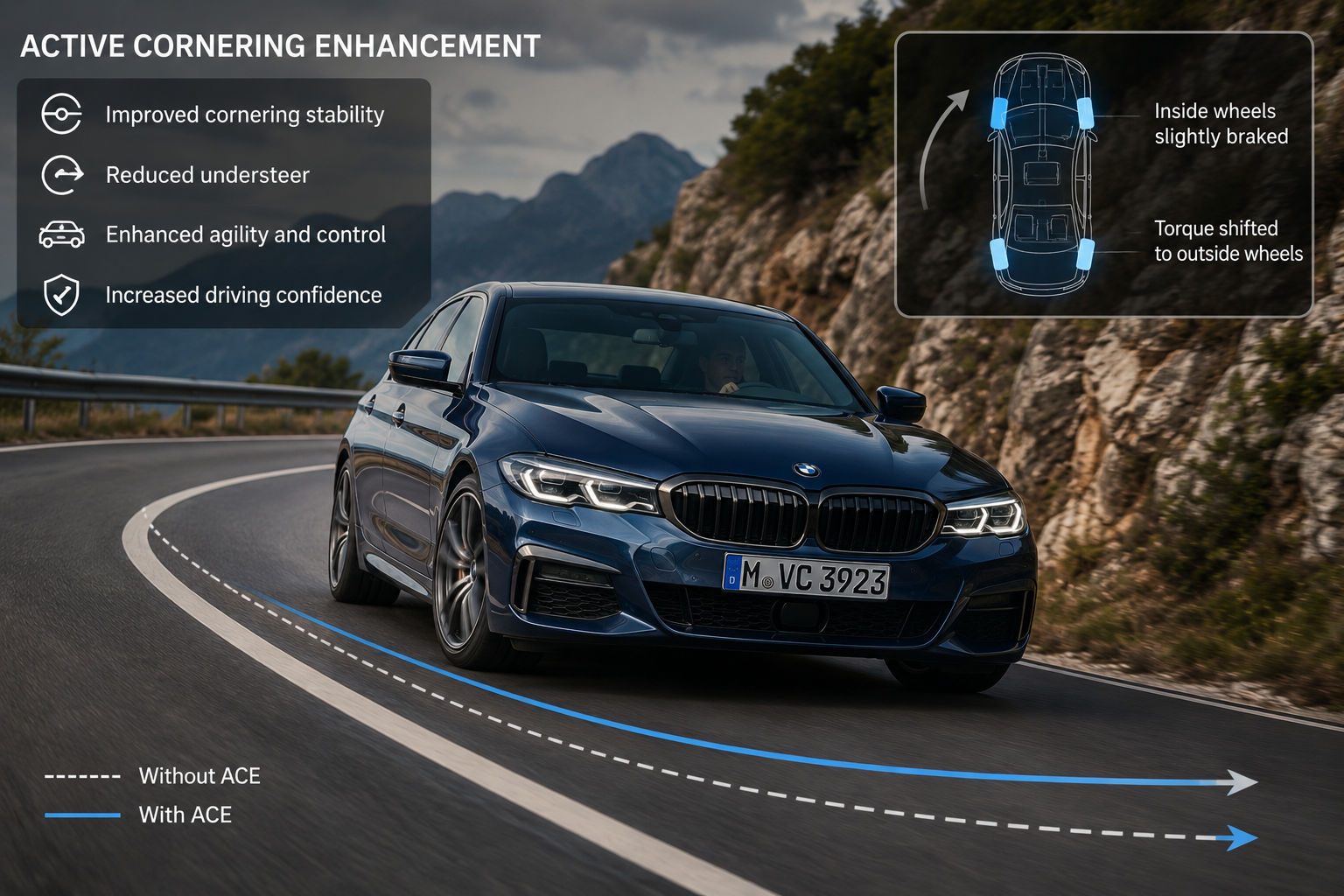
Active Cornering Enhancement: How Land Rover ACE Works
Active Cornering Enhancement, commonly shortened to ACE, is Land Rover’s hydraulically operated active anti-roll system. It was introduced on the Discovery Series II in 1998 to reduce body lean while cornering without requiring an excessively stiff suspension during straight-line driving.
ACE uses accelerometers, an electronic control unit, a hydraulic pump, control valves, and actuators connected to the front and rear anti-roll bars. When the vehicle turns, the system applies hydraulic force to the bars to resist body roll. On rough ground, it changes its response so the axles can articulate more freely. Land Rover describes the Discovery as the first vehicle in its class to introduce electronically controlled anti-roll bars through this system. (Land Rover Media Centre)
The name is mainly associated with older Land Rover Discovery Series II vehicles. Newer active roll-control systems may perform a similar job, but they are not automatically the same ACE system and may use different hydraulic, electromechanical, suspension, and control architectures.
Active Cornering Enhancement at a Glance
| Question | Practical answer |
|---|---|
| What does ACE do? | Reduces body lean during cornering |
| Which vehicle is it closely associated with? | Land Rover Discovery Series II |
| How does it operate? | Hydraulic actuators apply force to electronically controlled anti-roll bars |
| Does the driver switch it on? | No, operation is automatic |
| Does it work off-road? | Yes, the system adjusts to preserve suspension articulation |
| Is it the same as stability control? | No, ACE manages body roll; stability control manages vehicle direction through braking and engine intervention |
| What does a steady amber light mean? | Reduced ACE performance; drive cautiously and arrange service |
| What does a flashing red light and warning chime mean? | Stop safely, switch off the engine, and do not continue driving |
| Can it create more tire grip? | No, it cannot overcome the physical traction available from the tires and road |
Why Tall Vehicles Lean in Corners
A vehicle’s center of mass shifts toward the outside of a turn as lateral force increases. Springs compress on the outside of the corner, extend on the inside, and allow the body to lean.
A conventional anti-roll bar connects the left and right suspension. When one side moves farther than the other, the bar twists and resists that difference. A stiffer bar can reduce lean, but it may also restrict independent wheel movement and make the ride less comfortable on uneven roads.
ACE was designed to reduce that compromise. Land Rover’s owner handbook says the system limits body lean during cornering while preserving a softer ride during straight-line travel. It also changes its response on rough tracks to improve comfort, wheel articulation, and traction. (Manuals+)
This is particularly useful in a tall SUV. The system can provide firmer roll control when the driver turns and less resistance when the vehicle travels straight or crosses uneven ground.
How the Land Rover ACE System Works
1. Sensors measure vehicle movement
The Discovery Series II system uses two accelerometers to monitor lateral movement and body behavior. Historical manufacturer documentation states that the sensors provide data to the ACE computer before excessive body lean develops. (BMW Group PressClub)
The control unit considers how strongly the vehicle is cornering rather than responding only to visible body movement after it has occurred.
2. The ACE computer calculates the required correction
The control unit interprets sensor information and determines how much counteracting force is needed at the front and rear of the vehicle.
A gentle turn may need little intervention. A faster or sharper turn creates more lateral force and requires greater hydraulic action.
3. A hydraulic pump supplies pressure
An engine-driven pump produces the hydraulic pressure required to operate the system. Fluid passes through dedicated pipes and a valve block before reaching the actuators.
The owner handbook lists a specific fluid requirement for the system. Although the power-steering and ACE sections of the reservoir use the same specified fluid, they are separate hydraulic circuits with different compartments and filler caps. (TOPIx)
4. Actuators apply torque to the anti-roll bars
Hydraulic actuators influence the front and rear anti-roll bars. By twisting or loading the bars, the system creates a force opposing the direction of body lean.
Land Rover’s historical technical description says ACE could virtually eliminate lateral body lean up to 0.4 g and react to forces as high as 1.0 g in less than 130 milliseconds. These are manufacturer figures from the original Discovery Series II launch period, not independent measurements applying to every vehicle after decades of wear. (BMW Group PressClub)
5. The system changes its behavior off-road
A conventional stiff anti-roll bar can restrict axle articulation because movement on one side affects the other.
ACE can reduce its stabilizing effect on uneven terrain, allowing the suspension to move more freely. The original handbook states that the system automatically compensates for off-road conditions to improve articulation and traction. (Manuals+)
The driver does not manually select an ACE road or off-road setting. The system operates automatically.
Main ACE Components
| Component | Function | Possible effect of a fault |
|---|---|---|
| Accelerometers | Measure lateral movement and body behavior | Incorrect or missing body-roll data |
| ACE control unit | Calculates and commands system response | Warning light and reduced operation |
| Hydraulic pump | Generates system pressure | Noise, loss of assistance, warning, or component damage |
| Fluid reservoir | Stores the specified hydraulic fluid | Low level may reveal a leak |
| Valve block | Directs hydraulic pressure | Incorrect pressure distribution or leakage |
| Pressure sensor | Reports system pressure | Warning light or inaccurate pressure control |
| Hydraulic pipes and hoses | Carry fluid between components | Fluid loss and reduced system performance |
| Front and rear actuators | Apply force to the anti-roll bars | Reduced roll control or uneven response |
| Active anti-roll bars | Resist body lean when commanded | Vehicle handles more like a passive system if assistance is lost |
A dashboard warning light may identify that the control unit has recorded a problem, but it does not identify the failed component by itself. Proper diagnosis can require stored fault codes, hydraulic-pressure testing, wiring checks, sensor calibration, and physical inspection.
ACE Is Not the Same as Electronic Stability Control
Active roll control and electronic stability control address different parts of vehicle behavior.
| System | Main purpose | Typical intervention |
|---|---|---|
| ACE or active roll control | Reduces body lean | Applies force through active anti-roll hardware |
| Electronic stability control | Corrects understeer, oversteer, or skidding | Brakes individual wheels and may reduce engine power |
| Traction control | Limits driven-wheel spin | Applies braking or reduces engine torque |
| Adaptive dampers | Adjust ride firmness and wheel-motion control | Changes shock-absorber damping |
| Air suspension | Supports and adjusts vehicle height | Changes air pressure in the suspension |
| Torque vectoring | Influences how drive torque reaches the wheels | Alters torque distribution across an axle or between axles |
NHTSA describes electronic stability control as a system that compares the driver’s intended path with the vehicle’s actual direction and can brake individual wheels to correct the heading. ACE instead acts primarily on roll stiffness and body position. (NHTSA)
A vehicle can have both technologies because they perform complementary jobs.
What ACE Can and Cannot Do
What it can do
When operating correctly, ACE can:
- Keep the vehicle flatter through normal corners
- Improve steering response
- Reduce passenger movement
- Allow a softer straight-line suspension setup
- Adapt its roll control for rough surfaces
- Preserve more off-road articulation than a permanently stiff passive bar
These benefits are consistent with Land Rover’s original system description and with the broader operating principle of active roll stabilization. Modern systems from suppliers such as ZF similarly generate stabilizing torque during cornering while allowing a more comfortable setting during straight-line driving. (Manuals+)
What it cannot do
ACE cannot:
- Increase the friction available from the tires
- Make worn tires safe
- correct excessive speed for the corner
- Prevent every skid or rollover
- Replace electronic stability control
- Repair worn suspension joints or shock absorbers
- Compensate for improper tire pressures
- Make an overloaded vehicle handle normally
- Eliminate the need for cautious driving
Less visible body lean can make a vehicle feel more confident, but it does not change every physical limit. Drivers still need to account for speed, road surface, tire condition, load, weather, and stopping distance.
What the ACE Warning Light Means
The Discovery Series II owner handbook describes a red-and-amber self-check each time the ignition is switched on.
Normal startup sequence
When the starter switch moves to position II:
- The ACE warning light illuminates red.
- After approximately two seconds, it changes to amber.
- After another two seconds, it switches off.
This is the normal system check. A light that does not follow the expected sequence deserves investigation. (Manuals+)
Constant amber ACE light
A steady amber light while driving indicates a fault that reduces ACE performance.
The handbook says the vehicle may continue to be driven, but the driver should reduce speed, use extra care, and arrange qualified service as soon as possible. The vehicle may lean more than expected because full active roll assistance may not be available. (Manuals+)
Flashing red ACE light with a warning chime
A flashing red light, accompanied by a warning chime and later changing to constant red, indicates a more serious system fault.
Land Rover’s instruction is unambiguous: stop as soon as it is safe, switch off the engine, do not continue driving, and seek qualified assistance. The fault may cause serious component damage as well as reduced ACE performance. (Manuals+)
Do not assume the warning is merely an old sensor problem. A severe fluid leak or pump fault can affect components driven by the auxiliary belt.
Documented ACE Fault Areas
ACE-equipped Discovery II vehicles are now old enough that condition and maintenance history matter more than a general claim that the system is reliable or unreliable.
Hydraulic fluid leaks
The system depends on maintaining hydraulic pressure. Leaks may develop at pipes, hoses, fittings, actuators, the valve block, or pump connections.
Land Rover’s handbook tells owners to investigate any large or sudden fluid-level drop rather than repeatedly adding fluid. (Manuals+)
High-pressure pipe and pump-connection recalls
Certain Discovery vehicles were subject to recalls involving ACE fluid leaks.
One campaign concerned a high-pressure pipe that could fracture near the pump connection. Fluid loss could lead to pump failure, displacement of the auxiliary drive belt, loss of several engine-driven functions, and, in extreme cases, a fire risk. A later NHTSA document addressed leakage caused by insufficient torque at an ACE pump connection. Recall applicability must be checked by VIN rather than assumed from model year alone. (Cars.com)
US owners and buyers can use the NHTSA recall lookup to check for open safety campaigns.
Accelerometer faults or calibration problems
A Land Rover technical bulletin documented amber warning-light complaints caused by missing calibration data, a deformed accelerometer mounting bracket, or a faulty upper accelerometer on certain Discovery II vehicles.
The prescribed diagnosis used Land Rover’s TestBook or T4 equipment to test and calibrate the sensor before replacement. This is one reason replacing parts based only on a warning light can waste money. (Workshop Manuals)
Pump noise or pressure loss
A pump running with insufficient fluid may become noisy and can suffer damage. A squeal should not automatically be blamed on the ACE pump because the auxiliary belt drives several components, but it warrants prompt inspection when combined with low ACE fluid or a warning light.
Electrical and sensor faults
Damaged wiring, connectors, pressure-sensor faults, control-unit problems, or poor sensor signals can also trigger reduced operation.
A visual inspection alone cannot confirm these faults. Diagnostic data should be read before dismantling the hydraulic system.
Can You Drive With an ACE Fault?
The warning-light color determines the immediate response.
- Steady amber: Reduce speed, expect reduced roll assistance, drive cautiously, and arrange qualified service promptly.
- Flashing red with a chime: Stop safely, switch off the engine, and do not continue driving.
- No warning but visible fluid loss: Do not keep topping up and driving without locating the leak.
- Sudden belt noise, steering change, overheating, or battery warning: Stop because an auxiliary-drive problem may be developing.
These instructions are based on the Discovery Series II handbook. Another Land Rover model may use different warning messages or procedures, so its own manual must take priority. (Manuals+)
Checking an ACE-Equipped Discovery Before Buying
A used Discovery Series II with working ACE may feel more controlled on paved roads while retaining useful off-road articulation. A neglected hydraulic system can also add substantial repair work.
Use this inspection framework.
Confirm that ACE is actually fitted
Do not rely only on a seller’s description.
Check for:
- The ACE warning-light self-test
- The dedicated section of the hydraulic reservoir
- Hydraulic lines leading to the control system
- The valve block
- Front and rear hydraulic actuators
- Vehicle documentation showing the option
A warning light that never illuminates during startup is not proof that the system is fault-free. The bulb or instrument display may have been altered.
Inspect the fluid level and condition
Check the level according to the owner handbook and look for wet areas around the pump, valve block, lines, unions, and actuators.
Do not open a pressurized hydraulic line or work beneath an unsupported vehicle.
Scan the ACE control unit
A Land Rover-capable diagnostic scan should check:
- Stored and pending fault codes
- Accelerometer readings
- Pressure-sensor information
- Solenoid operation
- Calibration status
- Warning-light history where available
A generic engine-code reader may not communicate with the ACE control unit.
Check recall completion by VIN
Recall records can identify whether the vehicle was included in an ACE pipe or pump-connection campaign. A model-year match does not confirm whether one specific vehicle was affected or repaired.
Arrange a specialist inspection
A technician familiar with Discovery II suspension and hydraulic systems should evaluate the vehicle before purchase. The inspection should cover the ACE system as well as steering, anti-roll-bar links, suspension bushes, wheel bearings, tires, frame corrosion, and other age-related concerns.
Headlinza’s used trucks buying guide provides a broader VIN, recall, history, test-drive, and pre-purchase inspection framework that can also be applied to an older SUV.
Is Removing ACE a Good Repair?
Some aging vehicles have had ACE removed and replaced with passive anti-roll components. This may appear cheaper than rebuilding a leaking hydraulic system, but it is not a like-for-like repair.
Removing ACE can change:
- Body-roll behavior
- Steering response
- Straight-line ride
- Off-road articulation
- Warning-light operation
- Vehicle value
- Insurance declarations
- Inspection or registration compliance
- Compatibility with the remaining suspension parts
A safe conversion requires more than disconnecting hydraulic lines or hiding a dashboard warning. Correct passive anti-roll hardware, mounting parts, control-system handling, fluid-circuit changes, and documentation may all be required.
Before modifying the system, compare the full cost of proper ACE repair with a professionally engineered conversion. Buyers should treat an unexplained ACE deletion as a modification requiring inspection, not as an automatic upgrade.
ACE and Modern Active Roll Stabilization
The idea behind ACE remains relevant. Current active roll systems use hydraulic or electromechanical actuators to generate stabilizing force during cornering and reduce intervention during straight-line driving.
Modern electromechanical systems can vary stabilizing torque without an engine-driven hydraulic pump. Some are integrated with adaptive dampers, rear-wheel steering, braking, ride-height control, or centralized vehicle-motion software. ZF’s current electromechanical roll-control technology follows the same broad comfort-versus-cornering principle, although its components and controls differ from the Discovery II system. (ZF Group)
For this reason, active cornering enhancement may be used generically in some online articles. In a Land Rover service, parts, or warning-light context, however, ACE normally refers to the specific Discovery II hydraulic system.
Frequently Asked Questions
What is Active Cornering Enhancement?
Active Cornering Enhancement is Land Rover’s electronically controlled hydraulic anti-roll system. It reduces body lean by applying force to the front and rear anti-roll bars during cornering. (Land Rover Media Centre)
Which Land Rovers have ACE?
The ACE name is most directly associated with the Discovery Series II, where it was offered on selected vehicles. Later Land Rover and Range Rover systems used names such as Dynamic Response and may have different designs.
Confirm equipment using the VIN, build specification, physical components, and owner documentation rather than assuming every trim has it.
Is ACE the same as air suspension?
No. ACE controls body roll through active anti-roll hardware. Air suspension supports the vehicle and can adjust ride height or spring behavior. Some vehicles may have both systems.
Is ACE the same as traction control?
No. Traction control limits wheelspin. ACE controls body lean. Electronic stability control may brake individual wheels to correct the vehicle’s direction, while ACE acts through the suspension’s anti-roll system. (Bosch Mobility)
What fluid does a Discovery II ACE system use?
The original technical data specifies Texaco Cold Climate PAS fluid 14315 for both power steering and ACE. The circuits remain separate even though they share a reservoir assembly and fluid specification. Owners should verify the current approved replacement specification before adding fluid because original products and part numbers may have been superseded. (TOPIx)
Can I continue driving with an amber ACE light?
The Discovery II handbook permits cautious driving with a steady amber light, but advises reduced speed and service at the earliest opportunity. A flashing red light with a chime requires stopping and switching off the engine. (Manuals+)
Does ACE need regular maintenance?
The fluid level should be checked according to the vehicle’s maintenance instructions, and leaks or sudden level changes require investigation. Service history, line condition, warning-light operation, and diagnostic faults are especially important on an older vehicle.
Can ACE prevent a rollover?
ACE can reduce body lean, but it cannot prevent every rollover or overcome excessive speed, tire failure, road conditions, overloading, or loss of traction. It is a handling aid rather than permission to corner faster.
Final Takeaway
Active Cornering Enhancement was an important Land Rover chassis technology. By using sensors, hydraulic pressure, and active anti-roll bars, it allowed the Discovery Series II to remain flatter during road driving while preserving suspension movement on rough terrain.
Its operation is automatic, but its warning light demands attention. A steady amber light means roll-control performance has been reduced and the vehicle needs service. A flashing red light with a warning chime means the driver should stop safely, switch off the engine, and not continue driving.
For an existing owner, diagnose the system before replacing components. For a used buyer, confirm that ACE is fitted, check the startup warning sequence, inspect for fluid loss, scan the control unit, verify recall completion, and arrange an inspection by a technician familiar with the Discovery II.
ACE improves body control. It does not create additional tire grip, repair worn suspension parts, or remove the physical limits of a tall SUV.
Browse more vehicle systems, consumer technology, and technical explainers in Headlinza’s Technology section.