





Blue Lock Manga: Is It Worth Reading? A Beginner’s Guide
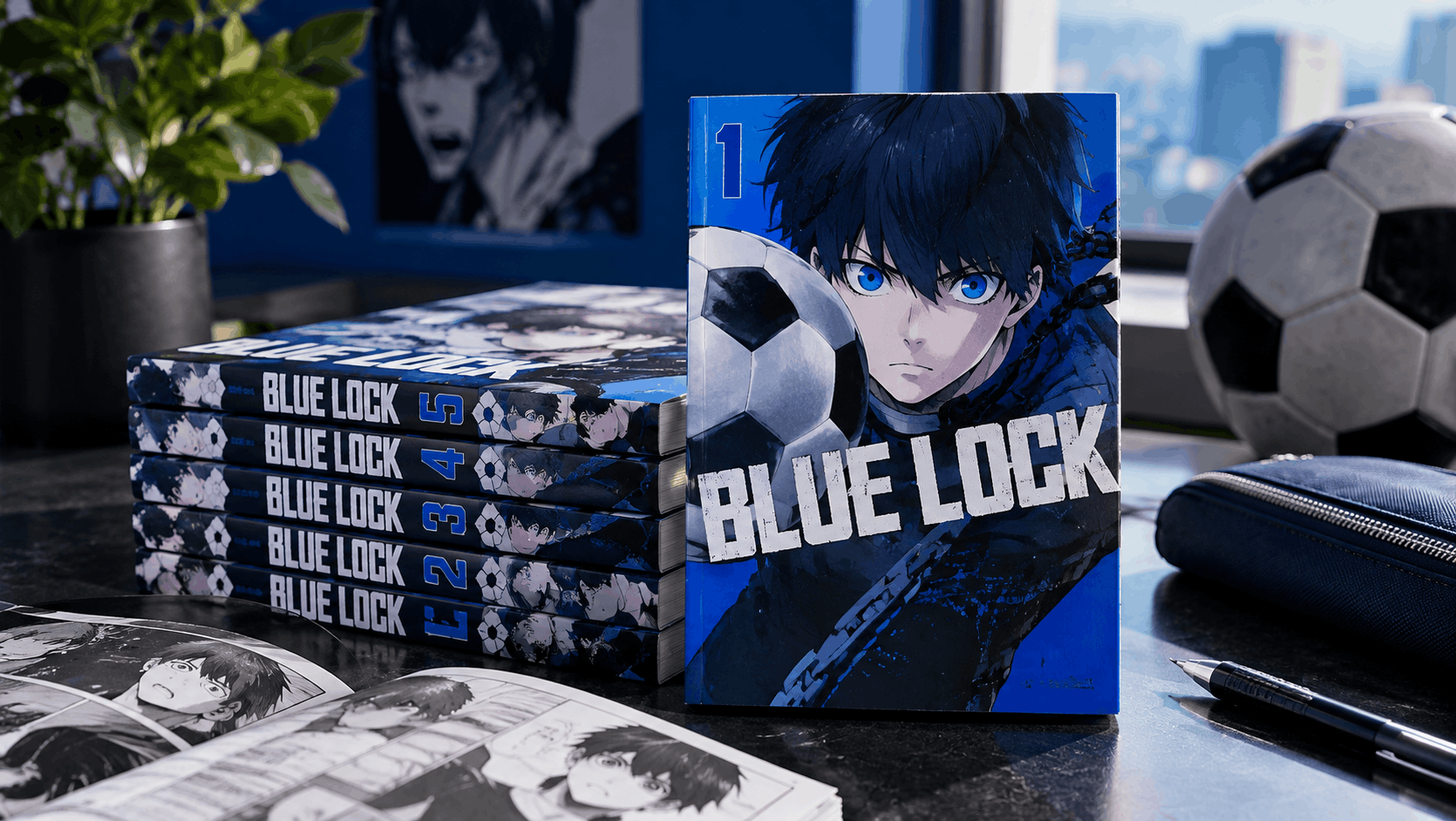
Blue Lock Manga: Japan loses badly on the international stage, and a mysterious coach named Jinpachi Ego decides the country’s problem is a shortage of selfish strikers. Not a shortage of talent, a shortage of ego. So he locks 300 young forwards inside a facility called Blue Lock and turns the whole thing into a survival tournament. Only one will emerge as the striker Japan needs to win a World Cup.
The story follows Yoichi Isagi, a high school forward who’s decent but unremarkable and who has just missed a goal because he passed to a teammate instead of shooting. That single moment is the hook. The series takes the “pass to the open man” instinct that every coach preaches and asks what happens when you refuse it.
If you’ve never followed association football closely, you can still follow this. The manga explains positioning and decision-making as it goes, mostly through Isagi’s internal monologue, and it’s more interested in the psychology of scoring than in rulebook detail.
Who made it and where it started
The Blue Lock manga is written by Muneyuki Kaneshiro and illustrated by Yusuke Nomura. It began in Kodansha’s Weekly Shonen Magazine on August 1, 2018, and the first collected volume arrived on November 16, 2018. According to the list of Blue Lock chapters, 40 volumes had been released as of August 17, 2026.
Kodansha USA licensed the series for English digital release in North America, starting in March 2021, and announced a print edition in 2022. The series also won the shonen category at the 45th Kodansha Manga Award in 2021. If you want to buy legitimately, Kodansha USA is the official starting point, and it’s worth checking there for current volume and omnibus availability since release schedules shift.
One thing that tends to surprise newcomers is how visually loud the art is. Nomura draws faces in moments of pressure with an intensity that borders on unsettling, and the shot sequences are staged like fight scenes. Some readers find it thrilling. A few find it exhausting after twenty chapters.
What makes the blue lock manga different from other sports stories
It treats ego as a skill
Where a typical sports series preaches teamwork as the highest value, this one builds its world on the opposite belief. Characters are ranked, eliminated, and rebuilt around a single question: what is the one thing you can do that nobody else can? A player who’s fast isn’t interesting. A player who’s fast and has a specific, weaponized way of using that speed is.
That framing is why the series can feel closer to a battle manga than a sports one. Each rival has a “weapon,” and the tension comes from watching Isagi figure out how to steal, adapt, or counter it.
It’s a story about growth by observation
Isagi isn’t a prodigy. He gets better by reading opponents, absorbing what works, and turning it into his own style. In my experience, readers who like underdog stories where the protagonist wins through thinking rather than raw talent tend to enjoy this most. It’s less about a chosen one and more about a student who never stops taking notes.
The tone is aggressive, and it’s meant to be
This is not a wholesome series. There’s trash talk, humiliation, and characters who treat losing like a personal insult. If you want warm locker-room bonding, you’ll find pieces of it, but it’s always secondary to competition. I’d say the intensity is the main reason people either become obsessed or bounce off within the first volume.
Characters worth knowing before you start
You don’t need a cheat sheet, but a few names come up constantly.
Isagi is the lens through which most of the story is told. Meguru Bachira is a dribbler with a playful, unpredictable style that makes him a fan favorite early on. Seishiro Nagi is a naturally gifted striker who initially seems uninterested in trying hard, and Reo Mikage is the ambitious partner who latches onto him. Rin Itoshi is a cold, elite forward whose presence hangs over much of the story, and Shoei Barou is an overbearing, self-declared king who thrives on dominance.
Later on, foreign players and veterans join the cast, and the stakes broaden from Japan’s internal selection to something international. I won’t spoil the specifics, but the scale does grow in a way the early volumes only hint at.
The Nagi spin-off is worth a mention too. Blue Lock: Episode Nagi ran in Bessatsu Shonen Magazine from June 2022 to July 2025 and was collected in eight volumes. It’s a companion piece, and you don’t need it to follow the main series. Read it after you’ve finished a few arcs if you want extra context on that character.
Where to start and how to read it
Start at volume 1 of the main series. There’s no prequel you need first and no reading-order trick. The spin-off can wait.
Kodansha sells the series in standard volumes, and there are also omnibus editions that bundle several volumes into one book. As an example, a UK retailer listing shows an omnibus covering volumes 16 to 18 with a December 2026 release date, though listings like this change, so confirm with the seller. I’d buy the first three or four volumes before committing to a full run. If the tone works for you by then, it’ll keep working.
Read from the official sources. Fan scans exist, but they cut out the people who make the series and they’re often low quality. And frankly, the art deserves the crisp printing.
Manga vs anime: which should you pick?
The anime was produced by Eight Bit and aired from October 2022 to March 2023, with more seasons following. It’s a good entry point if you want to test the premise before buying anything. Motion and sound add a lot to the match sequences, and the pacing is smoother than some readers expect.
But I lean toward the manga for the long haul. The inner monologue is where the series does its best work, and the manga gives you far more of it. The anime can condense or skip the reasoning behind a play, and that reasoning is half the fun. If you want the full experience, watch the first season and then read from the point it stops, or start fresh from volume 1 if you don’t mind re-reading events you’ve already seen.
One caution: the manga is well ahead of the anime, so reading online discussion can spoil you fast. Turn off spoilers on social media before you get too deep.
Who should skip it
If you dislike aggressive, competitive protagonists, you’ll probably find this grating. The series leans hard into ego, and it rarely apologizes. A reader who wants a gentle, character-driven sports story like a small-town team growing together will likely be happier elsewhere.
The art can also feel over-the-top. Close-ups, dramatic angles, and exaggerated expressions are constant. And the pacing during longer matches can stretch, since a single game can span many chapters. If you want quick resolutions, that structure may test your patience.
Is the Blue Lock manga worth reading?
Yes, if you like tension, rivalry, and heroes who win by thinking. It’s one of the more distinctive sports manga in recent memory, because it takes an unpopular idea (selfishness) and builds a whole philosophy around it. Even readers who don’t care about soccer often get pulled in.
My recommendation: read the first three volumes. If Isagi’s arc grabs you by then, keep going. If you find yourself rolling your eyes at every shouted monologue, it’s probably not your series, and that’s fine.