






Edge Control: How to Use It Without Flakes or Buildup
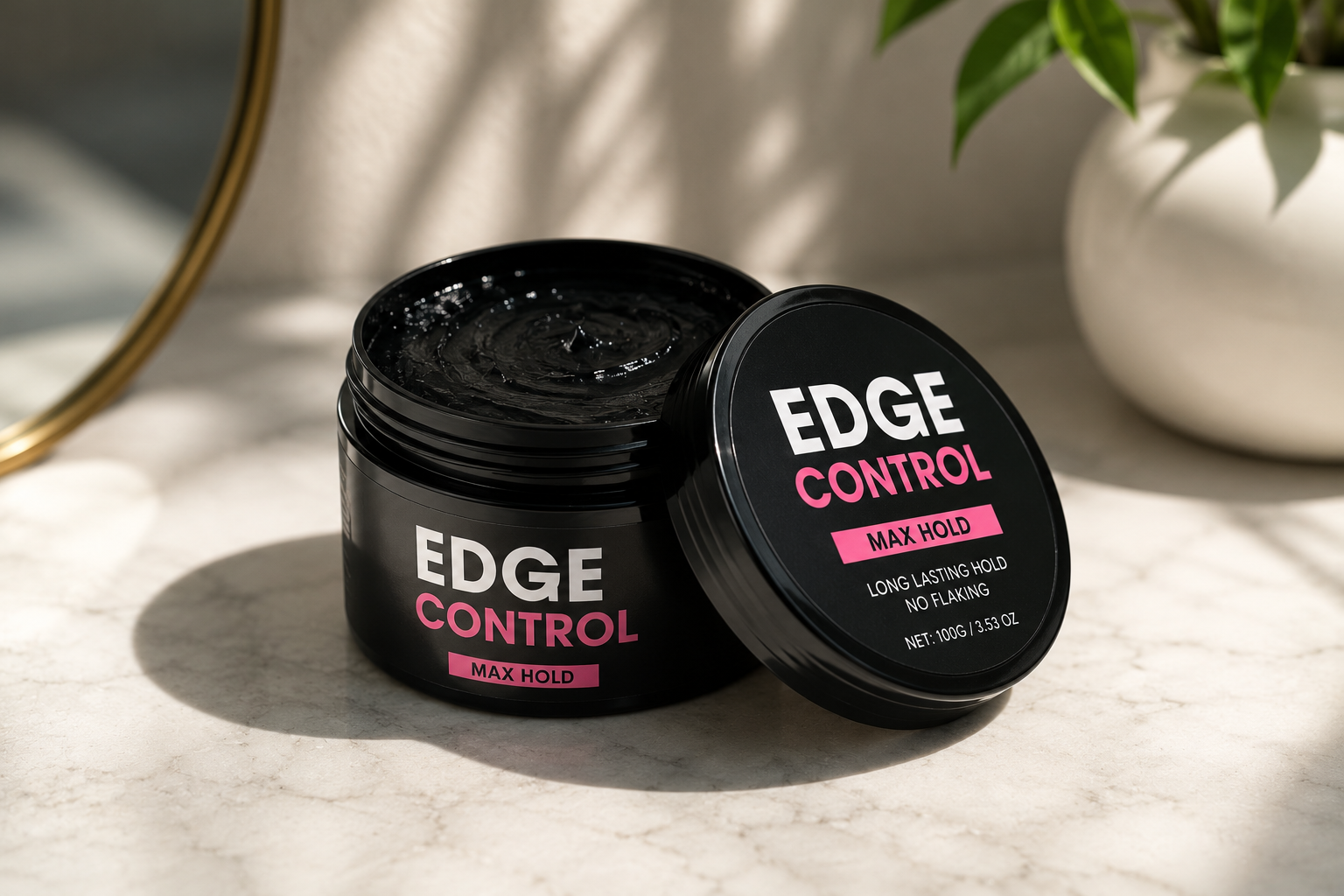
Edge control is a concentrated hair-styling gel or pomade designed to smooth and shape the short, delicate hairs around the hairline, often called edges or baby hairs. It is usually thicker and more targeted than regular styling gel, which helps it create defined swoops, flatten flyaways, or finish a sleek bun, braid, wig, or ponytail. (byrdie.com)
For a clean result, apply a very small amount to product-free edges, shape the hair with short and gentle strokes, and set it with a satin or silk scarf. Using more product rarely creates better hold. It is more likely to leave a greasy surface, stiff hair, or visible white residue.
Edge control is a cosmetic styling product. It can temporarily hold hair in position, but it does not regrow thinning edges or treat hair loss.
Edge Control at a Glance
| Question | Practical answer |
|---|---|
| What does edge control do? | Smooths and shapes short hairs around the hairline |
| Is it the same as regular gel? | No. It is usually thicker and more concentrated |
| How much should you use? | Begin with a light dab and add only if necessary |
| Why does it turn white? | Too much product, buildup, moisture, or incompatible layered products |
| Can it damage edges? | Rough brushing, tight hairstyles, irritation, and repeated manipulation can contribute to breakage |
| Does it grow edges? | No. Styling claims should not be confused with hair-growth treatment |
| Can you use it every day? | Frequent use may be possible, but daily buildup and manipulation should be monitored |
| What should sensitive users check? | Fragrance, preservatives, previous reactions, and scalp condition |
What Is Edge Control Made From?
Formulas vary, but edge controls commonly combine film-forming polymers or waxes with water, oils, emollients, preservatives, and sometimes fragrance. The polymers and waxes create hold, while water and emollient ingredients can improve spreadability, flexibility, or shine. (byrdie.com)
A thicker product is not automatically stronger, healthier, or more suitable for your hair. The final performance depends on the complete formula, how much is applied, the products already on the hair, humidity, perspiration, and the hairstyle’s tension.
Marketing terms such as “maximum hold,” “24-hour control,” “moisturizing,” and “strengthening” are not standardized performance guarantees. A product may provide excellent hold for one person and lose control quickly on another hair texture or in another climate.
Edge Control vs Hair Gel
Edge control and regular hair gel can overlap, but they are not designed for exactly the same job.
| Product | Best use | Typical texture | Main limitation |
|---|---|---|---|
| Edge control | Hairline details, baby hairs, small flyaways | Thick gel, paste, or pomade | Can build up quickly |
| Styling gel | Larger sections, curls, slick styles, braids | Usually more spreadable | May not hold stubborn edges |
| Pomade | Shine, smoothing, flexible control | Waxy or oily | Can feel heavy or greasy |
| Wax stick | Flyaways, part lines, wigs, sleek sections | Firm solid wax | Easy to overapply |
| Mousse | Light shaping and setting | Foamy and lightweight | Usually provides less concentrated hold |
Edge control is the more precise option when only the perimeter needs styling. Regular gel may be more efficient when the entire ponytail, bun, braid base, or curl pattern needs coverage.
You can sometimes use styling gel on edges, but layering several different gels, oils, creams, and edge products increases the chance of residue.
How to Choose the Right Edge Control
Choose the hold according to the style
A flexible or medium hold may be enough for loose flyaways, soft baby-hair styling, or wavy textures. Stronger formulas may be more useful for dense, coarse, or coily edges and highly polished styles.
Extreme hold is not automatically the best option. A rigid finish may feel tight, require more brushing to restyle, and make delicate strands harder to manipulate without breakage.
The useful goal is the lowest level of hold that keeps the intended style in place.
Match the texture to your hair and finish
Current hairstylist guidance generally associates lighter, water-based gels with softer control and thicker wax-based products with stronger shaping. Individual results still vary, and the ingredient list alone cannot predict performance perfectly. (byrdie.com)
Consider:
- Soft, flexible finish: Choose a lighter gel or paste.
- Strong sculpted swoops: Consider a thicker formula.
- Silk press or straightened hair: Avoid a very wet product if it causes reversion.
- Dry or fragile edges: Avoid repeatedly coating the area with a formula that leaves it hard.
- Oily skin or heavy skincare: Use less product near the forehead.
- Humid conditions: Look for hold without assuming any product is fully humidity-proof.
Check fragrance and previous reactions
Cosmetic products can cause allergic contact dermatitis in some users. The FDA identifies fragrances, preservatives, dyes, natural rubber, and metals among common cosmetic-allergen classes. Fragrance mixtures may also be listed simply as “fragrance” rather than naming every component. (fda.gov)
A fragrance-free product may be a better starting point for someone with a history of fragrance sensitivity, eczema around the hairline, or repeated cosmetic reactions. “Unscented” and “fragrance-free” do not necessarily mean the same thing.
No ingredient is automatically harmful to every user. The more relevant questions are whether the formula is legally labeled, suitable for its intended use, and tolerated by your skin and hair.
How to Apply Edge Control
1. Start with clean, product-light edges
Remove obvious oil, old gel, makeup, or heavy skincare from the hairline. Edge control is more likely to grip clean hair than a surface already coated with several products.
Your edges do not need to be aggressively scrubbed. The goal is simply to avoid layering new product over visible buildup.
2. Separate only the hair you want to style
Use the pointed end of an edge tool or comb to isolate a small section.
Do not pull long strands from farther behind the hairline merely to create larger baby-hair designs. Taking too much hair can make the style look heavy and increase manipulation around the perimeter.
3. Apply a small amount
Place a light dab on the selected section rather than covering the full hairline immediately.
Spread the product thinly. You should be able to add more where needed without creating a thick visible layer.
4. Shape with short, gentle strokes
Use a clean, soft or moderately firm edge brush, small comb, or suitable styling tool. Move the hair in the intended direction without repeatedly scraping the skin.
Short strokes provide more control than pressing hard and brushing the same area for several minutes.
5. Set the style
Wrap the hairline with a clean satin or silk scarf while the product sets. Current hairstylist guidance commonly recommends this step to reduce flyaways and help the style hold its shape. The necessary setting time depends on the formula, amount used, and hairstyle. (byrdie.com)
Remove the scarf gently instead of dragging it against the finished edges.
6. Leave the style alone
Repeatedly brushing, touching, wetting, and reapplying the product throughout the day can create buildup and increase stress on fragile hair.
Correct one small section when necessary rather than restarting the entire hairline.
Why Edge Control Turns White or Flakes
White residue does not always mean the product is defective.
Common causes include:
- Applying too much
- Layering it over leave-in conditioner
- Mixing it with another gel or mousse
- Applying it over heavy oils
- Reapplying without washing away old product
- Sweat or moisture interacting with the dried formula
- A wax-heavy product sitting visibly on the hair
- Product incompatibility
Hairstylists interviewed by Byrdie identified excessive layering and interactions between polymers and other styling products as common reasons an edge control turns white. Oils and oily skincare near the forehead can also prevent the product from setting properly. (byrdie.com)
How to fix white residue
Do not keep adding more edge control.
Instead:
- Gently remove the residue.
- Clean the affected hairline.
- Allow the area to dry.
- Apply one product in a thinner layer.
- Test the combination before styling the full hairline.
When two products repeatedly create flakes together, stop layering them. Each product may work normally when used alone.
Can Edge Control Damage Your Hairline?
Edge control itself is not automatically damaging, but the way it is used can contribute to problems.
The American Academy of Dermatology describes the hair around the edges as fragile and advises protecting it from repeated heat, tight styling, and excessive stress. Tight braids, ponytails, buns, weaves, and extensions can cause traction alopecia when they repeatedly pull on the hairline. (aad.org)
Possible warning signs include:
- Pain or stinging from the hairstyle
- A tight or pulling sensation
- Broken hairs around the forehead
- A receding hairline
- Small bumps or crusting
- Persistent redness or itching
- Areas that appear thinner after repeated styling
Edge control can make a tightly pulled style look smoother, but it does not make the tension safer. If a ponytail, braid, wig installation, or bun hurts, loosen the hairstyle rather than using more product to hold it down.
The AAD warns that long-term pulling can damage follicles and may lead to permanent hair loss. (aad.org)
Is Edge Control Safe for Daily Use?
There is no universal schedule that suits every formula, hairstyle, or scalp.
Daily use may be tolerated when the product does not cause irritation, stiffness, buildup, breakage, or repeated aggressive brushing. It becomes less sensible when each application is layered over the previous one or the hairline must be scrubbed and restyled every day.
A more protective routine is to:
- Use the smallest effective amount
- Avoid pulling the hairstyle too tightly
- Clean away visible buildup
- Keep styling tools clean
- Limit repeated brushing
- Moisturize and condition according to your hair’s needs
- Give the hairline breaks from tightly controlled styles
- Stop when the skin becomes irritated
Edge control should not replace regular cleansing and conditioning.
Edge Control and Thinning Edges
Edge control cannot diagnose or treat the reason a hairline is thinning.
Breakage may result from repeated brushing, tight hairstyles, extensions, friction, chemical processing, or heat. Hair loss can also have medical causes unrelated to styling.
Do not attempt to hide progressive thinning by pulling more hair forward and applying stronger products. A dermatologist can assess whether the problem is breakage, traction alopecia, another form of hair loss, or a scalp condition.
Early assessment matters because advanced traction alopecia can become permanent. (aad.org)
When to Stop Using an Edge-Control Product
Stop using the product if you develop:
- Rash
- Persistent redness
- Burning
- Swelling
- Significant itching
- Unexpected hair loss
- Blistering
- Scalp infection symptoms
- A sudden reaction that worsens
The FDA’s current cosmetic complaint guidance says the first step after a reaction is to stop using the product and contact a healthcare provider. Consumers can also report cosmetic reactions, contamination, unusual odor, color changes, or foreign material to the FDA. (fda.gov)
Save the packaging and ingredient list if medical evaluation is needed.
Common Edge-Control Mistakes
Using too much product
A thick layer can remain visible, attract lint, feel greasy, or dry into flakes.
Applying over oil
Oil can make the hair too slippery for the edge control to grip. Heavy facial skincare near the hairline may create the same problem.
Brushing too hard
Pressure does not guarantee better hold. It can increase friction against delicate strands.
Using a dirty edge brush
Old product on the tool can transfer dried residue into a new application and make it harder to judge how the fresh formula performs.
Restyling the same area repeatedly
Constant manipulation may matter more than the product itself. Shape the hair, set it, and leave it alone where possible.
Expecting hair growth
Ingredients such as oils, aloe, rosemary, or biotin may be promoted in hair products, but the presence of a familiar ingredient does not prove that an edge control will regrow a thinning hairline.
Ignoring hairstyle tension
A smooth finish can hide how tightly the hair is being pulled. Pain is not a sign that the style will last longer.
Frequently Asked Questions
What is edge control used for?
Edge control smooths, shapes, and temporarily holds the short hairs around the hairline. It can also control small flyaways and finish sleek hairstyles. (byrdie.com)
Is edge control the same as gel?
No. Edge control is usually thicker and more concentrated for precise hairline styling. Regular gel is often easier to spread across larger sections of hair.
Should edge control go on wet or dry hair?
Follow the product label. Many formulas grip best on clean, dry, or only slightly damp edges, while excess water can dilute the hold or increase residue.
Why does my edge control stop working?
Oil, sweat, humidity, buildup, insufficient hold, or applying the product over incompatible styling products can weaken the result.
Can edge control grow my edges?
No reliable conclusion about hair growth can be made from styling performance. Persistent thinning, breakage, or hair loss should be assessed separately.
Can edge control cause traction alopecia?
Traction alopecia is caused by repeated pulling or tension on hair follicles. Edge control does not create that tension by itself, but it is often used with tight styles or repeated brushing that can stress the hairline. (aad.org)
How do I remove edge-control buildup?
Use your normal gentle cleansing routine and avoid scraping dried product from the hairline. Follow with appropriate conditioning for your hair type.
Final Takeaway
Edge control works best as a finishing product, not as a substitute for a healthy hair-care routine.
Choose the lightest hold that can manage your intended style, begin with a small amount, avoid mixing several products, and use gentle movements around the hairline. White flakes usually call for less layering, not more product.
Pay equal attention to the hairstyle beneath the finish. A perfectly smooth hairline is not worth pain, repeated breakage, irritation, or progressive thinning.
Browse more personal care, beauty, and everyday consumer guidance in Headlinza’s Lifestyle section. (HEADLINZA)
Medical disclaimer: Headlinza provides general educational information and does not replace professional medical advice, diagnosis, or treatment. Consult a qualified dermatologist about persistent irritation, scalp symptoms, breakage, or hair loss.