
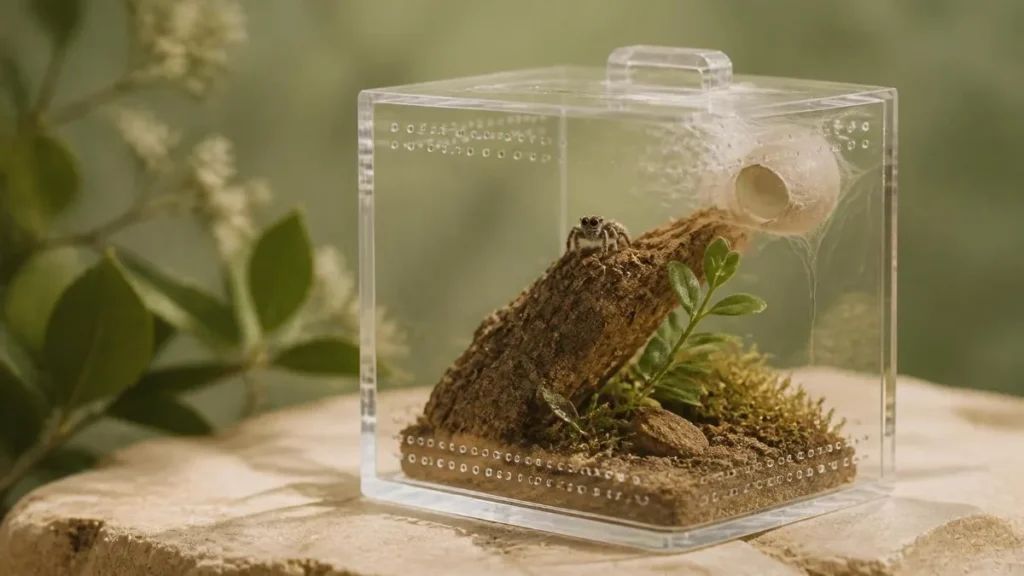

Jumping Spider Enclosure: A good jumping spider enclosure is tall rather than wide, well-ventilated, and filled with climbing surfaces and places to build a silk hideout. PetSmart’s regal jumping spider guide puts the minimum at 4 x 4 x 7 inches and encourages going larger. Beyond that, published care sheets disagree on several details, including ideal humidity, temperature and how much space is enough. This guide explains where they agree, where they differ, and how to set up a safe home while you work out what your spider needs.
Why the enclosure is shaped the way it is
Jumping spiders don’t build capture webs. They hunt by sight and make small silk retreats for sleeping and molting, according to the National Park Service. The University of Michigan’s BioKIDS project adds that they are mostly active by day and shelter in silk chambers at night and while molting.
That gives the enclosure two jobs. It needs vertical space and anchor points so the spider can climb, jump and build a retreat. It also needs to stay secure, because a spider this small can slip through gaps a larger animal couldn’t.
Most care guides are written for the regal jumping spider (Phidippus regius), the species most often kept as a pet. Other species may differ in size and needs, so treat the numbers below as a starting point rather than a rule.
How big should a jumping spider enclosure be?
Orientation matters more than raw volume. PetSmart recommends a habitat taller than it is wide, with a minimum of 4 x 4 x 7 inches. A retailer’s sizing guideline, published by Josh’s Frogs on a regal jumping spider listing, suggests width and length of at least four times the spider’s diagonal leg span and height of at least six times. For a spider with a leg span of 1 to 1.5 inches, that works out to roughly 4 to 6 inches across and 6 to 9 inches tall.
Experienced keepers don’t agree on how much more is better. The Tarantula Collective notes that some keepers are happy with an adult in an 8-inch-tall enclosure, while others argue for more room. Its author keeps adults in larger setups and still says smaller enclosures aren’t necessarily wrong if the spider’s needs are met.
Spiderlings and small species need smaller containers than adults, so size the enclosure to the individual animal.
Ventilation: the detail that’s easy to get wrong
Care sheets consistently stress airflow. The Bio Dude’s regal jumping spider care sheet calls for strong cross-ventilation and no stagnant air. The Tarantula Collective likewise pairs its humidity range with proper ventilation to prevent stale air.
In practice, that means vent openings in at least two places, ideally at different heights so air can move through. Keep openings fine enough that feeder insects and the spider can’t get out, and check them whenever you move to a smaller spiderling or a new enclosure. A sealed box with a few small holes, plus persistent condensation on the walls, is a sign airflow is too low.
Temperature, humidity and light
Published guidance here varies more than most people expect:
| Source | Temperature | Humidity |
|---|---|---|
| PetSmart | Day 75–85°F, night 70–75°F | 40–70% |
| The Tarantula Collective | 68–76°F | 65–75% |
| Josh’s Frogs | Room temperature | No specific humidity; mist one side every few days |
The sources overlap in the low-to-mid 70s °F, which is also a comfortable room temperature for most homes. A cheap thermometer and hygrometer let you check what’s happening inside the enclosure instead of guessing, and PetSmart lists both in its shopping checklist. If you like comparing small monitoring tools, our Gadgets & Electronics section is a good place to browse.
For light, PetSmart recommends 10 to 12 hours a day, from indirect window light or a lamp on a timer, and says no special bulbs are needed. If you’d rather automate that day cycle, smart light bulbs are one option. All the guidance warns against direct sun, which can overheat a small enclosure quickly.
Substrate and decor
Substrate advice ranges from a thin layer to a few inches. PetSmart suggests 1 to 2 inches of sphagnum moss or coconut fiber, which helps hold humidity and softens falls from missed jumps. The Tarantula Collective fills about the bottom third of the enclosure with a slightly damp, never soggy, substrate. Whatever you choose, keep it free of fertilizers and chemical additives.
For decor, build upward. Cork bark, branches, sticks and real or artificial plants all work, and PetSmart recommends securing pieces so they can’t shift or fall. Provide a clear route from floor to top, anchor points near the top for a silk retreat, and some open space for hunting. The Tarantula Collective warns against overcrowding the enclosure because spiders also need room to jump. If you plan to use live plants, the Gardening section covers general plant topics, but choose pesticide-free plants and check each species is safe for your setup.
Water without drowning your spider
Most guides describe lightly misting the enclosure walls so the spider can drink the droplets. Some also add a small dish, and PetSmart suggests a shallow lid with a few small rocks in it so the spider can reach the water safely.
Never spray the spider directly. PetSmart explains that water can get into the book lungs and may interfere with breathing.
Setting up step by step
- Choose a tall, ventilated enclosure with a secure lid and a convenient opening.
- Rinse it and all decor with plain water and let everything dry. Avoid harsh or scented cleaners.
- Add substrate.
- Position branches, cork and plants to create climbing routes and anchor points near the top.
- Place the enclosure away from direct sun, drafts, heaters and vents.
- Add a thermometer and hygrometer.
- Mist a wall lightly and check that air moves through.
Give a new spider several days to settle. Hiding early on is normal.
Feeding, cleaning and molting inside the enclosure
Prey should be smaller than the spider. PetSmart says smaller than its body, and Josh’s Frogs says no larger than its abdomen. PetSmart also advises against wild-caught insects, which can carry pesticides or parasites. Josh’s Frogs recommends removing uneaten prey, since leftovers can endanger a spider during molting.
Feeding schedules vary by source, from every 5 to 7 days for adults (PetSmart) to once or twice a week (The Tarantula Collective). Both suggest watching the abdomen rather than following a fixed timetable. A plump abdomen means it’s time to wait.
When a spider seals itself in a silk hammock to molt, leave it alone. PetSmart advises not touching a molting spider and keeping humidity appropriate. Skip feeding and avoid moving the enclosure until it comes out and starts exploring again.
Common enclosure mistakes
- Too little airflow. Persistent condensation and a musty smell are warning signs.
- Soaking everything. Light misting is the norm, and constant dampness invites mold.
- Direct sunlight. A small enclosure can overheat fast.
- Going wide instead of tall. Vertical climbing space matters more than floor area.
- Loose or sharp decor. Falls and shifting pieces are a risk for such a small animal.
- Spraying the spider. Mist the walls, not the animal.
- Housing two spiders together. Jumping spiders are solitary.
Buying or building an enclosure
Purpose-built enclosures usually have front-opening doors and designed ventilation, but prices vary widely and change often, so compare current listings before buying. A DIY container can work if you add proper vents and check for sharp edges. Whichever route you take, confirm the dimensions against your spider’s size rather than going by a label. For more ideas on organizing small spaces at home, browse Home & Garden.
Frequently asked questions
Can jumping spiders share an enclosure?
No. PetSmart and Josh’s Frogs both say they should be kept singly, and sharing can lead to aggression or cannibalism.
Do I need a heat lamp?
Often not. Josh’s Frogs says room temperature suits this species, though PetSmart’s daytime range is warmer. Use a thermometer and avoid direct heat.
What if my spider gets sick?
Veterinary care for spiders is limited, according to PetSmart, but some exotics vets do treat arachnids. Start by checking humidity, hydration and enclosure conditions.
The takeaway
For a regal jumping spider, start with a tall enclosure of at least 4 x 4 x 7 inches (larger if you have room), strong cross-ventilation, stable climbing decor, light wall misting, and a thermometer and hygrometer. Then adjust to your species and your individual spider, since even experienced keepers disagree on the finer points.
Want more practical how-tos? Explore Everyday Living or the full Lifestyle section.
Last updated: October 26, 2026