





IKEA Smart Light Bulbs: The 2026 Buyer’s Guide
IKEA Smart Light Bulbs IKEA now runs two overlapping smart lighting families. There’s the original TRÅDFRI range, which has been around since 2017 and relies on a separate hub for full functionality. And there’s KAJPLATS, a newer line that launched in a big refresh earlier in 2026 with 19 new products, according to reporting from onoff.gr’s coverage of the launch.
The practical difference matters more than the branding. TRÅDFRI bulbs generally need the DIRIGERA hub to unlock scenes, automation, and voice assistant integration. Some KAJPLATS products, on the other hand, come with Matter support built in, so they can join a smart home setup without a dedicated IKEA hub at all. That’s a genuinely useful shift if you already have an Apple, Google, or Amazon smart home hub and don’t want to add another gateway to the pile.
Both lines use Zigbee under the hood when paired with DIRIGERA, and both are priced well below what you’d pay for Philips Hue. A basic TRÅDFRI E26 bulb runs around $14.99 to $17.99 depending on lumen output, and KAJPLATS starter kits start closer to $9.99. That’s not a typo. This is still, by a wide margin, the cheapest entry point into a serious smart lighting setup.
Do You Need the DIRIGERA Hub?
This is the question I get asked most, and the answer depends entirely on what you want the bulbs to do.
Without a hub, you can control individual TRÅDFRI bulbs with a physical remote, and that’s about it. No scheduling, no scenes, no “turn off all lights” voice command. It works, but it’s basic in a way that feels dated once you’ve used a proper smart home setup.
With DIRIGERA, everything changes. The hub acts as a Matter bridge, which means your IKEA bulbs can show up natively inside Apple Home, Google Home, Amazon Alexa, or Samsung SmartThings, all without an IKEA cloud account standing between you and your lights. That’s a bigger deal than it sounds. A lot of budget smart home gear locks you into a proprietary app forever. IKEA didn’t do that here, and I think it’s the single best decision in the whole ecosystem.
The catch is cost. DIRIGERA runs $139.99 in the US, which is a real jump on top of bulb pricing and roughly triples the cost of a small starter setup. If you’re only buying two or three bulbs for one room, the hub can end up costing more than the lights themselves.
My practical advice: if you’re planning to expand beyond a single lamp, or if you want voice control through an existing ecosystem, buy the hub upfront. Retrofitting it later means re-pairing everything, and that’s an annoying afternoon you can just skip.
Brightness, Color, and What the Numbers Actually Mean
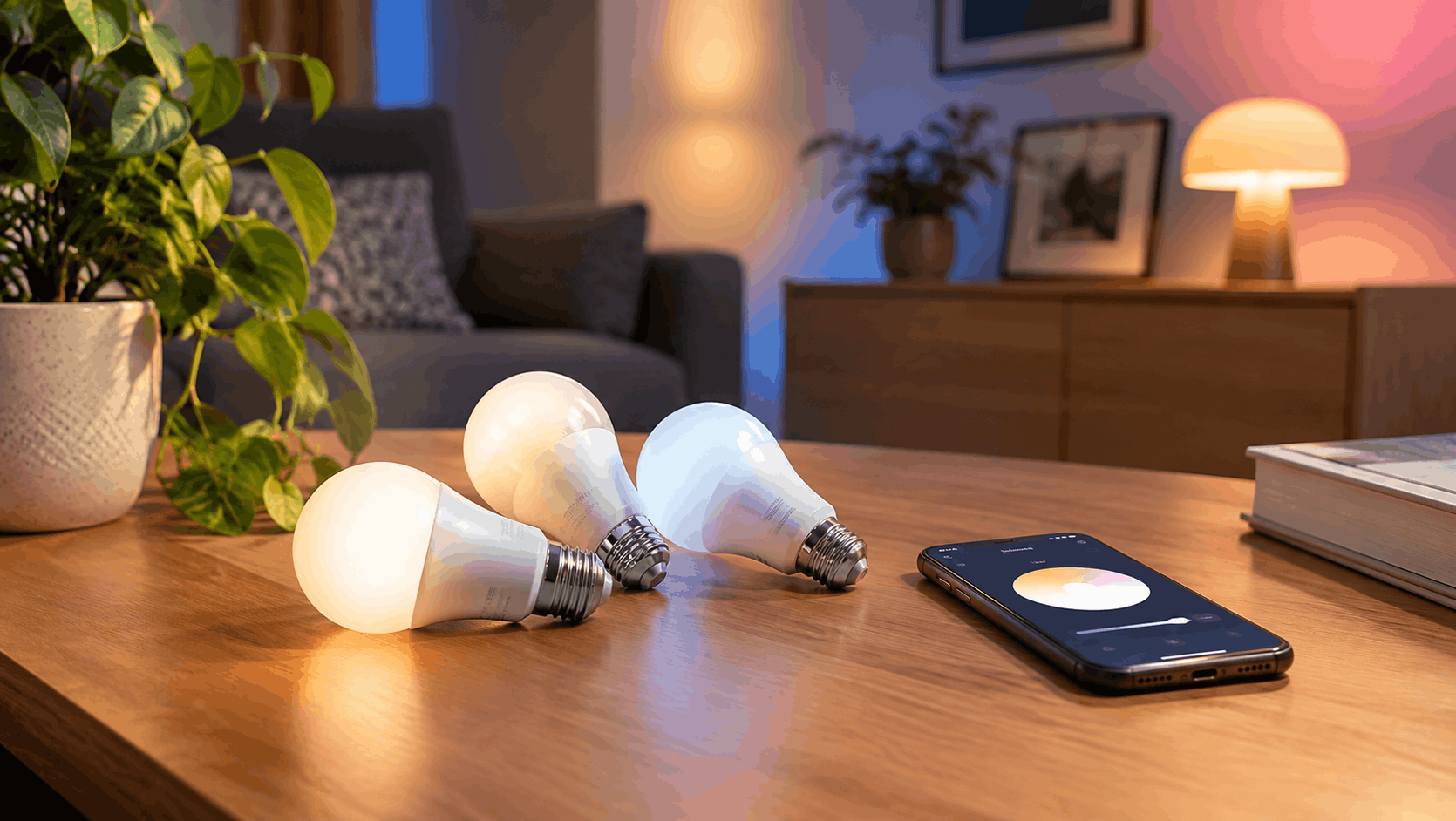
IKEA’s bulb lineup covers more ground than people expect. You can get plain white spectrum bulbs that shift between warm and cool white, or full color bulbs with roughly 16 million color options, in a range of fittings including E26, E27, GU10 spotlights, E14 candle bulbs, and B22 bayonet fittings for UK and Australian sockets.
Lumen output varies by model, running from around 450 lumens up to 1,100 lumens or more on the brighter globe bulbs. For context, a standard 60-watt incandescent bulb puts out roughly 800 lumens, so most of IKEA’s mid-range options land right around that familiar brightness level.
What tends to surprise people is how good the white spectrum tuning feels in daily use. A lot of budget smart bulbs either run too cool and clinical or too warm and dim when you push them toward daylight settings. IKEA’s white spectrum bulbs shift fairly smoothly between about 2,200K and 6,500K, and the transition doesn’t feel jarring the way some cheaper competitors do.
Color accuracy on the full-color bulbs is solid but not exceptional. If you’re doing serious color-accurate work, don’t rely on any smart bulb, including these. For mood lighting, movie nights, or just having a purple glow for a party, they’re more than good enough.
Setup Experience
Setting up individual bulbs with the IKEA Home smart app is genuinely simple. You screw in the bulb, open the app, and it walks you through pairing in under a minute. Adding a hub complicates things slightly, since you’re now pairing the hub to your router and then pairing bulbs to the hub, but IKEA’s instructions are clear enough that most people won’t need outside help.
Where I’ve seen people run into trouble is mixing generations of hardware. If you’ve had an old TRÅDFRI gateway sitting around since 2018 and try to bring newer KAJPLATS bulbs into that same system, compatibility can get messy. The gateway predates a lot of the newer feature set. If you’re starting fresh in 2026, just buy DIRIGERA and skip the older gateway entirely. There’s no reason to deal with legacy hardware when the current hub is the same price and does more.
How It Stacks Up Against the Competition
Philips Hue remains the more polished, more expensive option, and it’s worth being honest about where it still wins. Hue’s app is more refined, its third-party integration ecosystem is larger, and its color bulbs generally edge out IKEA’s on richness and accuracy. If budget isn’t a constraint and you want the smoothest possible experience, Hue is still the safer recommendation.
But the price gap is enormous. A single Hue color bulb often costs more than an entire IKEA starter kit. For most people lighting a bedroom, a hallway, or a living room, the practical difference in daily use doesn’t come close to justifying triple the price. Wirecutter and other reviewers have made similar points over the past couple of years as IKEA’s ecosystem matured, noting the value proposition has become hard to ignore.
Wyze and Govee sit at a similar or slightly lower price point than IKEA, and both can be reasonable choices too. Where IKEA pulls ahead is the Matter and Zigbee openness. Wyze in particular has leaned more heavily on its own cloud ecosystem, which some people are fine with and others actively want to avoid.
Who Should Buy These, and Who Shouldn’t
If you want smart lighting without spending a fortune, and you’re not chasing the absolute best color rendering on the market, this is an easy recommendation. The combination of low bulb prices, genuine Matter support through DIRIGERA, and IKEA’s retail presence in most major cities makes it one of the more approachable entry points into smart home lighting right now.
Skip it if you’re already deep into a Hue ecosystem and don’t want to manage two brands. Mixing systems isn’t impossible with Matter, but it does add a layer of complexity that some people would rather avoid. I’d also steer people away if they need extremely precise, professional-grade color accuracy, since that’s genuinely not the strength here.