






Power 9 Magic Price: What These Cards Actually Cost
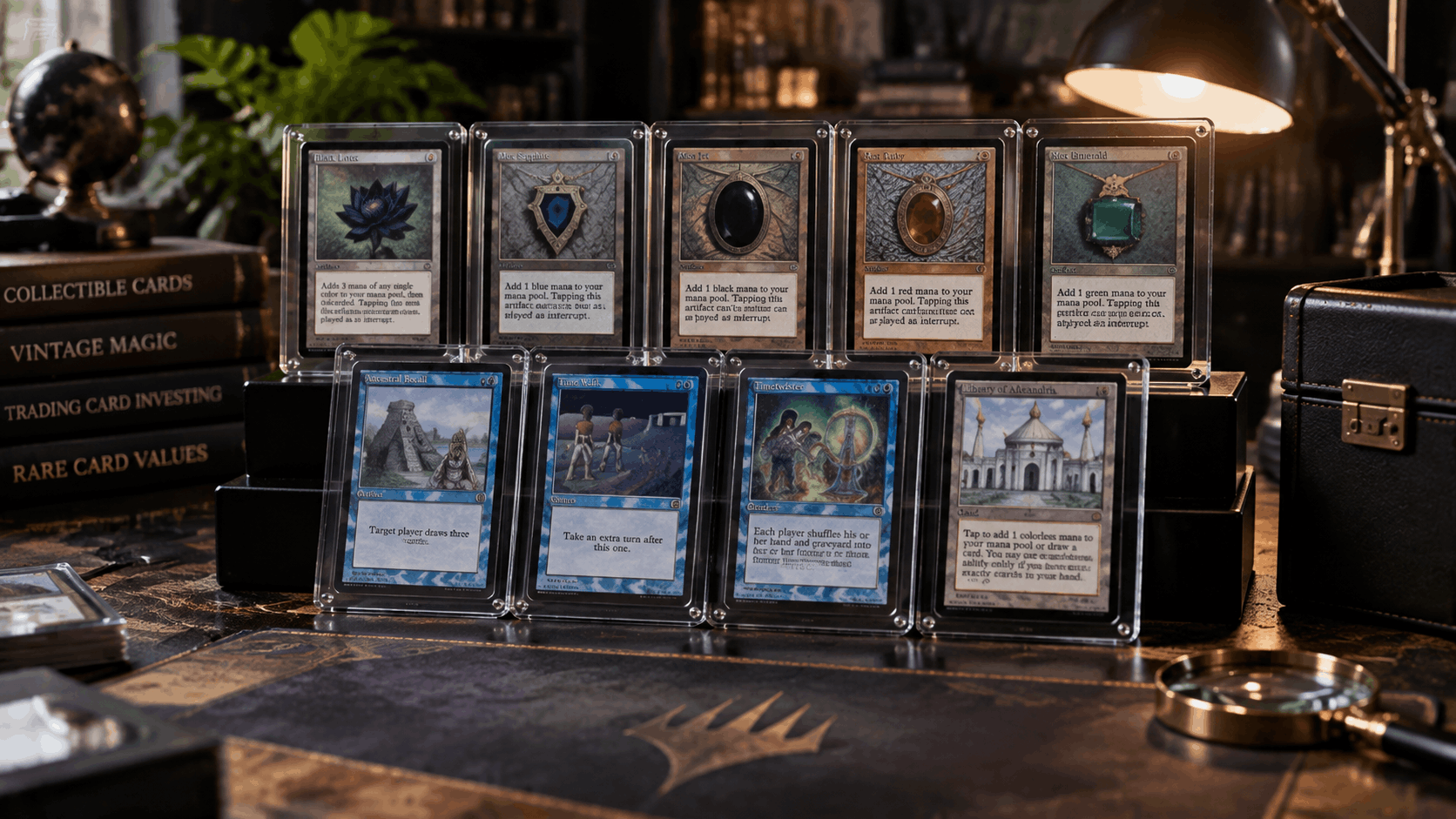
The Power Nine refers to nine cards printed during Magic: The Gathering’s earliest sets between 1993 and 1994: Black Lotus, Ancestral Recall, Time Walk, Timetwister, and the five original Moxen (Mox Pearl, Mox Sapphire, Mox Jet, Mox Ruby, and Mox Emerald). All nine sit on Wizards of the Coast’s Reserved List, a formal commitment never to reprint them, which means the total supply of legitimate copies is permanently fixed. No new ones are coming, ever, and that single fact drives almost everything about how these cards are priced today.
They’re also functionally absurd by modern game design standards. Black Lotus gives you three mana of any color for free, and Ancestral Recall lets you draw three cards for a single mana. Because of that power level, every one of these cards has been banned or restricted in nearly every competitive format they’ve ever been legal in. In my experience, that combination of extreme scarcity and legendary in-game power is exactly why collectors treat these differently than most other vintage cards.
Power 9 Magic Price by Card
Pricing on these cards varies a lot depending on print run (Alpha, Beta, or Unlimited), condition, and whether a copy has been professionally graded. Alpha copies, from the very first print run, consistently command the highest prices because so few exist. Here’s a general sense of where things stand as of 2026, based on recent market tracking and auction data.
Black Lotus sits well above the rest of the group. Played, ungraded Alpha copies tend to land somewhere between $20,000 and $60,000, while pristine graded examples have sold for dramatically more. A CGC-graded Pristine 10 Alpha Black Lotus sold for $3,000,000 in 2024, and Post Malone paid $800,000 for a signed artist’s proof back in 2022. Beta and Unlimited copies sell for considerably less than Alpha, often in the low thousands for played Unlimited examples.
Ancestral Recall generally runs in the $10,000 to $60,000 range depending on edition and grade, with Alpha copies at the top end and Unlimited copies selling closer to the $3,000 to $5,000 mark in recent sales. Time Walk follows a similar pattern, with Alpha copies reaching into the tens of thousands and Unlimited versions often trading around $2,000 to $5,000.
The five Moxen tend to trail Black Lotus and Ancestral Recall in price, though Mox Sapphire is usually the priciest of the group, sometimes reaching $40,000 or more for a high-grade Alpha copy. Mox Pearl is typically the most affordable Mox, though “affordable” is relative here since even played Unlimited copies often still sell in the $1,000 to $4,000 range. Timetwister rounds out the set and has seen rising demand from Commander format players in recent years, which has pushed its price up compared to a few years ago.
One thing worth flagging: these figures move constantly, and different tracking sites report noticeably different ranges depending on which sales they’re pulling from and how recently the data was updated. If you’re buying or selling, checking recent sold listings on a marketplace like TCGplayer will give you a far more accurate real-time number than any single article, including this one.
What Actually Moves the Price
Grading is the single biggest lever on power 9 magic price beyond the base rarity of the card itself. A raw, ungraded copy in played condition might sell for a fraction of what the same card fetches once it’s been slabbed by a service like PSA or CGC and receives a high numerical grade. The jump from a raw card to a PSA 10 or CGC Pristine 10 can multiply the price by two to three times or more, and at the very top end of the market, grading is often what separates a five-figure sale from a seven-figure one.
Print edition matters just as much. Alpha printings are the smallest and most sought-after, followed by Beta, then Unlimited. What tends to surprise newer collectors is just how big that gap can be. An Alpha Black Lotus in similar condition to a Beta copy can sell for more than twice as much, purely because of how few Alpha cards were printed relative to later runs.
Demand from actual gameplay adds a layer most people don’t expect. These cards remain legal (though usually restricted or banned outright) in Vintage and Legacy formats, so some of the buying pressure comes from players who want a real, functional copy rather than a pure collector’s item. Timetwister’s rise in price tracks closely with its usefulness in Commander decks, which is a good example of gameplay relevance affecting a card that’s decades old.
Where and How to Buy Safely
If you’re looking to buy into the Power Nine rather than sell one you already own, stick to established marketplaces and reputable auction houses rather than random online listings. Counterfeits and altered cards do exist in this market, and the stakes are high enough that a professional authentication step is worth the cost. Getting a card graded before a major purchase or sale, or buying one that’s already been graded by a recognized service, removes most of the guesswork around authenticity and condition.
It’s also worth setting a realistic budget expectation before you start shopping. Someone hoping to own a piece of Power Nine history without spending tens of thousands of dollars should look toward played, Unlimited-edition Moxen or a lower-grade Timetwister rather than chasing an Alpha Black Lotus. You’ll still own a genuinely rare, historically significant card, just without the price tag of the most extreme examples.