




Smart Casual Dress Code for Women: What Actually Works
smart casual dress code for women Strip away the noise and smart casual is one simple idea: take a casual outfit and elevate one or two elements until the whole thing reads intentional. That’s it. The smart casual category emerged as workplaces loosened up and people needed a middle ground that wasn’t quite business casual but still signaled effort.
The distinction matters. Business casual leans toward the office and generally rules out denim. Smart casual welcomes denim, as long as the denim is doing its job well: dark, clean, no rips, good fit. The difference between “casual” and “smart casual” often comes down to a single swap. Trade the sneakers for loafers and you’ve crossed the line. Trade the hoodie for a knit blazer and you’ve crossed it from the other direction.
What tends to surprise people is how much the fabric does the heavy lifting. A cotton-poplin shirt and a jersey t-shirt can have identical silhouettes, but one reads polished and the other reads weekend. Structure, drape, and finish communicate more than the garment category does.
The Three-Part Framework That Makes This Easy
Here’s how I think about building any smart casual outfit. You’re working with a foundation, a lift, and a finish.
The foundation is your base layer, usually the top and bottom. This is where casual is allowed to live. Straight-leg dark jeans, tailored trousers, a midi skirt, a simple knit dress.
The lift is the structured piece that pulls everything upward. A blazer is the classic answer, and there’s a reason the blazer has survived every fashion cycle since the nineteenth century. But a tailored trench, a leather jacket, a structured cardigan, or a well-cut waistcoat all do the same work.
The finish is footwear and accessories. This is where most smart casual outfits succeed or fall apart, and it’s also the cheapest place to fix a look that isn’t landing.
Get two of the three right and you’re fine. Get all three right and you look like you thought about it, which is the actual goal.
Outfit Formulas That Work Almost Everywhere
Rather than describing individual garments, it’s more useful to think in combinations you can rotate.
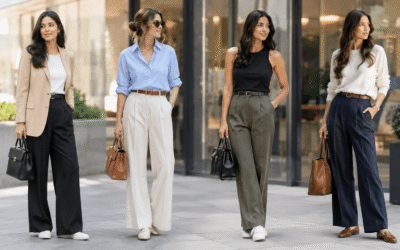
Dark denim, silk-blend blouse, loafers. The workhorse. Works for weekend brunch, gallery openings, casual Friday, and dinner with people you want to impress mildly. Swap loafers for ankle boots when it’s cold.
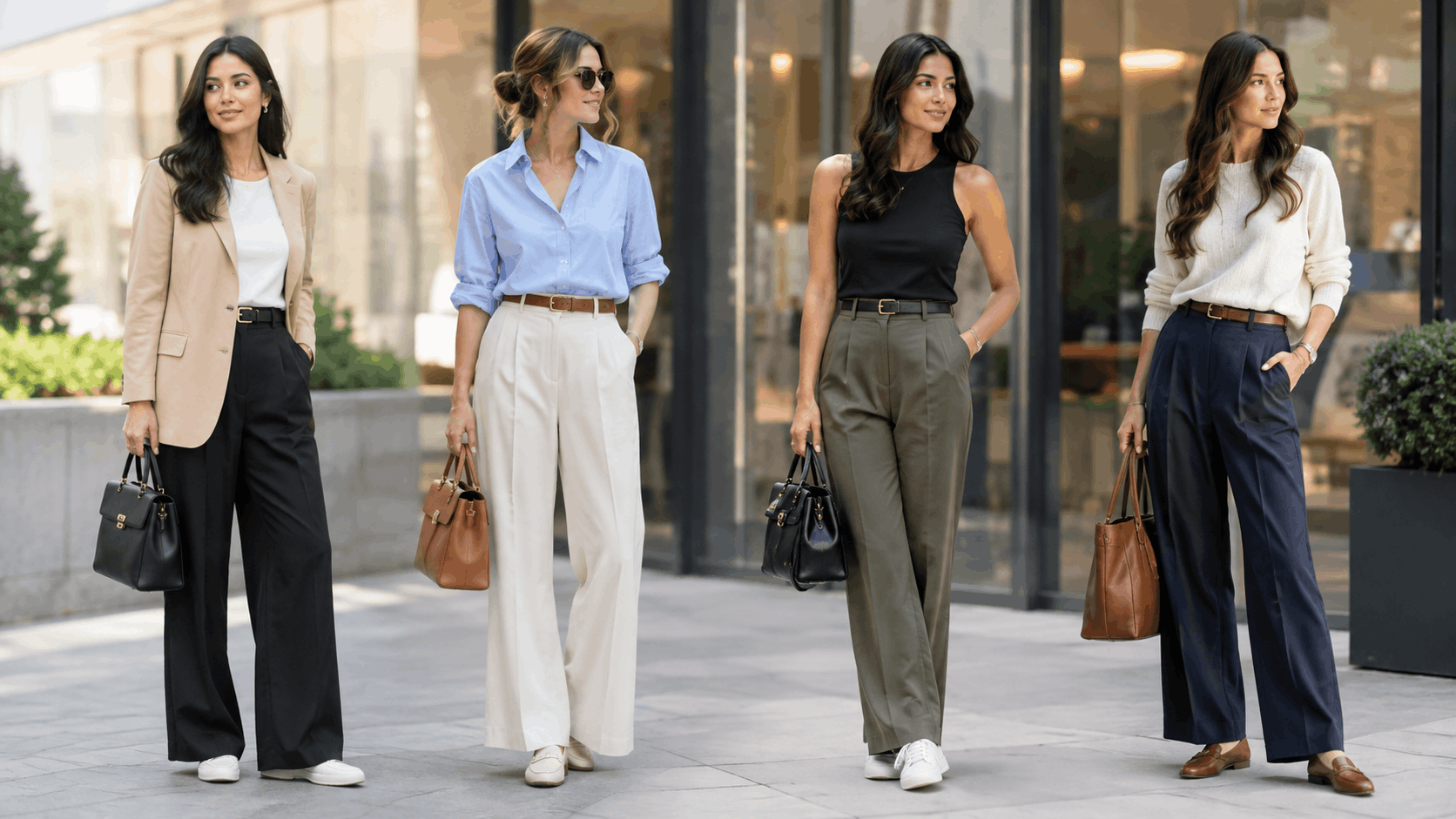
Tailored trousers, fitted knit, mules. Reads more polished than jeans without tipping into corporate. Wide-leg trousers in a fluid fabric have been particularly strong lately, and they’re forgiving in a way that pencil-cut trousers aren’t.
Midi dress, denim or leather jacket, flat sandals or boots. The easiest option because the dress does the work. A simple slip or shirt dress with a structured jacket over it handles almost any daytime smart casual situation.
Trousers, crisp button-down, blazer over shoulders. More formal end of the range. Good for client-facing work or a smart casual wedding where you’d rather be slightly over than under.
Pleated midi skirt, fine-gauge sweater, clean white sneakers. Yes, sneakers can work, but only minimal leather ones in white or a neutral tone, and only when the rest of the outfit is dressed up enough to balance them. This is the riskiest formula on the list and the one most likely to go wrong.
One thing worth flagging: the sneaker question is genuinely contested. Some workplaces and social circles have fully accepted clean leather sneakers as smart casual footwear. Others haven’t. If you don’t know the room, don’t test it there.
Smart Casual Dress Code for Women: Office vs. Evening
The same two words mean different things at 10am and 7pm, and pretending otherwise is how people end up uncomfortable.
| Context | Lean toward | Avoid |
|---|---|---|
| Office / daytime work | Tailored trousers, blazer, loafers, muted palette | Anything sheer, strappy, or high-shine |
| Client meeting | Structured layers, closed-toe shoes, minimal jewelry | Distressed denim, graphic prints |
| Evening dinner | Silk, satin, darker tones, heeled boots or mules | Heavy office blazers, obvious workwear |
| Smart casual wedding | Midi dress, elevated separates, statement accessory | Jeans, sneakers, white or ivory |
| Weekend social | Dark denim, knitwear, ankle boots | Anything you’d describe as loungewear |
The evening shift is mostly about fabric and tone. Same trousers, different top, different shoes. A satin camisole instead of a cotton shirt changes the entire register without changing the silhouette. This is the single most efficient wardrobe trick in the smart casual range, and once you internalize it you can pack for a three-day trip in a carry-on.
Publications like Vogue’s fashion coverage track these shifts closely, though I’d treat runway-adjacent advice as inspiration rather than instruction. Most real-world smart casual dressing is quieter than what gets photographed.
Fabric and Fit Matter More Than the Garment
I’d argue fit is where the smart casual dress code for women is won or lost, more than any individual item choice.
A blazer that doesn’t sit right at the shoulder undermines everything underneath it. Trousers that break awkwardly at the ankle make expensive shoes look cheap. And oversized is a deliberate silhouette, not an excuse for a bad fit. There’s a visible difference between a jacket cut generously on purpose and one that’s simply too big.
On fabric, a few things consistently read as elevated: wool and wool blends, silk and silk blends, structured cotton, good leather, fine-gauge knits. A few consistently read as casual regardless of cut: jersey, fleece, heavy sweatshirt cotton, anything with visible pilling.
Color plays a role too. Deeper and more muted tones generally read smarter than bright ones, though a single strong color against neutrals often looks more considered than an all-neutral outfit. Navy, charcoal, camel, cream, olive, and burgundy are reliable. That doesn’t mean you have to dress like a minimalist, but if you’re unsure, restraint wins.
Accessories: The Cheapest Upgrade Available
In my experience, people spend too much attention on clothes and not enough on the pieces that frame them.
A structured bag instead of a slouchy tote changes an outfit meaningfully. So does a leather belt that matches your shoes, or a watch instead of a fitness tracker. Jewelry should feel deliberate rather than accumulated, which usually means fewer pieces with more presence.
Shoes deserve the most attention. Loafers, ankle boots, block-heel mules, pointed flats, and Chelsea boots all sit comfortably in the smart casual range. Flip flops, running trainers, and anything visibly worn out sit outside it. If your budget is limited, put it into shoes and a bag before you put it into another top.
Common Mistakes with the Smart Casual Dress Code for Women
A few patterns come up repeatedly.
Going fully casual and hoping the blazer saves it. A blazer over leggings and a t-shirt doesn’t become smart casual. The foundation has to hold up on its own.
Overdressing out of anxiety. A full suit or a cocktail dress at a smart casual event is its own kind of misread, and it can make other people feel underdressed. Being slightly over is safer than being under, but there’s a limit.
Ignoring context entirely. Smart casual in a Milan design studio, a Dublin law firm, and a Texas tech company are not the same outfit. If you’re new to a workplace or a city, watch what people who are good at this actually wear, then calibrate.
Buying trend pieces for a dress code that rewards durability. Smart casual dressing rewards a small set of well-fitting basics you rotate constantly. Outlets like Harper’s Bazaar’s fashion section cover trends well, but the backbone of a smart casual wardrobe should be boring in the best sense.
Forgetting grooming and condition. Scuffed shoes, a wrinkled shirt, a coat that’s shedding lint. None of this is about the clothes themselves, and all of it reads instantly.
Building a Small Smart Casual Wardrobe
If you’re starting from close to zero, here’s roughly the order I’d buy in.
A well-fitting blazer in navy or black. Dark straight-leg jeans. Tailored trousers in a neutral. Two or three quality tops with some structure or drape. Leather loafers or ankle boots. A midi dress that works with a jacket. A structured bag in a neutral.
That’s seven purchases, and they combine into well over a dozen distinct outfits. The math works because smart casual dressing is fundamentally about recombination rather than volume.
Spend the most on the blazer, the shoes, and the trousers. Those three are where quality is most visible and where poor construction shows fastest.