







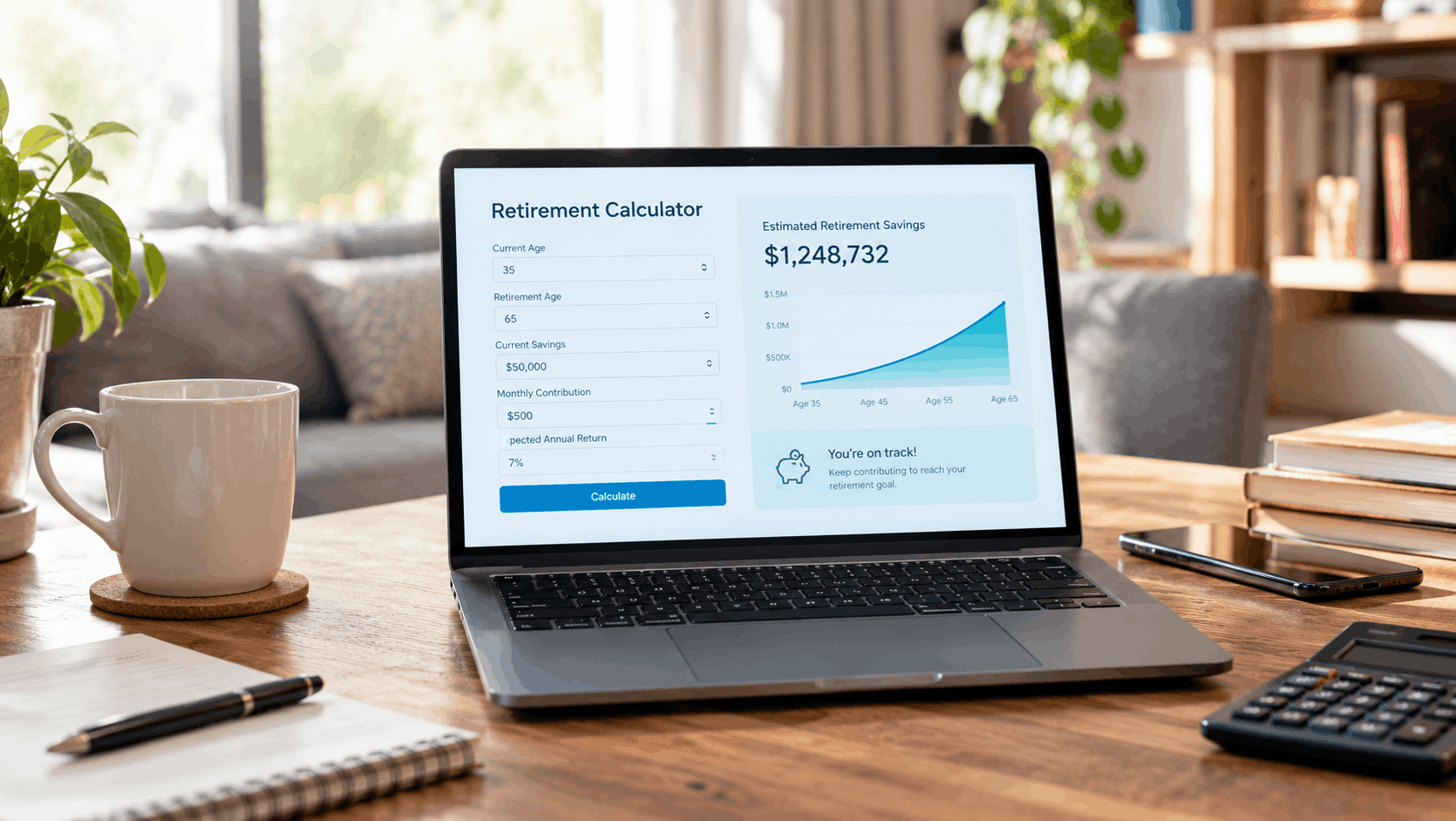
Ramsey Retirement Calculator: Is It Realistic? (2026)
Ramsey Solutions offers a free online retirement calculator built around the company’s investing philosophy. You enter your age, your income, your current savings, and how much you contribute. It projects what you could have by retirement and what that might support in yearly income.
It’s built for people who want a quick gut check, not a spreadsheet with forty tabs. You won’t find sliders for Roth conversions, pension offsets, or sequence-of-returns risk. That’s a feature if you’re a beginner and a limitation if you’re within ten years of retiring. Pricing and features can change, so check the official page for what’s currently offered. As of October 2026, I’d expect the basic calculator to remain free, but confirm that yourself.
What surprises most people is how little the tool asks. Less input means a cleaner experience, but it also means the output leans heavily on assumptions you didn’t choose.
The Assumptions Behind the Numbers
Here’s where I’d slow down. Dave Ramsey has long advised investing 15% of your gross household income in retirement accounts once you’ve cleared his earlier Baby Steps (a starter emergency fund and non-mortgage debt). That 15% rule is simple and sensible. It’s the return assumption that gets debated.
Ramsey’s public material has leaned on average annual returns in the 10% to 12% range, based on long-term stock market history. The S&P 500 has produced strong long-run nominal returns, but a 12% figure is on the optimistic end, and it ignores inflation. Most mainstream planners use something closer to 5% to 7% after inflation for a diversified portfolio.
Ramsey has also talked about withdrawing around 8% of your nest egg per year in retirement. The widely cited Trinity study pointed toward roughly 4% as a historically durable withdrawal rate over 30 years. That’s a big gap, and it’s the single most important thing to understand before you trust any projected retirement income.
A Worked Example: Same Person, Two Futures
Say you earn $60,000 a year and put 15% into retirement. That’s $9,000 a year, or $750 a month, for 30 years.
At a 7% average return, that grows to roughly $915,000. At 12%, it balloons to somewhere around $2.6 million. Same person, same discipline, nearly three times the result, purely from the return assumption.
Now apply withdrawals. Four percent of $915,000 is about $36,600 a year. Eight percent of $2.6 million is over $200,000 a year. One of those plans feels safe. The other feels like a lottery ticket that happened to hit.
I’m not saying the higher number is impossible. I’m saying you shouldn’t build your only plan around it. In my experience, people who anchor on the rosiest projection tend to under-save in the years when it matters most.
How to Use the Ramsey Retirement Calculator Without Fooling Yourself
Run it twice. Once with the default assumptions and once with a conservative return, say 6% or 7%. If you can only retire comfortably under the optimistic scenario, you’ve found a gap worth closing now.
Treat the output as a range rather than a promise. Then do three practical things:
- Convert the result into today’s dollars so you know what that future income buys.
- Add your expected Social Security from the SSA’s retirement benefits planner, since a simple calculator may not capture it well.
- Subtract any big known expense, like a mortgage that won’t be paid off by retirement.
One thing worth flagging is that Ramsey’s framework assumes you’re debt-free and on solid footing first. If you’re carrying credit card balances, the calculator’s future looks great, but your present doesn’t match its starting conditions.
Where It Works Well
It works well if you’re in your twenties or thirties and need to see why starting early matters. Watching a small monthly contribution turn into six or seven figures is motivating, even if you haircut the exact number. It also suits anyone who finds financial planning intimidating. A short form beats an abandoned spreadsheet every time.
It’s also good for couples who need a shared starting point. Plugging in joint income and a 15% target gives you something concrete to discuss without a three-hour money meeting.
Where It Falls Short
If you’re mid-career or close to retirement, the tool is too blunt. It doesn’t model taxes in any detail, so it can’t tell you whether pre-tax or Roth accounts make more sense for you. It doesn’t account for early retirement, part-time work, health care costs before Medicare, or a market crash right as you start withdrawing.
That last one matters more than people expect. Two investors can earn identical average returns and end up in very different places depending on when the bad years land. A basic calculator can’t show you that.
And the investment advice baked into the broader Ramsey ecosystem, such as spreading money evenly across four fund types and favoring actively managed funds, is a point of real disagreement. Many planners prefer low-cost index funds, and I lean that way too.
Alternatives Worth Trying
If you want a second opinion, the compound interest calculator at Investor.gov lets you set your own return and contribution schedule, which makes it easy to test conservative scenarios. It comes from the U.S. Securities and Exchange Commission, so it’s neutral and ad-free.
Brokerage tools from Fidelity, Vanguard, and Schwab go further with account-level projections, Monte Carlo simulations, and tax assumptions. They’re free if you have an account with them. Spreadsheet-minded folks can build their own in an hour and control every variable. For anyone with a complicated picture, a fee-only fiduciary advisor beats any online tool.
Should You Use the Ramsey Retirement Calculator?
Yes, as a starting point, and with your eyes open. It’s quick, free, and good at making retirement feel reachable. The 15% savings target it’s built on is a solid habit regardless of what return you assume.
But don’t plan your actual retirement income around a 12% return or an 8% withdrawal rate. Run the numbers at 6% to 7%, cross-check with Social Security estimates, and decide whether the plan still works. If it does, you’re in good shape. If it only works in the best-case version, keep saving more or plan to retire a little later.