





Leica SL2 Review: Is This Full-Frame Icon Still Worth It?
If you’ve spent any time browsing used camera listings lately, you’ve probably noticed something odd: the Leica SL2 keeps popping up at prices that would’ve seemed impossible a few years ago. This 47-megapixel full-frame beast used to sit at nearly $6,000 body-only. Now you can find clean used copies for a fraction of that. So the real question isn’t whether the Leica SL2 is a good camera. It obviously is. The question is whether it still deserves a spot in your bag in 2026, with newer Leica bodies and a flooded used market to compete against.
I’ll walk through what this camera actually does well, where it falls short, and who should (and shouldn’t) bother chasing one down.
What the Leica SL2 Actually Is
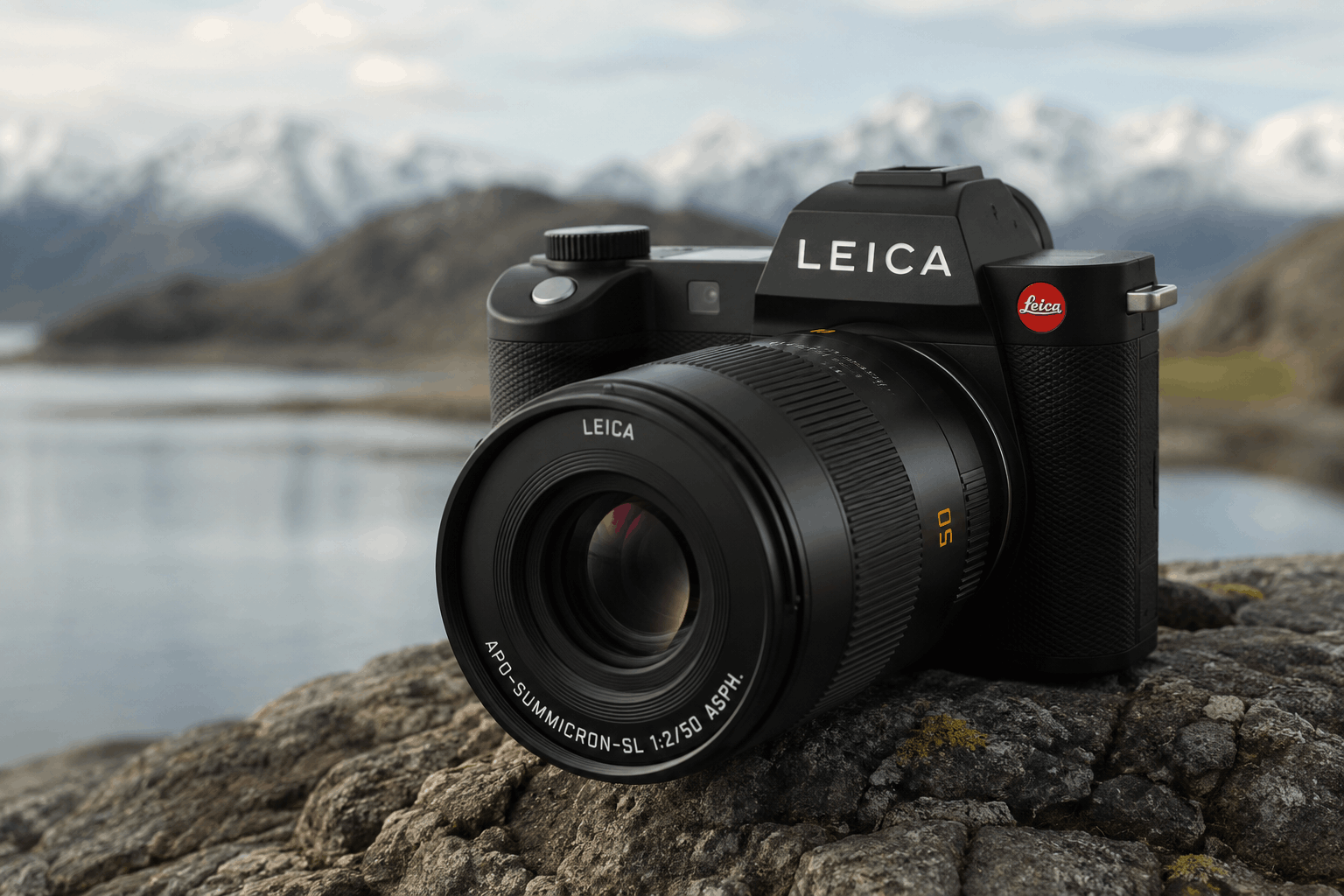
Announced back in November 2019, the Leica SL2 was Leica’s answer to the growing full-frame mirrorless arms race that Sony, Nikon, and Canon were already deep into. It replaced the original SL (which, frankly, felt a bit half-baked by comparison) with a completely redesigned body, a much-improved autofocus system, and a jump to a 47.3-megapixel full-frame BSI CMOS sensor paired with Leica’s Maestro III processor.
It uses the L-mount, which is shared with Panasonic and Sigma thanks to the L-Mount Alliance. That’s actually one of the more underrated parts of owning an SL2. You’re not locked into Leica-only glass (though Leica really wants you to buy Leica-only glass, and it shows in the pricing).
The SL2 sits in an interesting spot in Leica’s current lineup. It was eventually joined by the SL2-S (a lower-resolution, faster sibling aimed at video and low-light work), and then both were succeeded by the Leica SL3 in 2024 and the SL3-S in 2025. So the SL2 is no longer the flagship. It’s aged into more of a “excellent value if you catch it at the right price” position, which honestly suits it fine.
Design and Build Quality
This is where Leica earns its reputation, and the SL2 doesn’t disappoint. The body is milled from a solid block of aluminum, which sounds like marketing fluff until you actually hold one. It’s dense in a way that feels intentional rather than heavy for no reason. The minimalist control layout, just a handful of buttons and dials, takes some adjustment if you’re coming from a Sony or Canon body loaded with customizable buttons everywhere.
What tends to surprise people switching from other systems is how quiet the menu system is. Leica stripped things down hard here. There’s no dedicated mode dial cluttered with symbols; instead you get a clean top plate with basically two dials and a shutter button. Some photographers find this liberating. Others find it frustrating when they want quick access to a specific setting buried three menu levels deep.
The SL2 also carries an IP54 weather rating, which in plain terms means it shrugs off dust and light rain without a second thought. I’ve seen plenty of anecdotal reports of people shooting this camera in genuinely nasty weather with zero issues, and that tracks with how Leica builds its pro-oriented bodies generally.
Specifications Worth Knowing
Here’s the core spec sheet, since these matter for anyone comparing against competitors:
- 47.3MP full-frame BSI CMOS sensor
- Maestro III image processor
- 5-axis in-body image stabilization (IBIS)
- ISO range of 50 to 50,000
- 3.2-inch touchscreen, 2.1 million dot resolution
- 5.76 million dot EVF, one of the sharpest on the market at launch
- Dual SD card slots
- USB-C, Wi-Fi, Bluetooth, GPS via the FOTOS app
- Weight around 928g body only
That 47MP sensor is genuinely the standout number here. It gives you enormous flexibility for cropping, large prints, or commercial work where clients expect resolution headroom. But it’s also worth flagging that this resolution comes with tradeoffs in low light, which is exactly why Leica introduced the lower-res SL2-S alongside it.
Image Quality and Autofocus
Image quality out of the SL2 is where Leica’s reputation for color science actually pays off. Files have a distinct, slightly warmer rendering that a lot of photographers describe as more “filmic” straight out of camera, before any editing. Dynamic range is strong, comfortably competitive with what Sony’s A7R series was offering around the same generation.
Autofocus is the more complicated story. The SL2 uses contrast-detection AF rather than the hybrid phase-detection systems that Sony and Canon had already refined by 2019. In practice, this means single-point focus for static subjects is fine, even good. But continuous autofocus tracking for moving subjects, sports, kids running around, wildlife, lags noticeably behind what you’d get from a comparable Sony body. This is the single biggest limitation of the camera, and it’s not something firmware updates ever fully solved.
If your work leans toward landscapes, portraits, studio work, or architecture, this won’t bother you much. If you’re shooting fast action regularly, the SL2 will frustrate you.
Video Performance
The SL2 records 4K video at up to 60fps, with support for L-Log and both Rec709 and Rec2020 color spaces added in later firmware. It’s a genuinely capable video tool, not an afterthought bolted onto a stills camera. Mic input and headphone output round out the package for anyone doing serious production work.
That said, if video is your primary use case, the SL2-S is the better pick within Leica’s own lineup. Its lower-resolution 24.6MP sensor handles rolling shutter and low-light video noticeably better, and it was more explicitly designed with hybrid shooters in mind.
Battery Life and Handling in the Field
Battery life sits in the “acceptable but not exceptional” range for full-frame mirrorless, roughly 370 shots per charge under CIPA testing, though real-world use (especially with the EVF on constantly) tends to run lower. Carrying a spare battery is basically mandatory for a full day of shooting, which is standard advice for most mirrorless systems at this point, not a specific SL2 problem.
Handling-wise, the grip is shallower than what you’d find on a Sony or Canon equivalent. It’s not uncomfortable, but photographers with larger hands sometimes find longer shooting sessions a bit more tiring without an added grip accessory.
Price and Availability
Here’s where things get genuinely interesting for anyone considering this camera today. At launch, the Leica SL2 carried an MSRP of $5,995 body-only in the US and around €6,000 in Europe. That was steep even by full-frame mirrorless standards.
As of mid 2026, prices have dropped considerably following the release of the SL3 and SL3-S. New units can occasionally be found in the $4,000 to $4,900 range during promotions, while used copies in good condition regularly sell for $2,300 to $3,000 depending on shutter count and included accessories. Since Leica pricing shifts with promotions and stock levels, it’s worth checking the official Leica online store directly for current figures before assuming any number you read online is still accurate.
Pros and Cons
The strengths are real: exceptional build quality, a genuinely gorgeous 47MP sensor, one of the best EVFs of its generation, solid weather sealing, and access to the growing L-mount ecosystem including affordable Sigma and Panasonic lenses.
The weaknesses are also real: autofocus tracking that trails the competition, a menu system that takes getting used to, no in-camera lens correction for third-party glass in some cases, and pricing that, even discounted, remains high relative to what Sony or Nikon charge for comparable resolution.
Alternatives Worth Considering
The Sony A7R V is the obvious comparison point at similar resolution, with vastly superior autofocus tracking and a lower price tag, though it lacks the tactile build quality and color rendering that draws people to Leica in the first place. The Leica SL2-S is worth a look if you want the same body and handling with better low-light and video performance. And if budget allows, the newer SL3 brings phase-detection autofocus finally into Leica’s SL lineup, addressing the SL2’s biggest weakness, though at a higher price point than a used SL2.
Who Should Buy the Leica SL2
This camera makes the most sense for photographers who prioritize image quality, resolution, and build over autofocus speed. Portrait photographers, landscape shooters, studio work, and anyone who values the distinct Leica color rendering will get real value here, especially at current discounted prices. If you’re chasing fast-moving subjects or need best-in-class autofocus, spend your money elsewhere.
FAQs
Is the Leica SL2 still worth buying in 2026? At current discounted prices, yes, particularly for stills-focused photographers who don’t need cutting-edge autofocus tracking.
What’s the difference between the Leica SL2 and SL2-S? The SL2 has a 47.3MP sensor optimized for resolution, while the SL2-S drops to 24.6MP for better low-light performance and faster continuous shooting.
Does the Leica SL2 use the same lenses as other L-mount cameras? Yes. It shares the L-mount with Panasonic and Sigma cameras, so you can use lenses from all three brands.
Is the Leica SL2 good for video? It handles 4K up to 60fps well, but the SL2-S or SL3-S are better suited if video is your main priority.