






Watch Repair Guide: Costs, Services, and Shop Tips
A watch repair can cost as little as a basic battery replacement or several hundred dollars for a complete mechanical overhaul. The final bill depends on the movement, brand, complications, damage, parts availability, water-resistance requirements, and whether the work is performed by a local watchmaker or an authorized manufacturer service center.
Current official US service examples show the size of that range. Tissot lists a $35 light service, a $130 complete service for a standard quartz watch, a $210 complete service for a basic mechanical model, and $310 for a mechanical chronograph. Seiko lists complete movement service at $137 for many 7S and 2R mechanical calibers, $176 for 4R calibers, $296 for 6R calibers, and substantially more for advanced Spring Drive movements. These figures apply to those brands and service programs, not to every watch shop.
A stopped quartz watch may need only a battery. A mechanical watch that loses time, stops repeatedly, or has moisture under the crystal may require a full assessment. Cracked crystals, damaged crowns, loose hands, failed seals, worn bracelets, and scratched cases are also common service requests.
The safest approach is to obtain a written estimate after inspection, understand whether refinishing is included, and confirm that water resistance will be tested whenever the case is opened.
Watch Repair at a Glance
| Problem | Likely service | Urgency |
|---|---|---|
| Quartz watch stopped | Battery test and replacement | Normal unless moisture is visible |
| New battery did not fix it | Movement and electrical diagnosis | Schedule service |
| Mechanical watch stops overnight | Winding, power-reserve, or movement assessment | Schedule service |
| Watch suddenly gains or loses substantial time | Regulation, magnetism check, or movement service | Schedule promptly |
| Moisture under the crystal | Immediate drying and internal inspection | Urgent |
| Cracked crystal | Crystal replacement and internal inspection | Prompt |
| Crown pulls out or will not screw down | Crown, stem, or tube repair | Stop exposing it to water |
| Loose or misaligned hands | Hand refitting and movement inspection | Stop wearing if hands touch |
| Bracelet pin or clasp is loose | Bracelet or clasp repair | Prompt to prevent loss |
| Scratched case | Optional refinishing | Cosmetic |
| Smartwatch screen or battery failure | Manufacturer or authorized device service | Model-dependent |
| Vintage watch with unknown history | Specialist inspection before operation | Do not force or overwind |
What Does Watch Repair Include?
“Watch repair” can refer to a small external service or a complete movement overhaul.
Battery replacement
A basic quartz battery service may involve:
- Opening the case
- Identifying the correct battery
- Checking the old cell for leakage
- Installing a fresh cell
- Confirming movement operation
- Inspecting the gasket
- Closing the case correctly
- Testing water resistance where equipment and watch design allow
Battery replacement becomes more involved when the watch has a screw-down case back, unusual case design, alarm function, perpetual calendar, chronograph, digital module, or high water-resistance rating.
Casio advises owners to use a retailer or authorized service center for battery replacement and to request a water-resistance inspection at the same time. Citizen states that battery-operated water-resistant models should be tested and resealed whenever the battery is changed.
Mechanical movement service
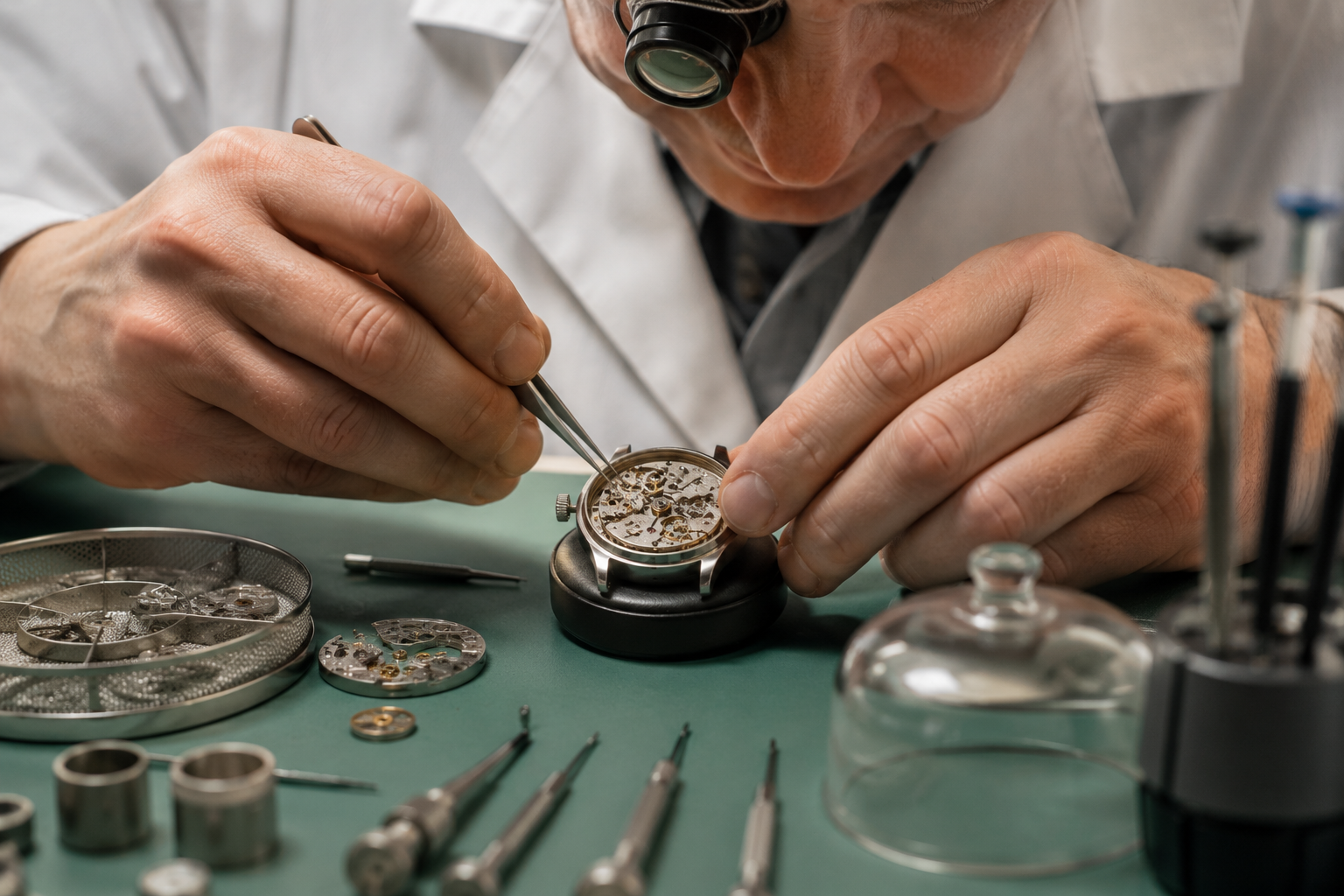
A complete mechanical service normally involves:
- Removing the movement from the case
- Disassembling the movement
- Cleaning components
- Inspecting parts for wear or damage
- Replacing approved worn parts
- Reassembling and lubricating the movement
- Adjusting accuracy
- Testing power reserve and function
- Replacing relevant seals
- Reassembling and testing the watch
Rolex describes a complete manufacturer service that separates the movement, case, and bracelet, fully dismantles and cleans the movement, replaces parts that no longer meet specification, lubricates and adjusts the mechanism, renews seals, tests water resistance, and performs final timing checks.
A local watchmaker may follow a similar general process, but the included work, testing equipment, replacement-part policy, warranty, and refinishing choices can differ.
Quartz movement service
A quartz watch can need more than a battery.
Possible faults include:
- Battery leakage
- Damaged contacts
- Coil failure
- Worn gear train
- Water damage
- Circuit failure
- Dirt or dried lubricant
- Motor problems
- Damaged calendar mechanism
- Failed buttons or pushers
Some inexpensive quartz movements are replaced as complete units rather than rebuilt. More valuable, vintage, or specialized quartz movements may justify component-level service.
Crystal replacement
A watchmaker may replace:
- Acrylic crystal
- Mineral crystal
- Sapphire crystal
- Domed crystal
- Shaped crystal
- Display case back
A cracked crystal should be addressed promptly. Small fragments can enter the dial or movement, while a damaged seal can allow moisture and dust into the case.
The replacement must match the case dimensions, thickness, shape, gasket system, optical treatment, and water-resistance design. Installing a crystal that merely appears to fit does not prove that the watch remains water resistant.
Crown and stem repair
The crown is used to wind the watch and set its time or calendar. The stem connects it to the movement.
Common problems include:
- Crown pulls completely out
- Crown spins without changing the hands
- Stem is bent or broken
- Screw-down crown no longer engages
- Crown feels unusually tight
- Watch will not wind
- Water-resistant seal is damaged
- Crown is missing
A screw-down crown problem may also involve the case tube. Replacing only the visible crown may not solve worn threads or sealing damage.
Avoid swimming or showering with the watch until the crown system has been repaired and pressure-tested.
Hands and dial work
Watch hands may become:
- Loose
- Misaligned
- Bent
- Corroded
- Detached
- Positioned incorrectly after previous work
- Locked against each other
- Scraping the dial or crystal
The watch should be stopped when possible if the hands touch each other or the dial. Continued movement can scratch the surface or damage the hand-setting components.
Dial refinishing is a separate restoration decision. Repainting an original vintage dial can materially change its appearance and collector appeal, so no cosmetic work should be authorized without a clear explanation.
Bracelet and strap repair
A watch shop may provide:
- Bracelet sizing
- Link installation or removal
- Pin and collar replacement
- Screw replacement
- Clasp adjustment
- Spring-bar replacement
- Strap replacement
- Buckle transfer
- Bracelet cleaning
- End-link adjustment
A loose bracelet pin or damaged spring bar can cause the entire watch to fall from the wrist. This is a small repair that should not be postponed.
Water-resistance service
Water resistance depends on the complete case system, including:
- Crystal
- Case back
- Crown
- Pushers
- Gaskets
- Tubes
- Correct assembly
- Case condition
Opening a watch can disturb its seals. A qualified shop should inspect the gaskets and perform the appropriate pressure test before representing the watch as water resistant.
Rolex’s official process includes seal replacement and more than one waterproofness check. Seiko’s movement service includes gasket replacement and water-resistance testing, although Seiko warns that water resistance cannot always be guaranteed on older models when cases are damaged or correct gaskets are no longer available.
Current Watch Repair Cost Examples
There is no reliable single national price covering every watch. A basic quartz model, mechanical chronograph, vintage watch, luxury dive watch, and smartwatch require different labor, parts, and equipment.
The table below uses official US prices published by watch brands as of August 4, 2026.
| Service example | Published price |
|---|---|
| Tissot light service | $35 |
| Tissot standard quartz partial service | $60 |
| Tissot quartz chronograph partial service | $70 |
| Tissot standard quartz complete service | $130 |
| Tissot standard mechanical complete service | $210 |
| Tissot mechanical chronograph complete service | $310 |
| Seiko standard analog quartz service | $100–$135 |
| Seiko 7S or 2R mechanical service | $137 |
| Seiko 4R mechanical service | $176 |
| Seiko 6R mechanical service | $296 |
| Seiko 8R mechanical service | $373 |
| Seiko 5R6 Spring Drive service | $630 |
| Seiko 5R8 Spring Drive service | $1,105 |
| Shinola battery | $35 |
| Shinola quartz crystal | $50 |
| Shinola mechanical crystal | $75 |
| Shinola standard quartz movement service | $76 |
| Shinola standard mechanical service | $275 |
| Shinola mechanical chronograph service | $550 |
Tissot notes that shipping and extra parts may not be included, and independent authorized centers may set different prices. Seiko excludes tax, shipping, insurance, and additional requested parts. Shinola states that every repair is assessed individually and that listed prices are general guides.
Why one repair quote can be much higher
A quote can increase because of:
- Chronograph or alarm complications
- Proprietary movement
- Luxury-brand labor rates
- Limited parts access
- Water or corrosion damage
- Damaged dial or hands
- Replacement crown, crystal, pushers, or bracelet
- Gold, ceramic, titanium, or carbon case
- Vintage restoration
- International shipping
- Manufacturer-only service
- Required cosmetic replacement parts
- Previous improper repairs
Ask for an itemized estimate separating required movement work from optional refinishing and cosmetic parts.
Repair, Partial Service, or Complete Service?
Simple repair
A simple repair addresses one limited issue, such as:
- Battery replacement
- Spring-bar replacement
- Strap installation
- Bracelet sizing
- Minor clasp adjustment
It does not automatically include full movement diagnosis, seal replacement, or extended performance testing.
Partial service
A partial service may include external cleaning, gasket replacement, pressure testing, battery replacement, or timing adjustment without fully dismantling the movement.
Tissot’s current partial-service description includes case and bracelet cleaning, restoration of water resistance, battery replacement for quartz models, and rate adjustment for mechanical watches.
Complete service
A complete service addresses the movement as a complete mechanism.
It usually includes:
- Full disassembly or movement replacement
- Cleaning
- Lubrication
- Inspection
- Necessary movement parts
- Accuracy adjustment
- Gaskets
- Case testing
- Functional testing
Before approving a complete service, ask whether the shop rebuilds your original movement or replaces it with another unit. Either approach can be valid, but vintage collectors and owners of sentimental watches may have a strong preference.
Signs Your Watch Needs Professional Repair
It stopped running.
A stopped watch can have several causes.
For a quartz watch:
- Battery is depleted
- Battery leaked
- Contacts are dirty
- Movement has failed
- Water entered the case
A solar watch:
- Charge is too low
- Rechargeable cell has deteriorated
- Charging system has failed
- Watch has been stored in darkness
- Movement has another fault
For a mechanical watch:
- It needs winding
- Automatic rotor is not generating enough reserve
- Lubricants have aged
- Mainspring or gear train is damaged
- Movement has suffered impact, moisture, or magnetism
Confirm the movement type before assuming every stopped watch needs a disposable battery.
It gains or loses time
Mechanical watches do not normally match quartz accuracy, but a sudden change from their usual performance deserves attention.
Possible causes include:
- Magnetism
- Impact
- Poor regulation
- Low power reserve
- Worn movement parts
- Dried or displaced lubricant
- Temperature effects
- Water or contamination
Record the change over several days in the watch’s normal wearing position. This gives the watchmaker more useful information than saying only that it “runs badly.”
Moisture appears beneath the crystal
Condensation, droplets, fogging, or a milky appearance inside the case requires prompt service.
Take the watch off, avoid operating the crown or buttons, and do not place it in an oven, microwave, or direct high heat. The watch needs to be opened, dried, inspected, and evaluated for corrosion.
Waiting for visible fog to disappear does not prove that the movement is dry.
The crown feels different
Service is advisable when the crown:
- Will not screw down
- Pulls out too far
- Feels gritty
- Spins freely
- No longer winds
- Cannot change the date
- Has become difficult to turn
- Appears bent
Do not force it. Broken setting components can turn a small problem into a more expensive repair.
The power reserve is shorter
An automatic watch that previously ran through the night but now stops after a few hours may have:
- Insufficient winding
- Reduced mainspring performance
- Automatic-winding fault
- Excessive movement friction
- Need for service
Fully wind it according to its official instructions before assuming the mechanism has failed.
The watch was dropped
An impact can cause hidden damage even when the crystal remains intact.
Check for:
- Loose hands
- New rattling
- Sudden timing change
- Stopped movement
- Crown damage
- Cracked crystal
- Bracelet damage
- Case-back separation
Stop wearing it if a loose component can be heard moving inside.
Authorized Service Center vs Independent Watchmaker
Authorized manufacturer service
An authorized center is often the stronger choice when:
- Watch remains under warranty
- Brand restricts parts distribution
- Model uses a proprietary movement
- Watch has advanced electronics
- Factory water-resistance certification matters
- Official service history affects resale
- Software or specialized diagnostic equipment is required
Citizen asks owners to submit watches for evaluation before it provides an exact out-of-warranty quote. Its current US guidance estimates 30 to 45 business days after approval, excluding shipping time.
Rolex accepts watches through official jewelers and affiliates, provides an estimate after examination, and returns serviced watches with a two-year international service guarantee covering replacement parts and labor.
Independent watchmaker
A qualified independent watchmaker may be preferable when:
- The watch is outside warranty
- Movement is widely serviceable
- Owner wants to preserve vintage components
- Manufacturer will not service the caliber
- Owner wants direct communication with the watchmaker
- Manufacturer quote exceeds the watch’s practical value
- Optional refinishing must be tightly controlled
The American Watchmakers-Clockmakers Institute offers a professional directory and CW21 certification. AWCI says certified watchmakers demonstrate competence in automatic, quartz, and chronograph work through technical examination and continuing education.
Certification is a useful signal, but it does not guarantee that every certified watchmaker specializes in every brand or vintage caliber.
Questions to Ask a Watch Repair Shop
Ask these questions before leaving the watch:
- Do you service this exact brand and movement?
- Is the work performed on-site or sent elsewhere?
- Is there an inspection or estimate fee?
- What work is required?
- Which cosmetic work is optional?
- Will the movement be rebuilt or replaced?
- Are original manufacturer parts available?
- Will replacement parts be genuine, aftermarket, or used?
- Will you contact me before exceeding the estimate?
- Is polishing included?
- Can I decline polishing?
- Will the watch receive pressure testing?
- What water-resistance result will be documented?
- What repair warranty is included?
- What is the expected completion period?
- Is the watch insured while in your possession?
- Will replaced parts be returned when policy permits?
- How will the watch be shipped and insured?
A professional shop should be able to explain what it can test and what it cannot guarantee.
Watch Repair Red Flags
Be cautious when a shop:
- Gives a firm full-service price without identifying the watch
- Claims every watch needs the same service
- Cannot explain who performs the work
- Opens a water-resistant watch without pressure-testing capability
- Cannot identify the movement
- Recommends polishing without permission
- Promises unavailable vintage parts
- Refuses to provide a written estimate
- Demands full payment before assessment without clear terms
- Provides no repair warranty
- Uses excessive force on a stuck case
- Cannot describe how the watch will be insured
- Claims water resistance based only on closing the case
- Replaces original parts without discussing the effect on appearance or value
Photograph the watch before service, including its dial, case, case back, bracelet, clasp, and existing scratches.
Watch Repair and Water Resistance
A printed depth rating is not a permanent guarantee.
Gaskets age, crowns wear, crystals become damaged, and previous case openings can affect sealing. Citizen’s current warranty guidance recommends water-resistance testing and resealing every two to three years for water-resistant models, or whenever a battery is replaced in a battery-powered watch. Casio recommends regular gasket replacement for dive watches and inspection during battery service.
Request pressure testing before using a recently opened watch for:
- Swimming
- Diving
- Surfing
- Paddleboarding
- Showering
- Frequent water exposure
A shop may report that an older case cannot safely meet its original rating. Replacing seals alone cannot repair corrosion, worn crown tubes, damaged crystal seats, or distorted cases.
How Often Should a Mechanical Watch Be Serviced?
There is no single interval that applies to every watch.
Tissot currently recommends service every four to five years as a general rule, while noting that the model, climate, and owner’s care affect the interval. Hamilton says a precise interval cannot be established because maintenance needs depend on the watch and its use.
Factors include:
- Movement design
- Lubricant condition
- Water exposure
- Frequency of wear
- Shock
- Dust or moisture
- Manufacturer instructions
- Accuracy changes
- Power-reserve changes
- Previous service quality
Follow the instructions for the exact watch and arrange assessment when its behavior changes.
Vintage Watch Repair
Vintage repair requires a different conversation from ordinary maintenance.
Parts may be unavailable even through the original brand. Seiko currently lists several older mechanical and quartz calibers that its US service center can no longer repair because required parts are discontinued and no stock remains in its service network.
Before approving vintage work, decide whether the priority is:
- Reliable daily operation
- Maximum originality
- Cosmetic restoration
- Resale value
- Family history
- Museum-like preservation
Protect original components.
Ask the watchmaker not to replace or alter the following without authorization:
- Dial
- Hands
- Crown
- Bezel
- Crystal
- Case
- Bracelet
- Movement
- Date wheel
A faded dial or scratched case may be part of the watch’s history. Restoring it to look new can change its character.
Control polishing
Polishing removes material. Aggressive refinishing can soften edges, alter brushing, reduce engraving definition, and change case proportions.
Written instructions such as “No polishing or refinishing without separate approval” can prevent misunderstandings.
Expect parts challenges
A vintage specialist may need to:
- Source donor parts
- Manufacture a small component
- Repair an existing part
- Use a compatible period component
- Decline the job
No shop should promise successful restoration before inspecting the movement and parts availability.
Readers assessing whether an older automatic is worth maintaining can compare its serviceability with Headlinza’s Seiko 5 watch guide. The guide explains why familiar movements and broad parts support matter in an entry-level mechanical watch.
Should You Repair or Replace the Watch?
Repair is usually reasonable when:
- Watch has sentimental value
- Replacement cost exceeds repair cost
- Movement is serviceable
- Case and dial remain in good condition
- Repair restores normal use
- Watch has collector value
- Model is discontinued
- Manufacturer or qualified specialist supports it
Replacement may be more practical when:
- Repair exceeds the cost of an equivalent watch
- Parts are unavailable
- Case is badly corroded
- Movement and exterior both require major work
- Smartwatch no longer receives software support
- Water resistance cannot be restored for intended use
- Watch has no sentimental or collector value
Price alone should not decide the question. A $300 repair can make sense for a family watch that will be worn for decades, while a $100 movement replacement may not make sense for a disposable fashion watch.
Headlinza’s best watches under $1,000 guide can help compare a repair estimate with the price and long-term serviceability of current alternatives.
Smartwatch Repair Is Different
A smartwatch combines a sealed electronic device, rechargeable battery, sensors, display, wireless hardware, and software.
Common services include:
- Battery service
- Screen or case damage evaluation
- Button or crown issues
- Charging faults
- Sensor failure
- Connectivity diagnosis
- Complete device replacement
Traditional watchmakers usually cannot repair the circuit board or operating system. Use the manufacturer or an authorized electronics-service provider.
Apple’s current US repair page asks the owner to select the exact model and problem before displaying an estimate. Apple states that it may arrange repair or replacement, that final cost depends on inspection, and that authorized providers can set their own fees. Apple-backed service and parts carry a 90-day guarantee or the remaining warranty term, whichever is longer.
Back up compatible data and remove payment credentials or device locks according to the manufacturer’s service instructions before sending a smartwatch away.
Can You Repair a Watch at Home?
Safe owner-level work is limited.
Reasonable tasks may include:
- Replacing a normal strap
- Using the correct quick-release spring bar
- Cleaning the exterior according to the manual
- Charging a solar or smartwatch battery
- Winding a mechanical watch correctly
- Checking model and movement numbers
Professional work is safer for:
- Opening a water-resistant case
- Battery replacement in sealed watches
- Pressure testing
- Removing hands
- Replacing crystals
- Movement disassembly
- Crown and stem repair
- Bracelet pin systems you do not recognize
- Vintage watches
- Luxury watches
- Any watch with moisture inside
An inexpensive tool kit does not provide the training, replacement seals, cleanliness, timing equipment, or pressure-testing equipment required for reliable repair.
Preparing a Watch for Mail-In Service
Before shipping:
- Photograph the watch from every side.
- Record the model, serial, and case numbers.
- Write a clear description of the symptoms.
- State which cosmetic work is not authorized.
- Include warranty documents when applicable.
- Remove accessories the center does not request.
- Do not send a presentation box unless instructed.
- Pack the watch securely.
- Use tracking and suitable insurance.
- Keep copies of every document.
Citizen and Seiko both advise customers not to include original gift boxes because incoming packaging may not be returned. Both request identifying and problem information with the shipment.
Frequently Asked Questions
How much does a basic watch battery replacement cost?
Published examples vary. Tissot lists a $35 light service that can cover battery replacement, while Shinola lists a $35 battery charge. Independent local shops may charge differently according to the watch, battery, case construction, and pressure-testing requirements.
How much does mechanical watch repair cost?
Official current examples range from $137 for service of certain Seiko mechanical calibers to $310 for a Tissot mechanical chronograph and $550 for a Shinola mechanical chronograph. Luxury, vintage, complicated, damaged, or parts-restricted watches can cost considerably more.
Why is my watch still stopped after a battery change?
The problem may involve battery contacts, movement electronics, a damaged coil, water intrusion, corrosion, calendar damage, or complete movement failure. Return it for diagnosis rather than repeatedly replacing the battery.
Can a jeweler repair a watch?
Some jewelry stores employ watchmakers or work with qualified repair centers. Others provide only batteries, straps, or bracelet sizing. Ask who performs the work, where it is performed, and what testing is included.
Can scratches be removed from a watch crystal?
Acrylic crystals can sometimes be polished. Mineral and sapphire crystals are more commonly replaced when damage is significant. Coatings, shape, depth of damage, and water-resistance design affect the correct approach.
Does changing the battery affect water resistance?
Opening the case can disturb the gasket. The seal should be inspected, replaced when required, and tested before the watch is exposed to water. Casio and Citizen both recommend water-resistance attention during battery service.
How long does watch repair take?
Turnaround ranges from same-day work for some batteries or bracelet adjustments to several weeks or months for manufacturer service, imported parts, complicated movements, and vintage restoration. Citizen currently estimates 30 to 45 business days for many US repairs after approval, excluding shipping.
Is an automatic watch worth repairing?
It depends on repair cost, replacement value, movement support, condition, and sentimental importance. A serviceable automatic watch can remain useful for many years, but an estimate should be compared with the cost of a suitable replacement.
Should a vintage watch be polished?
Only with informed permission. Polishing removes metal and can alter original edges and finishes. Many collectors prefer to preserve normal age and wear.
Final Takeaway
Watch repair begins with identifying the movement and diagnosing the actual problem.
A stopped quartz watch may need a battery, but moisture, leakage, or movement failure can require more work. A mechanical watch that stops, changes accuracy, or loses power reserve may need adjustment or a complete service. Cracked crystals, damaged crowns, loose hands, and bracelet faults should be addressed before they cause further damage or loss.
Current official prices show that a simple service may cost around $35, while a complete mechanical service can range from under $200 to several hundred dollars depending on the brand and movement. Advanced, vintage, luxury, and complicated watches require individual estimates.
Choose an authorized center when warranty, proprietary parts, factory testing, or official service history matters. A qualified independent watchmaker may be better for familiar movements, vintage preservation, direct communication, and repairs that the manufacturer no longer supports.
Get the estimate in writing, separate required work from optional refinishing, and request proper water-resistance testing whenever the case is opened.