
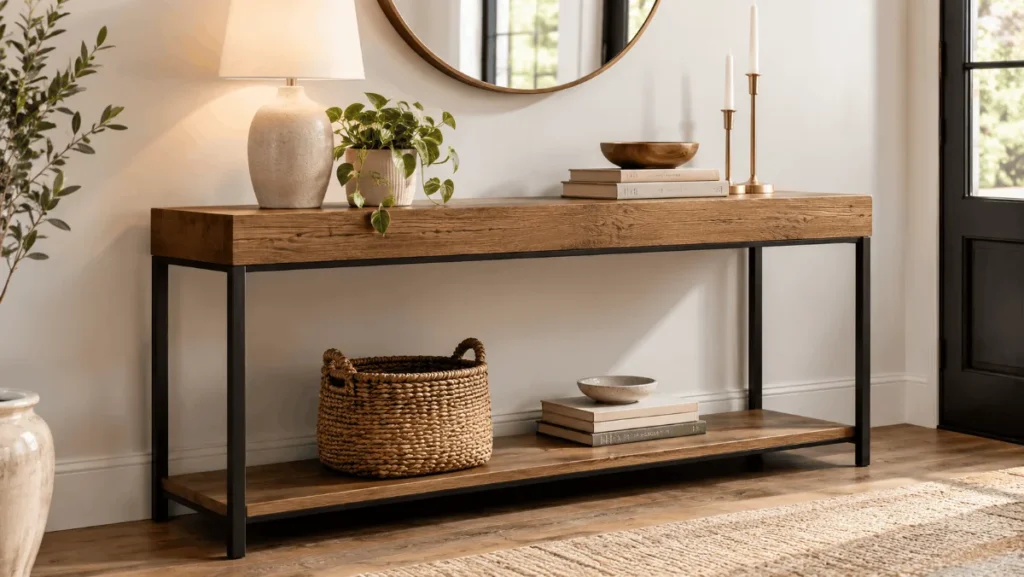

Console Table Guide: A console table is a long, narrow table, usually about 10 to 18 inches deep, made to sit against a wall or behind a sofa. The right one depends mostly on two measurements: how much floor you can spare, and how long the wall or sofa is. Choose by those numbers first, then by style.
What a console table does well
The name has a practical origin. In 17th-century France the word console referred to a bracket, and early console tables were wall-mounted tops carried on decorative brackets. Modern versions stand on their own legs, but the slim, wall-hugging shape stayed.
That shape is the point. A console table gives you a surface without taking much floor space. A hallway can hold one, and so can the back of a sofa, the wall beside a bed, or the side of a dining room. It also gives clutter a home: a bowl for keys, a tray for mail, a lamp.
Where it works best
The entryway
This is the classic spot. A table by the door catches keys, wallets and packages. If your entry has no closet, a model with a drawer or lower shelf is worth the extra cost, and baskets underneath can take shoes and scarves.
Measure the door swing and the walkway before you buy. A table that looks fine on a screen can turn a narrow hall into something you pass sideways.
Behind the sofa
If a sofa floats in an open room, a console table behind it marks the edge of the seating area and gives you a place for a lamp and a drink. Retailers often call this a sofa table, and one furniture guide says the two are not really different in practice. The usual advice is to keep the top level with the sofa back or an inch or two below it.
Dining rooms, bedrooms and bare walls
In a dining room, a deeper console can work as a small sideboard for serving dishes. In a bedroom, a shorter one can serve as a vanity alternative. On a bare living room wall, one looks best under a mirror or artwork.
Getting the size right
There is no official standard for console table dimensions. The figures below are commonly cited ranges from furniture retailers, and they vary a little from source to source.
| Placement | Length | Depth | Height |
|---|---|---|---|
| Behind a sofa | About 1/2 to 3/4 of the sofa length, about 2/3 is common | 10–14 inches | Level with the sofa back, or 1–2 inches lower |
| Entryway | Based on the wall; leave a few inches of bare wall at each end | 12–16 inches | 30–32 inches |
| Narrow hallway | Shorter is fine | 8–12 inches | 30–32 inches |
| Dining room | Medium to long | 14–18 inches | 30–34 inches |
For a free-standing wall, a length of about two-thirds of the wall looks intentional. A table that fills the whole wall tends to feel heavy, and a very short one looks lost.
Hallway math
Depth is the dimension that causes problems, and it comes down to simple subtraction: hallway width minus the walking space you want equals the deepest table you can fit.
Design retailers commonly recommend 30 to 36 inches of clear walking space. For reference, the U.S. Access Board’s ADA standards set a minimum clear width of 36 inches for walking surfaces. Those rules apply to public and commercial buildings, not private homes, but 36 inches is a sensible benchmark if anyone uses a mobility aid or carries bags and boxes through the space.
Here is how that plays out:
- In a 48-inch hallway, keeping 36 inches clear leaves a maximum table depth of 12 inches.
- Allowing only 30 inches clear raises that to 18 inches, though that will feel tighter.
- In a 36-inch hallway, even a 12-inch table leaves 24 inches, which is tight.
Behind a sofa, add the table depth to a few inches of clearance behind it. One guide suggests at least 3 to 4 inches so you can reach behind it to clean.
Materials and style
Wood
Solid wood is the long-term pick. It lasts, it can be refinished, and it suits traditional, farmhouse and mid-century looks. Veneer over engineered wood costs less and is fine in low-traffic spots, though the edges can chip. In a busy hall, solid wood forgives more.
Metal and glass
Metal frames with glass tops feel light and keep small rooms from looking crowded. The trade-off is fingerprints and dust, which show quickly on glass. A glass top may be more upkeep than you want in a busy entryway.
Mixed materials
A wood top on a metal base, or a stone-look top on slim legs, is a middle ground. A neutral mixed-material table usually survives decor changes better than a very trend-specific piece.
Marble and stone
Real marble looks beautiful but needs care. The Natural Stone Institute’s guidance explains that wiping up spilled red wine at once usually prevents a stain, but the wine’s acid may still etch the stone. The same guidance recommends coasters and trays, and notes that sealer helps against stains but does nothing for etching. If you want the look with less upkeep, a sealed stone-look surface or a mixed-material top may suit you better.
Styling it without making a mess
A simple formula works. Put something tall on one side, such as a lamp or a vase with branches. Add something at medium height, such as a stack of books or a framed print leaning on the wall. Finish with a low item like a bowl, tray or small plant. Odd numbers of objects tend to look more natural, but treat that as a habit, not a rule.
Leave breathing room. As a rule of thumb, keep about a third of the surface open so you have somewhere to drop your keys. Two or three larger pieces read as styled, while five small trinkets read as clutter.
A mirror above the table bounces light around dim entryways and gives you a last check before you leave. If you use a lamp, plan for a nearby outlet so a cord isn’t trailing across a walkway.
Storage options
Drawers swallow chargers, takeout menus, and loose change. An open lower shelf suits baskets or magazines. Be honest about what you will actually store: open shelves in a visible hallway fill up fast. If you’re not a tidy person, choose drawers or lidded baskets over open shelving.
Common mistakes
- Buying without measuring. The most common return is a table an inch or two too deep for the space.
- Ignoring nearby heights. A table taller than the sofa back looks off, and one that is much lower gets overshadowed.
- Pushing it flat against the wall. Leave a couple of inches so you can clean behind it. Baseboards often hold it slightly off the wall anyway.
- Buying it with no purpose. A table with nothing assigned to it becomes a clutter magnet.
Is a console table right for your space?
Almost certainly, if you have a narrow wall, an empty hallway, or a sofa floating in the room. Skip it if your hallway is so tight that anything you add blocks movement. A wall-mounted floating shelf or a slim floating console gives you the surface without the legs.
For most homes, a mid-priced wood or mixed-material table in a neutral finish is the safest choice. Before you buy, check current dimensions, finishes, and prices with the retailer, since stock and prices change often. If you’re weighing a console against other options, Headlinza’s Table Buying Guide covers how to choose tables in general, and the Furniture section has related buying guides.
Next step: measure your wall length and floor depth, subtract 36 inches from the hall or walkway width to get your maximum depth, and pick the length at about two-thirds of the wall or sofa.
Last updated: October 29, 2026