







What Is a Riser Desk? A Plain-Language Guide
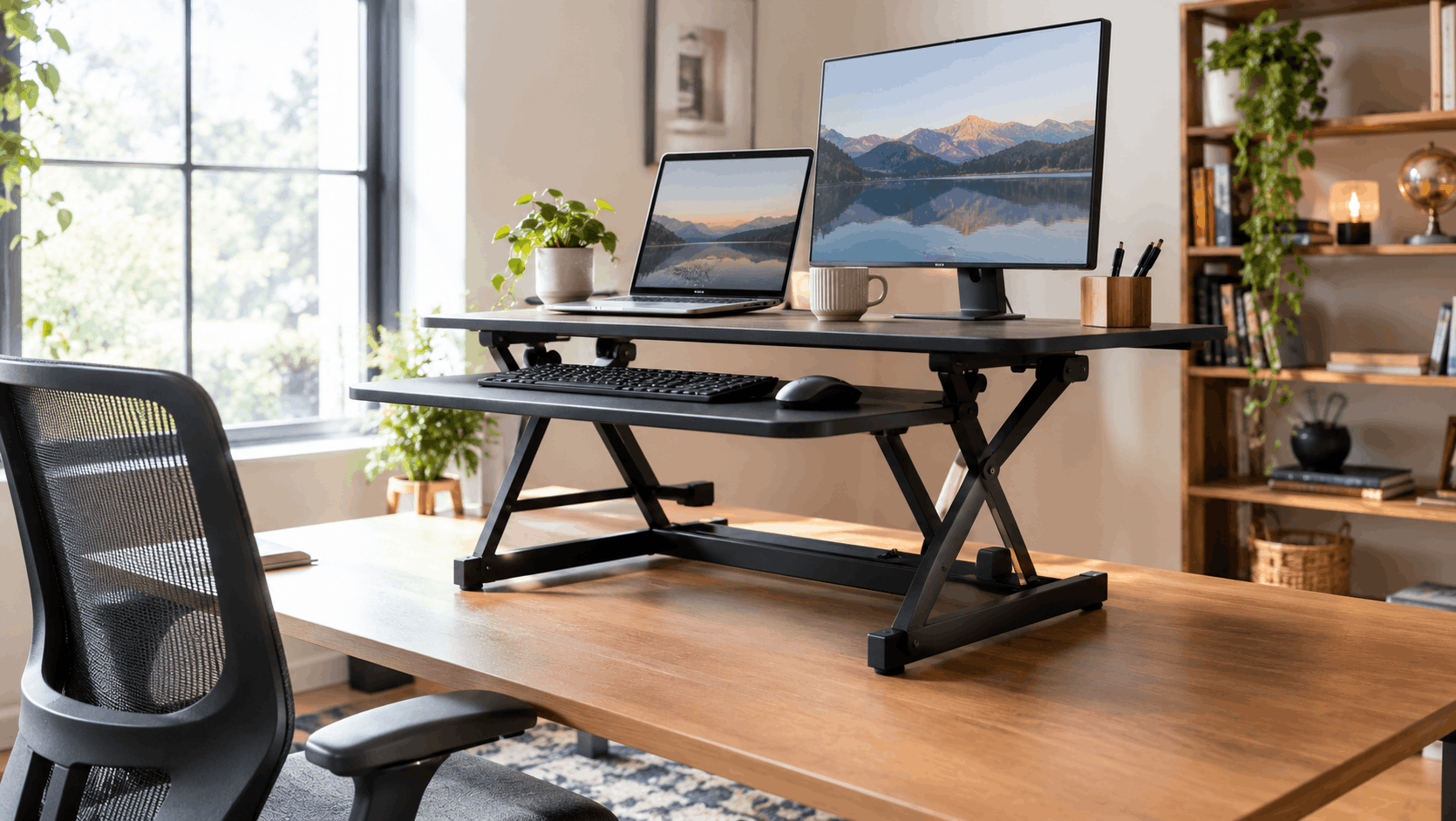
What Is a Riser Desk? Most riser desks use one of two lift mechanisms. Pneumatic models rely on a gas spring, the same basic technology in an office chair, that you engage by squeezing a handle or lever. Lift it with a light push, lower it by squeezing again and letting gravity do the work. Electric models use a motor and a button, which costs more but means zero physical effort to adjust.
The platform itself usually has one or two tiers. A single-tier riser just lifts everything on one flat surface. A two-tier design puts your monitor on the upper level and your keyboard and mouse on a lower shelf, which keeps the screen at eye level and your hands at a comfortable typing height at the same time, rather than forcing a compromise between the two.
Weight capacity matters more than people expect going in. Most riser desks are rated somewhere between 30 and 40 pounds, enough for a monitor, laptop, keyboard, and mouse, but if you’re running a dual-monitor setup or a heavier all-in-one computer, check the specific weight rating before assuming it’ll hold everything you want on it.
Why People Buy One Instead of a Full Standing Desk
The appeal is straightforward: it’s a fraction of the cost and effort of replacing your entire desk. If you’re renting, sharing a workspace, or just not ready to commit to a full height-adjustable desk, a riser sits on top of what you already own and does most of the same job.
What tends to surprise first-time buyers is how much desk space a riser actually eats up when it’s sitting there permanently. Since it takes up the footprint of your existing desk plus its own base, you end up with less usable surface for papers, a notebook, or anything else you’d normally spread out. If you already work on a smaller desk, this is worth thinking through before buying rather than after.
The other real advantage is portability. Most riser desks aren’t bolted down, so you can move one to a different room, take it to a shared office, or bring it along if you switch workspaces, which a fixed height-adjustable desk simply can’t offer.
The Health Case for Alternating Between Sitting and Standing
This is the reason riser desks exist in the first place, so it’s worth being specific about what’s actually established. Prolonged sitting has been linked to a range of health concerns, and OSHA’s ergonomics guidance addresses workstation setup as part of reducing musculoskeletal strain in office environments generally. The CDC’s guidance on physical activity also emphasizes that breaking up long periods of sitting with movement supports overall health, even short bouts of standing or walking.
That said, a riser desk on its own isn’t a fitness tool, and standing all day isn’t automatically better than sitting all day. Standing for extended stretches without moving can bring its own discomfort, particularly in the lower back and feet. The actual benefit comes from alternating between positions rather than replacing one static posture with another, so treat a riser as a tool for variation, not a cure.
What to Look For Before Buying
Height range is the first thing to check, and it depends entirely on your own height and your existing desk height. A converter with too limited a range might not get your monitor to true eye level once it’s stacked on top of your current desk, especially if you’re on the taller side. Measure your standing elbow height and compare it against the riser’s maximum height plus your desk’s height before assuming it’ll fit.
Stability is the second consideration, and it’s easy to overlook until you’re typing on a wobbly platform at full extension. Heavier steel-frame models with a wider base tend to feel more solid at maximum height than lighter, narrower designs, particularly if you’re using a mechanical keyboard or typing with any real force.
Keyboard tray design matters for anyone who types a lot. A tray that’s too shallow crowds your mouse, and one without a slight negative tilt option can strain your wrists over long sessions. If ergonomics is the whole reason you’re buying one, don’t treat the keyboard tray as an afterthought.
And check how it transitions between sitting and standing. Pneumatic models are quick but can feel a bit jerky if the gas spring is under- or over-rated for your setup’s weight. Electric models are smoother and quieter but cost more and need a power outlet nearby.
Common Misconceptions
A frequent assumption is that a riser desk automatically fixes back pain or posture problems. It can help by encouraging movement and variation, but it doesn’t correct an otherwise poor setup. A monitor that’s still too low, a chair with no lumbar support, or a keyboard positioned awkwardly will undermine most of the benefit, riser or not.
Another common mix-up is assuming “riser desk” and “standing desk” are interchangeable in every sense. A standing desk is typically the whole desk itself, height-adjustable from the floor up. A riser desk sits on top of whatever desk you already have. They accomplish a similar goal, but they’re physically different products with different tradeoffs in stability, cost, and desk space.
People also sometimes expect a riser to feel identical to a full standing desk in terms of surface space and stability. It generally won’t, since you’re working with a smaller platform stacked on an existing surface rather than one continuous, purpose-built desktop.
Who a Riser Desk Actually Fits
If you’re testing whether standing while you work suits you before committing to a bigger purchase, a riser is a sensible, low-risk way to find out. It’s also a good fit if you rent your space, share a desk, or need something portable between locations.
If you already know you want to stand regularly, have the budget, and have a fixed workspace, a full height-adjustable desk is generally the more comfortable long-term option, since you get the full surface area back and don’t lose desk space to a platform sitting on top of it. Wirecutter’s coverage of standing desk converters is a decent place to compare specific models if you’ve decided a converter is the right call for your situation.