
Oni Mask Guide: An oni mask depicts a horned ogre or demon from Japanese folklore. People use it for Setsubun bean-throwing, wall decor, costumes, and collecting. Before you buy one, know that it isn’t the same thing as a hannya mask. Hannya is a separate Noh theater mask with its own meaning, and sellers sometimes mix the two up.
What an oni looks like
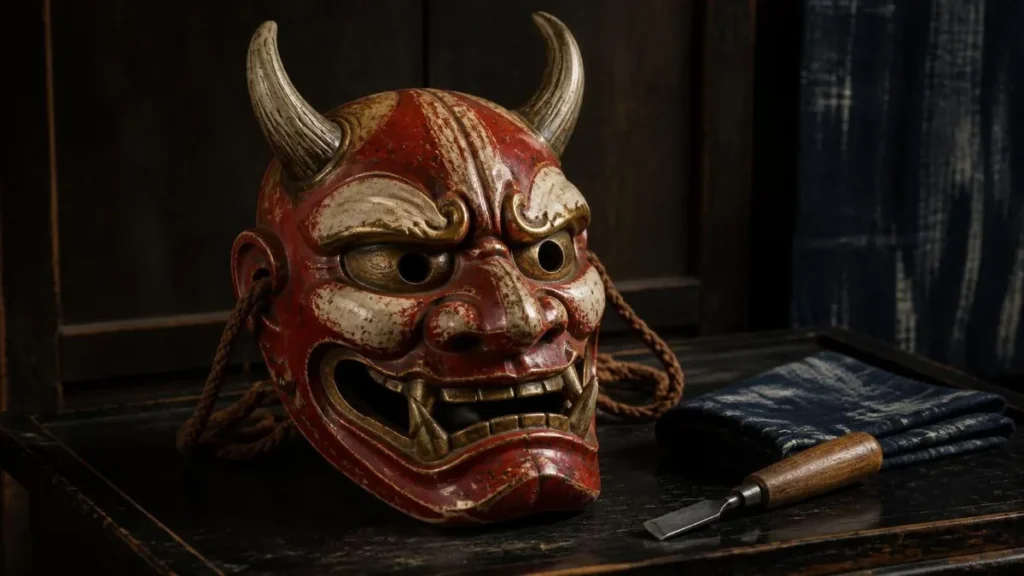
Japan’s Ministry of Foreign Affairs runs a Kids Web Japan profile of the oni that describes the standard look: usually two horns, large fangs, red or blue skin, a tiger-skin loincloth, and a big iron club. The same page explains where the ox horns and tiger skin come from. The northeast was traditionally called kimon, the “demon gate,” and its old name, ushitora, combines the words for ox and tiger.
Regional and period variations are common, so no single design counts as the official oni.
What an oni mask symbolizes
Folklore doesn’t treat oni as purely evil. The same Kids Web Japan page says they are feared as powerful ogres, but they can also help people in need, and their frightening appearance is used to protect people from evil. That ambiguity is much of the mask’s appeal.
The clearest example is Setsubun, usually held around February 3. According to the Embassy of Japan in Trinidad and Tobago, people throw roasted soybeans out of a door or window, or at a family member wearing an oni mask, while chanting “Oni wa soto, fuku wa uchi” (“Demons out, fortune in”). Customs vary. Nippon.com notes that some temples invite both oni and good fortune inside. The next Setsubun falls on February 3, 2027.
Outside Japan, the mask has taken on other meanings. In anime, games, and streetwear, it often signals strength or an edgy look. If you follow that side of the culture, our manga coverage is one place to explore. These modern designs are free to change colors, horns, and details, so they aren’t always faithful to folklore.
Oni mask vs. hannya mask
The two are easy to confuse, and the difference matters if you want a specific one.
| Oni mask | Hannya mask | |
|---|---|---|
| Character | A folkloric ogre or demon | A jealous female demon from Noh theater |
| Horns | Usually two | Two sharp, bull-like horns |
| Typical context | Setsubun, folklore, pop culture | Noh performance |
| Look | Fangs, often red or blue | Metallic eyes, leering mouth, sorrowful and angry |
The Metropolitan Museum of Art describes the hannya as a female serpent-demon with an open mouth, sharp teeth, golden eyes and two horns, worn by a Noh actor. The Hikone Castle Museum adds that hannya masks have to look fearsome while also conveying dignity and refinement. If a listing says “oni” but shows a hannya face, or vice versa, ask the seller which it is meant to be.
Colors and styles
Red and blue are the most common oni colors, according to Kids Web Japan. Modern and decorative masks also come in black, green, white, and gold. Color symbolism varies by tradition and interpretation, so treat any single meaning a seller assigns to a color as one view rather than a rule.
Expressions range from open-mouthed rage to a half-playful scowl. Some masks have one horn, some have two, and some add wild hair, fangs, or painted patterns.
Materials and quality
Material affects price, weight, durability, and how a mask can be used.
| Material | Best for | Watch out for |
|---|---|---|
| Carved wood | Display and collector pieces | Weight, cost, and damage if dropped |
| Papier-mâché or paper | Light decor and Setsubun-style use | Dents and tears |
| Resin | Detailed display pieces | Chipping; not usually suited to wearing |
| Plastic or foam | Costumes and cosplay | Less traditional look |
| Leather or cloth | Costume styles | Keeping its shape with age |
For reference, the Victoria and Albert Museum describes a Noh hannya mask as carved from Japanese cypress, coated with gesso and painted, with separately applied horns. That gives a sense of what traditional craftsmanship involves, though most masks on the market are not made this way.
For a mask you’ll wear, comfort matters more than most buyers expect. Check the eye openings, ventilation, and strap. For display, the finish and craftsmanship are what you’re paying for, so look at the carving, paint, and edges in photos. Prices vary widely by maker, material, and region, so compare current listings before buying.
Choosing the right one
Start with the purpose.
- Wall decor: Match the size to the wall and the color to the room. A small mask can disappear on a big wall.
- Costume or cosplay: Prioritize lightweight materials, a secure fit, and airflow. Our Clothing & Style section has more on costume and streetwear.
- Setsubun at home: Japanese retailers note that supermarkets sell inexpensive oni masks in February, so a simple paper mask suits this use.
- Collecting or gifting: Ask about the maker, materials, and origin. Treat claims like “antique” or “authentic Noh” with caution unless the seller provides clear documentation.
Displaying an oni mask at home
Hang it at roughly eye level, away from direct sunlight, which can fade paint. A sturdy hook works for light masks, and heavier carved pieces may need a proper mount. Keep it dry, since humidity can damage wood and paint, and dust it gently with a soft brush or cloth.
Some people hang oni imagery near an entrance, echoing its protective role, but that’s a cultural association rather than a requirement. Put it where you’ll enjoy looking at it. A console table can give a smaller mask or stand a place to sit, and our Home Decor section has more display ideas.
Respect and cultural awareness
Decorative and costume oni masks are widely sold and widely worn. It still helps to learn the background, avoid using ritual or theatrical masks as props, and think about where and how you wear one at cultural events. Setsubun itself is a good starting point if you want to understand the context. If you enjoy Japanese culture more broadly, you might also like our pieces on Japanese planners and nigiri vs. sashimi.
Tattoos, art and pop culture
Oni imagery is popular in Japanese-style tattoos, illustration, and graphic design. Meanings can differ between artists and traditions, so research the style and work with an artist experienced in it, rather than assuming a single fixed symbolism.
Common mistakes
- Mixing up oni and hannya masks. Check the horns, eyes, and face shape against the descriptions above.
- Buying on looks alone. Confirm the size, weight, and material, especially for online orders.
- Assuming “handmade” means traditional. It only means made by hand, in any style.
- Ignoring comfort on a wearable mask. If you can’t see or breathe well, it won’t get worn.
- Hanging it in the sun or damp. A little care helps a good mask last.Last updated: October 26, 2026