







Black Mulch Guide: Pros, Cons, Safety, and Cost
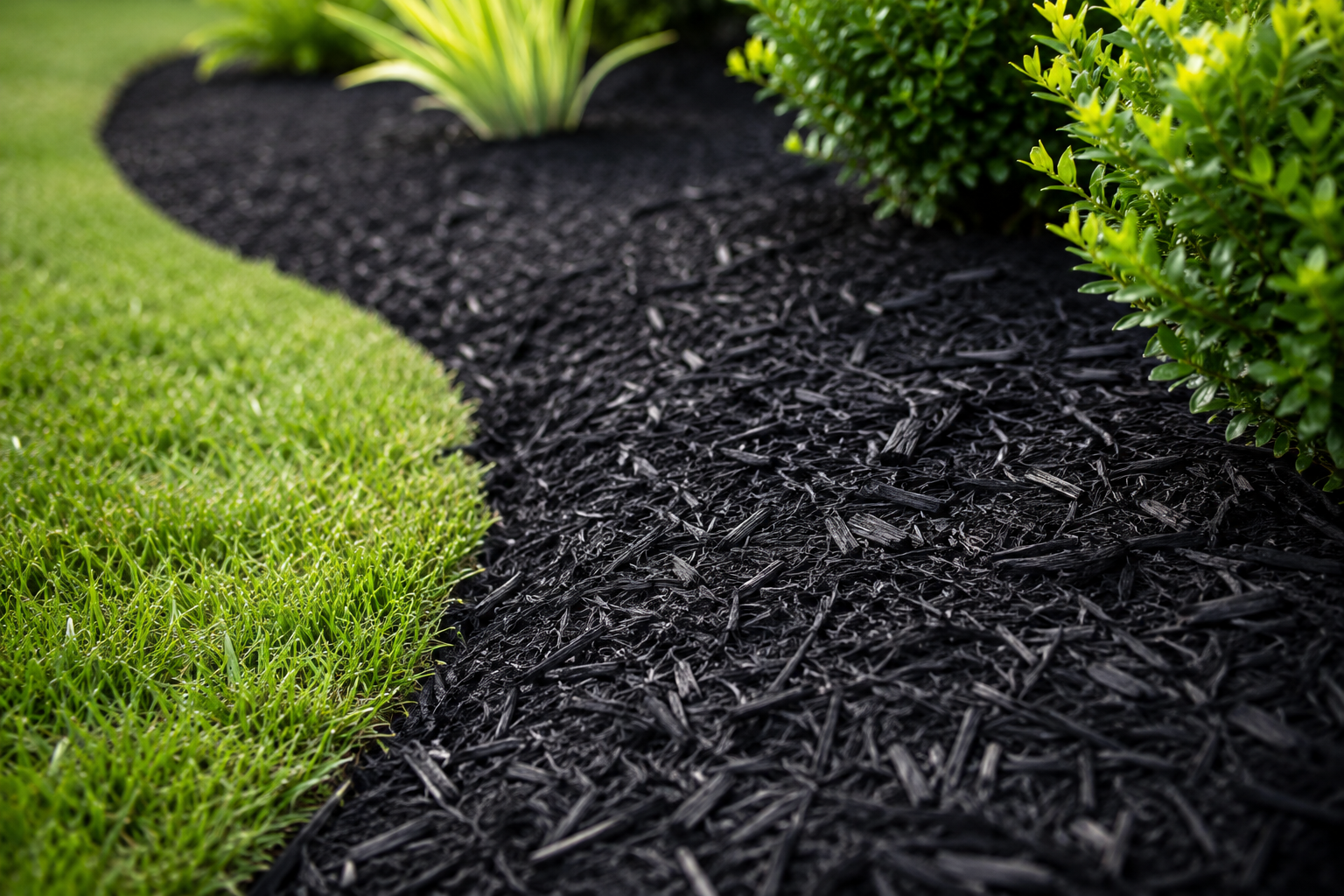
Black mulch is usually shredded or chipped wood treated with a dark colorant for use around trees, shrubs, and ornamental garden beds. It provides the normal benefits of organic mulch, including weed suppression, moisture retention, soil-temperature moderation, and a finished landscape appearance.
The black dye itself is generally not considered toxic to plants. The more important question is where the wood came from. University of Maine Cooperative Extension advises buyers to know the supplier and avoid recycled mulch containing pressure-treated wood, which may introduce unwanted contaminants. (extension.umaine.edu)
Apply black wood mulch about 2 to 4 inches deep, keep it away from plant stems and tree trunks, and do not automatically add another thick layer each year. Excess mulch can interfere with air and water movement, keep poorly drained soil too wet, and contribute to root or trunk problems. (extension.umn.edu)
Black Mulch at a Glance
| Question | Practical answer |
|---|---|
| What is black mulch? | Usually wood chips or shredded wood treated with a black colorant |
| Is the dye toxic to plants? | Extension guidance says commonly used mulch dyes are not known to be toxic |
| What is the bigger safety concern? | The source and quality of the underlying wood |
| How deep should it be? | About 2 to 4 inches in most landscape beds |
| Can it touch a tree trunk? | No |
| Does it stop every weed? | No, but a proper layer suppresses many weed seedlings |
| Does it conserve water? | Yes, organic mulch can reduce soil-moisture loss |
| Does the black color last permanently? | No, exposure to sunlight and weather causes fading |
| Is it suitable for vegetables? | Use a clearly identified untreated product or choose a known natural material |
| How much does one cubic yard cover? | About 108 square feet at 3 inches deep |
| Is black plastic the same thing? | No |
| Is black rubber mulch the same thing? | No |
What Is Black Mulch Made From?
The phrase black mulch can describe several very different landscaping products.
Dyed wood mulch
This is the product most homeowners mean when they search for black mulch.
Manufacturers start with shredded or chipped wood and add a black colorant. The wood may come from:
- Hardwood
- Softwood
- Bark
- Forest products
- Recycled pallets
- Reprocessed wood waste
- A blend of several materials
The dye produces a consistent dark appearance even when the underlying wood contains different colors or species.
Naturally dark wood or composted mulch
Some mulch looks dark brown or almost black without a strong artificial color treatment. It may consist of aged bark, composted wood, leaf material, or a dark organic blend.
Its appearance is usually softer and less uniform than dyed black mulch.
Black rubber mulch
Rubber mulch is commonly made from processed tires. It does not decompose and improve soil in the same way as organic wood mulch.
It should be evaluated as a separate material because its heat, fire, disposal, and environmental characteristics differ from wood. Oregon State University Extension advises against recycled rubber mulch in fire-resistant landscapes because it is highly flammable. (extension.oregonstate.edu)
Black plastic mulch
Black plastic is an agricultural or vegetable-production film placed directly over soil. It suppresses weeds and can warm the soil for heat-loving crops.
University of Maine Extension explains that black plastic blocks light, reduces evaporation, and warms the soil when it remains in close contact with the surface. It is not the same product as decorative black wood mulch. (extension.umaine.edu)
Is Black Dyed Mulch Safe?
The colorant is usually less concerning than the wood beneath it.
University of Maine Cooperative Extension states that there is no evidence that standard dyes used in colored mulch are toxic to plants. It advises buyers to focus on the supplier and the source of the wood, especially when recycled construction or pressure-treated lumber could be present. (extension.umaine.edu)
The Mulch & Soil Council also notes that some recycled or reprocessed wood products may contain treated construction and demolition material. Its certification program helps identify products tested according to published mulch and soil standards, including controls related to CCA-treated wood contamination. (mulchandsoilcouncil.org)
Before buying, check for:
- A clear manufacturer name
- Material description
- Mulch and Soil Council certification, when available
- A statement about untreated or clean wood
- Instructions for intended use
- Coverage information
- Color-care directions
- Contact information for questions
Avoid loose, unidentified dyed material when the seller cannot explain where the wood came from.
Can You Use Black Mulch in a Vegetable Garden?
A clearly identified wood mulch made from untreated material can function as a surface covering in a garden. Dyed landscaping mulch of unknown recycled origin is not the most cautious choice for an edible bed.
For vegetables and herbs, consider materials with a known source, such as:
- Shredded leaves
- Clean straw
- Pine needles
- Untreated arborist wood chips
- Natural bark
- Finished compost where appropriate
Do not mix fresh wood mulch deeply into planting soil. Leave it on the surface, where it can suppress weeds and reduce moisture loss.
Black plastic is another option for certain heat-loving crops. It should be installed with a planned watering system because the film limits direct rainfall penetration except through planting holes and exposed edges. (extension.umaine.edu)
Benefits of Black Wood Mulch
Strong visual contrast
Black mulch creates a defined background for green foliage, light-colored flowers, ornamental grasses, stone edging, and modern architecture.
It can work particularly well with:
- Gray siding
- White siding
- Red brick
- Concrete walkways
- Silver foliage
- Bright annual flowers
- Formal garden layouts
- Contemporary landscape designs
The dark surface may make bed edges look sharper than natural brown material.
Weed suppression
A sufficient mulch layer blocks light from reaching many weed seeds and makes it harder for seedlings to become established.
Mulch does not eliminate all weeds. Seeds can blow onto the top of the bed, and established perennial weeds may push through from below.
Remove existing weeds before spreading the mulch. Covering mature weeds without removing their roots may only hide them temporarily.
Moisture retention
Organic mulch slows evaporation from the soil surface. The University of Minnesota notes that mulched soil retains water better and may require less frequent irrigation than exposed soil. (extension.umn.edu)
Mulch does not remove the need to check soil moisture. Move the material aside and inspect the soil before watering. A bed can appear dry on top while remaining moist underneath.
For more household water-conservation ideas, Headlinza’s guide to reducing wastewater at home covers rain collection, efficient fixtures, and other water-saving practices.
Soil-temperature moderation
A layer of wood mulch insulates the soil from rapid temperature changes.
The surface of black material may become hot in strong sunlight, but the organic layer can still buffer the soil below. Black plastic behaves differently because it is specifically used to warm soil in crop production.
Organic-matter contribution
Wood and bark gradually decompose. University of Maryland Extension notes that organic mulches contribute organic matter as they break down. (extension.umd.edu)
The improvement is gradual. Dyed mulch should not be treated as a substitute for compost, fertilizer, or a soil test.
Protection from lawn equipment
A properly sized mulch ring reduces the need to mow or use a string trimmer close to a tree trunk.
This can help prevent mechanical wounds caused by lawn equipment.
Disadvantages of Black Mulch
The color fades
Black mulch does not stay deep black indefinitely.
Sunlight, rain, irrigation, foot traffic, decomposition, and surface movement gradually expose brown or gray wood. Current retail products commonly advertise color lasting up to one year, while also acknowledging that fading occurs. (homedepot.com)
Fading may be more noticeable on black mulch than on natural brown material because the contrast between fresh and weathered areas is stronger.
It may look artificial
Some homeowners prefer the sharp black appearance. Others find that it competes with plants or looks unnatural after it begins fading.
Test one or two bags in a small area before ordering several cubic yards.
Unknown wood sources can be a concern
A dark color can hide the appearance of mixed recycled materials.
Choose a reputable supplier rather than assuming every bag labeled “premium” uses the same wood quality.
It can become hot at the surface
Dark materials absorb solar energy. Black mulch exposed to intense sun can become uncomfortable to touch and may contribute to a hotter immediate surface environment.
This is most relevant in:
- Hot climates
- Full-sun beds
- Small containers
- Areas beside heat-reflective walls
- Beds with shallow-rooted, heat-sensitive plants
Do not confuse this with the predictable agricultural warming effect of black plastic film. Wood mulch contains air spaces and acts as insulation, so its effect on the root zone differs.
Improper application harms plants
Most mulch problems result from depth and placement rather than color.
Too much mulch can:
- Limit soil oxygen
- Keep poorly drained soil excessively wet
- Encourage roots to grow into the mulch layer
- Hide trunk decay
- Create stem and crown problems
- Provide shelter for rodents
- Prevent irrigation from reaching the soil efficiently
University of Minnesota Extension recommends a 2-to-4-inch layer and a clear space around trunks and stems. (extension.umn.edu)
Black Mulch vs Brown Mulch
| Feature | Black mulch | Brown mulch |
|---|---|---|
| Appearance | Dramatic and high contrast | Natural and understated |
| Best visual match | Modern homes, gray siding, bright flowers | Wood tones, naturalistic gardens, earthy brick |
| Fading | Can become gray or unevenly brown | Fading is often less visually obvious |
| Plant benefits | Similar when the base material and depth are the same | Similar when the base material and depth are the same |
| Heat at the surface | Dark surface can become hotter in strong sun | Usually less visually and thermally intense |
| Availability | Widely available as dyed wood | Available as dyed or natural wood |
| Source concern | Dark dye can hide mixed recycled wood | Brown dye can also hide mixed recycled wood |
The color itself does not provide superior weed control or moisture retention. Material, particle size, depth, decomposition rate, and installation quality matter more.
Black Mulch vs Natural Wood Chips
Natural arborist wood chips often contain a mixture of bark, branches, leaves, and differently sized pieces.
They may offer:
- Known local sourcing
- Little or no purchase cost
- Gradual organic-matter contribution
- A natural appearance
- Less concern about artificial fading
Black mulch may offer:
- More uniform particle size
- Consistent color
- A formal appearance
- Easier matching across visible front-yard beds
- Bagged convenience
Natural chips are often better for large planting areas where soil health and cost matter more than uniform appearance. Dyed black mulch may suit high-visibility ornamental beds where a controlled design is the priority.
How Much Does Black Mulch Cost?
Prices depend on bag size, wood source, brand, region, delivery, season, and promotional sales.
On July 29, 2026, current examples included:
- Approximately $3.33 for a 2-cubic-foot bag of black wood mulch at Home Depot
- A typical bagged-mulch price near $5, with a broader range of about $3.28 to $16 at Lowe’s
- Some seasonal sale prices below the normal range
Local store prices and availability can differ. (homedepot.com)
One cubic yard contains 27 cubic feet. That equals approximately:
- 14 bags containing 2 cubic feet each
- 18 bags containing 1.5 cubic feet each
At a regular price of $3.33 per 2-cubic-foot bag, 14 bags would cost about $46.62 before tax or delivery. Bulk material may be more convenient for larger projects even when the material price is similar.
Angi’s 2026 data places many common mulch delivery and installation projects between $75 and $325, with an average near $120. Actual projects can cost more when the landscaper must remove weeds, redefine beds, haul away old material, navigate difficult access, or install several cubic yards. (angi.com)
How Much Black Mulch Do You Need?
Use this formula:
Square feet × depth in inches ÷ 324 = cubic yards
Example
A bed measures 400 square feet, and you want a 3-inch layer:
400 × 3 ÷ 324 = 3.7 cubic yards
Round up to approximately 4 cubic yards when installing a new layer.
Approximate coverage per cubic yard
| Mulch depth | Coverage from 1 cubic yard |
|---|---|
| 1 inch | 324 square feet |
| 2 inches | 162 square feet |
| 3 inches | 108 square feet |
| 4 inches | 81 square feet |
A retail bag may provide its own coverage figure. For example, Home Depot lists one 2-cubic-foot black mulch bag as covering about 8 square feet at a 3-inch depth. (homedepot.com)
Do not calculate only the amount needed to make the bed look dark. Check how much old mulch remains before adding more.
How to Apply Black Mulch Correctly
1. Measure the beds
Measure the length and width of rectangular areas. Break curved or irregular beds into smaller shapes and estimate each section separately.
2. Check the existing depth
Dig through the old mulch in several places.
If 2 or 3 inches remain, you may need only a light cosmetic refresh rather than a complete new layer.
3. Remove weeds
Pull or dig established weeds before applying mulch. Remove roots where practical.
Mulch suppresses new germination more effectively than it kills mature perennial weeds.
4. Redefine the bed edge
A clear edge helps contain shredded material and gives black mulch its finished appearance.
Avoid cutting deeply enough to damage tree or shrub roots.
5. Spread the mulch evenly
Apply about:
- 2 to 3 inches around flowers and smaller plants
- 2 to 4 inches in general landscape beds
- No more than approximately 3 inches around newly planted trees and shrubs
The correct depth also depends on particle size, drainage, and what is already present.
6. Keep it away from trunks and stems
Leave several inches of clear space around tree trunks.
Do not pile mulch against bark in a cone or mound. Penn State Extension calls this practice volcano mulching and recommends a flat layer about 2 to 3 inches deep that does not touch the trunk. (extension.psu.edu)
Keep mulch away from:
- Tree trunks
- Shrub stems
- Perennial crowns
- House siding
- Foundation vents
- Door thresholds
7. Follow the color-setting instructions
Some black mulch manufacturers advise keeping newly applied mulch dry for 24 to 48 hours so the colorant can finish curing and resist premature fading.
Follow the specific bag rather than using one rule for every brand. Current Lowe’s product guidance recommends avoiding rain or sprinklers for 48 hours after application on certain color-enhanced products. (lowes.com)
Should You Remove Old Mulch First?
Complete removal is usually unnecessary when the existing material is organic, uncontaminated, free from disease concerns, and not already too deep.
Instead:
- Loosen compacted material with a rake.
- Measure its depth.
- Remove any plastic, trash, or obvious contamination.
- Correct mulch piled against plants.
- Add only enough new material to reach the desired total depth.
Remove or replace old material when it:
- Smells sour or fermented
- Contains construction debris
- Is mixed with rubber or plastic
- Has formed a thick water-resistant mat
- Is contaminated with chemicals
- Is creating excessive depth
- Was installed against trunks or siding
- Contains a serious weed or disease problem requiring specific management
Do not add 3 fresh inches every spring without checking the existing bed.
Why Black Mulch Sometimes Smells Bad
Bagged mulch stored in a waterlogged, oxygen-poor pile may develop a sour or fermented odor.
Do not place strongly sour-smelling mulch directly around plants. Spread it thinly in a safe open area and contact the supplier for guidance or replacement.
Normal woody or earthy smells are expected. A sharp vinegar, ammonia, sulfur, or silage-like odor deserves caution.
Does Black Mulch Attract Termites?
Mulch does not need to be treated as termite food alone to create concern. A thick, moist layer beside a building can provide sheltered conditions and make inspections more difficult.
Keep mulch below siding and away from vents, untreated wood, door frames, and other moisture-sensitive building components. Maintain a visible inspection area where required by local pest-control guidance.
Do not rely on mulch color as a termite-control method.
Does Black Mulch Cause Artillery Fungus?
Artillery fungus can grow in decomposing landscape mulch and release small dark spores onto siding, vehicles, and other nearby surfaces.
The problem relates to the organic material and moisture conditions rather than the black dye itself.
Risk-management options include:
- Avoiding deep, constantly wet mulch
- Improving airflow
- Turning or replacing old material
- Using larger bark pieces
- Keeping decomposing mulch farther from light-colored siding
- Asking a local extension office which materials perform best in the region
Do not assume that one brand or color is guaranteed to prevent fungal growth.
How Long Does Black Mulch Last?
Separate color life from material life.
Color life
A color-enhanced product may advertise dark color for approximately one year. Sun exposure, irrigation, rainfall, foot traffic, and surface disturbance affect actual fading. (homedepot.com)
Material life
Wood mulch can remain in the bed after the color fades. It continues decomposing and may not require complete replacement.
Rake the surface to expose darker pieces before buying more. Add a thin top layer only when the total depth remains appropriate.
When Black Mulch Is a Good Choice
Black dyed wood mulch may suit your project when:
- You want strong contrast.
- The beds are ornamental rather than edible.
- The supplier identifies the material clearly.
- The product is certified or traceable.
- You accept gradual fading.
- The area has suitable drainage.
- You can maintain correct depth.
- The landscape style is formal or modern.
- The dark color complements the house.
When to Choose Another Mulch
Consider a natural alternative when:
- You want the most natural appearance.
- The bed contains vegetables or herbs.
- The wood source is unknown.
- The site experiences intense reflected heat.
- You do not want to refresh faded color.
- Free local arborist chips are available.
- Improving soil organic matter is the main goal.
- The property is in a wildfire-prone area.
- The mulch will be placed close to a light-colored wall prone to spotting.
Frequently Asked Questions
Is black mulch bad for plants?
Not when a suitable product is applied correctly. Extension guidance says the dye itself is not known to be toxic to plants. Problems are more likely to result from contaminated wood, excessive depth, poor drainage, or mulch piled against stems and trunks. (extension.umaine.edu)
Is black mulch dyed?
Most uniformly black wood mulch is color-enhanced. Naturally dark composted material and bark blends also exist, so read the product description.
How deep should black mulch be?
Apply approximately 2 to 4 inches in most landscape beds. Keep the layer shallower when substantial old mulch remains. (extension.umn.edu)
Can black mulch touch plants?
Do not pile it against stems, crowns, or trunks. Leave a clear area to reduce moisture, disease, and pest problems.
Does black mulch fade?
Yes. Many products advertise color for up to one year, but sunlight and weather gradually expose the underlying wood.
Is black mulch safe around pets?
Do not treat any mulch as edible or chew-safe. Confirm the material, avoid unidentified recycled products, and prevent pets from swallowing wood, rubber, plastic, or landscaping debris.
Is black mulch better than brown mulch?
Neither color provides inherently better plant care. Choose according to appearance, wood source, particle size, price, and how noticeable fading will be.
How many bags equal one cubic yard?
A cubic yard is approximately 14 bags of 2 cubic feet or 18 bags of 1.5 cubic feet.
Should landscape fabric go under black mulch?
Organic wood mulch can suppress weeds without permanent fabric when applied at the correct depth. Fabric may be useful in certain hardscape or non-organic installations, but it can complicate planting and does not prevent weeds from germinating in material that accumulates above it.
Final Takeaway
Black wood mulch can provide effective weed suppression, moisture retention, soil protection, and a sharp landscape appearance.
The dye itself is not the main issue. Choose a product from a supplier that identifies the wood source, and consider Mulch and Soil Council certification when comparing recycled materials.
Apply a total layer of about 2 to 4 inches, not an additional thick layer every year. Keep it several inches away from tree trunks, shrub stems, and plant crowns.
Expect the color to fade. Rake existing mulch and measure the depth before purchasing more. For large projects, compare the cost of bagged products with bulk delivery rather than selecting material based only on the per-bag sale price.
Natural wood chips or bark may be a better choice for edible beds, naturalistic landscapes, and homeowners who do not want to maintain a consistent artificial color. Black mulch is strongest where visual contrast and a formal finished appearance matter most.
Explore more household, garden, and practical living guidance in Headlinza’s Lifestyle section.