





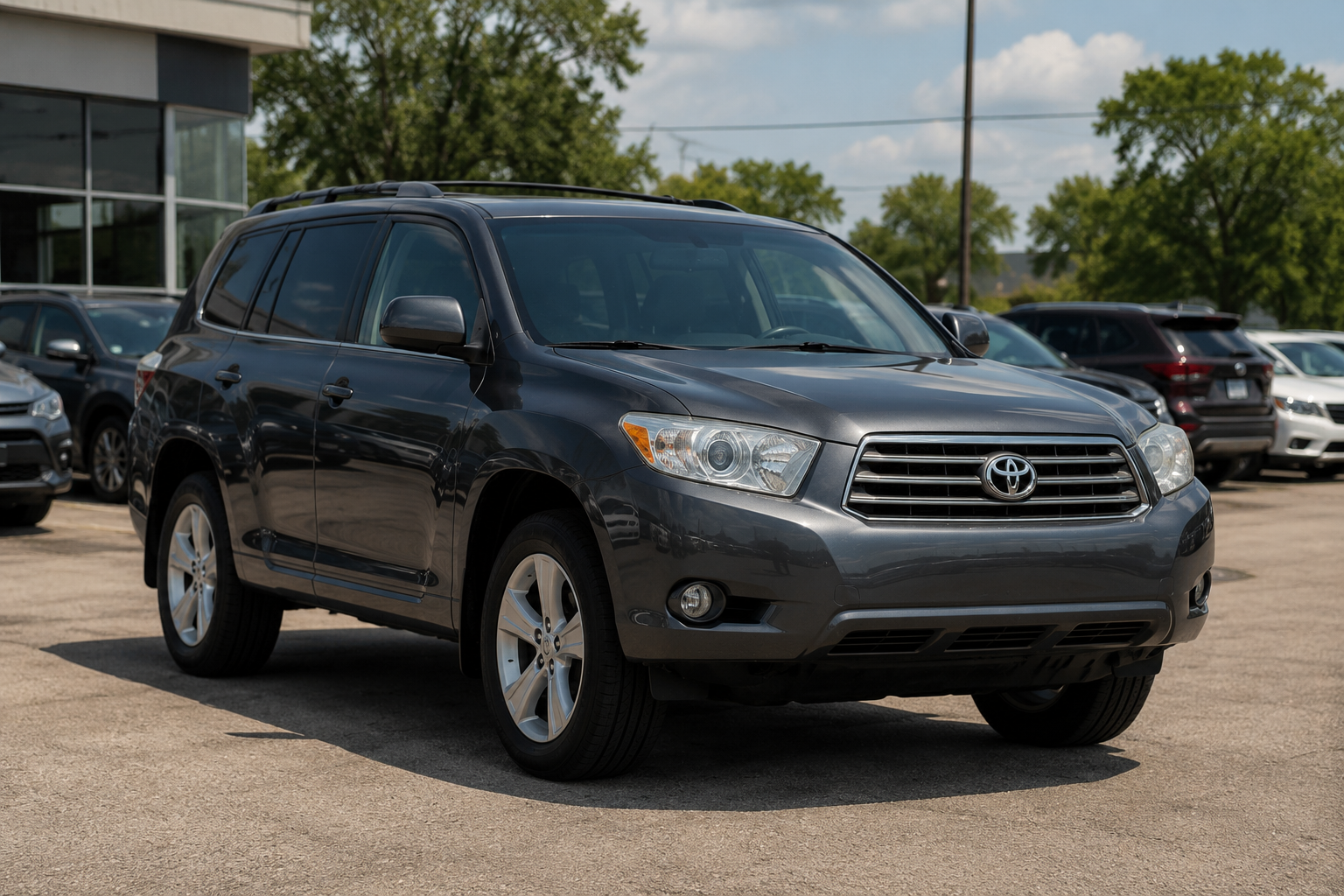
Used Toyota Highlander Buying Guide: What to Check
A used Toyota Highlander can be a practical choice for buyers who want a comfortable midsize crossover with three-row seating, available all-wheel drive, and a choice between gasoline and hybrid powertrains.
The strongest purchase is not automatically the newest Highlander or the one with the lowest mileage. Model generation, drivetrain, service history, accident history, recall completion, corrosion, tire condition, transmission behavior, and the results of an independent inspection matter more than the badge alone.
For many shoppers, a 2019 Highlander offers a useful balance of mature third-generation design and standard Toyota Safety Sense P. Buyers prioritizing fuel economy should consider a properly inspected 2020 or newer Highlander Hybrid, while shoppers on a tighter budget may find value in a well-maintained 2011–2016 model.
No model year should be purchased without inspecting the individual vehicle. Toyota issued model-specific recalls, technical service bulletins, and customer support programs that apply only to certain years, configurations, production ranges, or vehicle identification numbers.
Used Toyota Highlander at a Glance
| Buyer priority | Suitable starting point | Main reason | Important check |
|---|---|---|---|
| Lowest purchase price | 2008–2013 | Older vehicles can be relatively affordable | Age, corrosion, leaks, suspension, maintenance history |
| Value and modern features | 2014–2016 | Third-generation space and design without later-model pricing | Infotainment, liftgate, AWD operation, accident history |
| Safety-feature value | 2017–2019 | Standard Toyota Safety Sense P | 2017–2018 transmission symptoms |
| Strong mature-year option | 2019 | Final third-generation model year with standard TSS-P | Full service and recall history |
| Fuel economy | 2020–2026 Hybrid | Newer hybrid system with substantially higher EPA economy | Battery diagnostics, underbody cable condition, recalls |
| Newer cabin and technology | 2020–2022 | Fourth-generation platform and standard TSS 2.0 | Recall completion and electronic features |
| Turbocharged gas power | 2023–2026 | Higher torque than the outgoing V6 | Complete service history and cold-start test |
| Maximum third-row space | Consider Grand Highlander instead | Standard Highlander third row may not suit every adult | Test actual passenger and cargo fit |
The Highlander was redesigned for the 2008, 2014, and 2020 model years. Toyota replaced the fourth-generation gas model’s 3.5-liter V6 with a 2.4-liter turbocharged four-cylinder for 2023. (IIHS Crash Testing)
Current Used Toyota Highlander Prices
Used prices vary according to model year, trim, mileage, drivetrain, location, accident history, condition, certification, and dealer fees.
CarGurus’ US pricing index listed the average used Toyota Highlander at approximately $27,512 on July 29, 2026, after a 1.7% decrease over the preceding 30 days. These figures represent advertised-market data rather than a guaranteed transaction value. (CarGurus)
| Model year | Average listing-price indicator |
|---|---|
| 2008 | $8,406 |
| 2011 | $11,042 |
| 2013 | $12,892 |
| 2016 | $18,476 |
| 2017 | $20,484 |
| 2019 | $24,206 |
| 2020 | $27,872 |
| 2022 | $33,268 |
| 2024 | $39,243 |
| 2025 | $41,980 |
These national averages mix different mileages, trims, conditions, locations, and histories. A low-mileage Platinum AWD can cost far more than an LE with accident history, high mileage, or overdue repairs. (CarGurus)
Compare at least five genuinely similar vehicles. Match the:
- Model year
- Trim
- Gas or hybrid powertrain
- Front-wheel drive or all-wheel drive
- Mileage
- Accident and title history
- Seating configuration
- Major options
- Dealer fees
- Warranty coverage
A listing price should not be treated as the purchase price until the seller provides a complete out-the-door quote.
Toyota Highlander Generations Explained
First generation: 2001–2007
The first-generation Highlander arrived for the 2001 model year. Early vehicles were offered as five-passenger crossovers, with three-row availability appearing later in the generation. Toyota introduced the Highlander Hybrid for the 2006 model year. (Cars.com)
This generation may suit someone who wants:
- A relatively simple and inexpensive midsize crossover
- A smaller exterior than newer Highlanders
- Occasional rather than frequent third-row use
- A secondary household vehicle
- A low purchase price with room for repairs
The main concern is age. Even a vehicle with modest mileage may have deteriorated rubber hoses, seals, bushings, engine mounts, wiring, weather seals, suspension parts, brake components, and interior plastics.
Inspect:
- Timing-related maintenance applicable to the exact engine
- Cooling-system condition
- Engine and transmission leaks
- Rust underneath the body
- Brake lines and fuel lines
- Suspension noise
- AWD operation
- Air conditioning
- Hybrid battery condition on 2006–2007 hybrids
- Evidence of neglected fluid services
Do not buy a 20-year-old Highlander based only on Toyota’s reputation. Age-related repairs can exceed the value of an inexpensive vehicle.
Second generation: 2008–2013
The Highlander was redesigned for 2008 with a larger body and more family-oriented interior. IIHS ratings for the redesigned structure generally apply across the 2008–2013 generation, although equipment and test criteria can vary by year. (IIHS Crash Testing)
This generation can offer a useful balance for buyers seeking:
- Three-row seating at a relatively low price
- Available V6 power
- Gasoline or hybrid choices
- Fewer screens and electronic features than newer models
- A family SUV below typical late-model prices
Current national listing indicators ranged from approximately $8,406 for a 2008 model to $12,892 for a 2013 model, before adjusting for mileage, trim, condition, and location. (CarGurus)
Inspect the underbody carefully in snow-belt and coastal areas. At this age, worn struts, control-arm bushings, wheel bearings, exhaust components, brake parts, fluid leaks, and deteriorated engine mounts may matter more than minor cosmetic defects.
A clean exterior does not prove that the vehicle has avoided corrosion or structural repairs.
Third generation: 2014–2019
Toyota redesigned the Highlander for 2014. The third generation offered seating for up to eight and introduced a more modern interior and body design. V6 models initially used a six-speed automatic transmission. (Toyota USA Newsroom)
For 2017, Toyota refreshed the Highlander, introduced a direct-injected 3.5-liter V6 with an eight-speed automatic transmission, and made Toyota Safety Sense P standard. The package included pre-collision assistance, pedestrian detection, lane-departure alert, automatic high beams, and dynamic radar cruise control. (Toyota USA Newsroom)
Why 2019 deserves consideration
The 2019 model remained part of the established third generation and came standard with Toyota Safety Sense P. Gas versions used the direct-injected V6 and eight-speed automatic, while hybrid versions retained their separate hybrid powertrain. (Toyota USA Newsroom)
The 2019 model also sits outside the model-year scope of Toyota’s published 2017–2018 Highlander transmission customer support program discussed below. That does not guarantee that every 2019 transmission is problem-free, but it removes one specific documented concern from the comparison. (NHTSA Static)
A 2019 Highlander averaged approximately $24,206 in CarGurus’ July 29, 2026 listing index. Edmunds’ broader appraisal range for 2019 vehicles was approximately $14,540 to $30,635 depending on mileage, options, condition, and transaction type. (CarGurus)
Fourth generation: 2020–2026
The fourth-generation Highlander launched for 2020 on Toyota’s TNGA-K platform. Toyota Safety Sense 2.0 became standard, and buyers could choose seven- or eight-passenger seating. The original gas powertrain was a 3.5-liter V6, while the redesigned hybrid combined a 2.5-liter four-cylinder with electric motors. (Toyota USA Newsroom)
The 2020 Highlander Hybrid achieved up to an EPA-rated 36 mpg combined in front-wheel-drive form, compared with roughly 22–23 mpg combined for many 2019 V6 configurations. Exact figures vary by year, drivetrain, trim, and wheel specification. (Fuel Economy)
Toyota replaced the gas V6 with a 265-horsepower 2.4-liter turbocharged four-cylinder for 2023. Toyota rated the new engine at 309 pound-feet of torque and up to 5,000 pounds of towing capacity when properly equipped. (Toyota USA Newsroom)
Buyers should compare:
- The smoother character and familiarity of the 2020–2022 V6
- The stronger low-speed torque of the 2023-and-newer turbo
- The lower fuel consumption of the hybrid
- The purchase-price difference
- Expected annual mileage
- Towing needs
- Remaining warranty
- Long-term service preferences
Do not assume that the newest powertrain is automatically better for every buyer.
Gas or Hybrid Highlander?
Choose the gas model when:
- The purchase-price difference is large
- Annual mileage is relatively low
- Frequent highway driving reduces the hybrid’s city-driving advantage
- The preferred trim or configuration is easier to find with a gas engine
- The vehicle will tow regularly within its documented rating
- A qualified inspection finds the gas vehicle to be in better condition
Choose the hybrid when:
- The vehicle will cover substantial annual mileage
- Much of the driving occurs in traffic or urban areas
- Fuel economy is a priority
- The buyer accepts the need for hybrid-system diagnostics
- The price premium can be recovered through lower fuel use
- The exact vehicle has a clean battery and service report
The 2019 Highlander Hybrid carried EPA combined estimates of approximately 28–29 mpg depending on configuration, while comparable gas versions generally returned around 22–23 mpg combined. The redesigned 2020 hybrid increased the maximum rating to 36 mpg combined. (Fuel Economy)
Check the remaining hybrid warranty
Toyota extended the hybrid battery warranty for model-year 2020 and newer hybrid vehicles to 10 years or 150,000 miles from the original in-service date, whichever comes first. Other hybrid-system components retained separate coverage terms. Warranty eligibility depends on the vehicle, in-service date, mileage, market, and warranty conditions. (Toyota USA Newsroom)
Do not calculate remaining warranty from the model year alone. Obtain the original in-service date and confirm coverage through Toyota using the VIN.
An older hybrid outside warranty can still be a reasonable purchase, but the price must reflect its battery age and the findings of a hybrid-capable inspection.
Model-Specific Issues to Check
A technical service bulletin does not mean that every vehicle has a defect. It tells dealership technicians how to diagnose or repair a documented condition in specified vehicles.
2017–2018 eight-speed transmission symptoms
Toyota issued a technical service bulletin and customer support program for certain 2017–2018 Highlander and Sienna vehicles equipped with the UA80 eight-speed transmission.
Documented symptoms included:
- Whining while driving
- Harsh shifting
- Reduced power
- Check-engine or master warning illumination
- Specific diagnostic trouble codes
The bulletin applied according to transmission type, production details, symptoms, and diagnostic criteria. It did not state that every 2017 or 2018 Highlander required transmission replacement. (NHTSA Static)
During the test drive:
- Start the vehicle cold.
- Drive at neighborhood and highway speeds.
- Test light and moderate acceleration.
- Observe upshifts and downshifts.
- Listen for whining or grinding.
- Check for delayed engagement.
- Scan all control modules for stored codes.
- Review repair records for transmission work.
A vehicle that drives normally can still benefit from a Toyota-specialist inspection.
Certain 2021 gas-model transmission noises
Toyota also issued a 2021 bulletin for certain Highlanders equipped with UA80E or UA80F transmissions that could exhibit a whine or grind caused by the front carrier assembly pinion shafts.
The bulletin applied only to vehicles within specified transmission serial-number ranges. A 2021 Highlander should therefore be assessed by VIN, build data, symptoms, and transmission identification rather than rejected based only on its model year. (NHTSA Static)
2020–2022 Highlander Hybrid AWD cable corrosion
Toyota created Customer Support Program 22TE09 for certain 2020–2022 Highlander Hybrid AWD vehicles.
The documented condition involved excessive corrosion at the connection between the high-voltage floor wire harness and rear traction-motor cable. Possible symptoms included AM radio static during certain driving conditions or a vehicle that would not start. The program provided extended coverage under stated time and mileage limits when Toyota’s inspection criteria were met. (NHTSA Static)
For a Highlander Hybrid AWD:
- Inspect the rear underbody and high-voltage cable area
- Look for corrosion, damaged covers, or previous repairs
- Ask whether the customer support procedure was performed
- Confirm remaining coverage through Toyota
- Use a hybrid-qualified technician
- Never touch orange high-voltage components
2020–2023 front bumper recall
Toyota recalled certain 2020–2023 Highlander and Highlander Hybrid vehicles because the front lower bumper cover assembly could detach after damage to its mounting tabs.
The remedy may involve inspecting and replacing affected parts or adding improved retention hardware. Check the individual VIN rather than assuming recall completion based on a dealer advertisement. (NHTSA Static)
2020–2021 occupant-classification recall
Certain 2020–2021 Highlander and Highlander Hybrid vehicles were included in a broader Toyota recall involving the front-passenger occupant-classification system.
The sensor system is involved in determining how the passenger airbag operates. Confirm that any applicable recall remedy has been completed. (NHTSA Static)
Check Every VIN for Open Recalls
Recall coverage is vehicle-specific.
Before buying:
- Copy the full 17-character VIN directly from the vehicle.
- Compare it with the title and dashboard plate.
- Search the VIN through the NHTSA recall lookup.
- Ask a Toyota dealer to check open recalls and service campaigns.
- Request written proof of completed work.
- Recheck shortly before purchase.
A listing stating “no recalls” is not sufficient evidence. Recall status can change, data can be entered incorrectly, and repairs may remain incomplete.
Inspect the Third Row Before Buying
The Highlander is commonly marketed as a seven- or eight-passenger SUV, depending on the seating configuration. Toyota offered second-row captain’s chairs on seven-seat models and a bench on eight-seat versions. (Toyota USA Newsroom)
Seat-count advertising does not prove that the space will fit your household.
Bring the intended passengers and test:
- Third-row knee room
- Headroom
- Foot space
- Entry and exit
- Child-seat placement
- Access with child seats installed
- Cargo room behind the third row
- Stroller or luggage fit
- Second-row sliding range
A buyer needing regular adult use of all three rows should compare the standard Highlander with larger alternatives, including the Toyota Grand Highlander.
Verify the Exact Drivetrain
Highlander listings may use terms such as AWD, 4WD, all-wheel drive, or hybrid AWD inconsistently.
Record:
- VIN
- Engine
- Transmission
- Front-wheel drive or all-wheel drive
- Gas or hybrid powertrain
- Trim
- Wheel size
- Factory towing equipment
- Seating arrangement
Hybrid AWD and gas AWD do not use identical mechanical layouts. Service requirements and inspection points therefore differ.
Check for four matching tires with similar tread depth. Large differences in tire size, wear, or circumference can create drivability and system problems on all-wheel-drive vehicles.
Test the Highlander From a Cold Start
Ask the seller not to warm the vehicle before you arrive.
A cold start can expose:
- Slow cranking
- Weak 12-volt battery
- Startup rattles
- Exhaust smoke
- Coolant leaks
- Rough idle
- Warning lights
- Hybrid-system errors
- Noises that fade as the engine warms
Verify that the check-engine, airbag, ABS, traction-control, tire-pressure, and hybrid warning indicators illuminate during startup and switch off normally.
A warning light that never appears may have been disabled or may indicate an instrument-cluster problem.
Conduct a Complete Test Drive
Do not restrict the test drive to a slow route around the dealership.
Test:
- Cold and warm starting
- Low-speed steering
- Full-lock maneuvering
- Acceleration
- Highway merging
- Transmission upshifts and downshifts
- Braking from different speeds
- Straight-line tracking
- Suspension over uneven pavement
- Cruise-control operation
- Driver-assistance systems
- AWD behavior where safely testable
- Heating and air conditioning
- Cameras and parking sensors
- Power liftgate
- Infotainment
- Every seating adjustment
- All windows, locks, and sunroof functions
Listen for:
- Transmission whine
- Wheel-bearing hum
- Suspension clunks
- Brake vibration
- Wind noise from previous body repairs
- Exhaust leaks
- Rattles from the dashboard or liftgate
A test drive cannot replace an inspection, but it can prevent paying a mechanic to evaluate an obviously unsuitable vehicle.
Check Maintenance Records
Mileage alone does not describe vehicle condition.
Look for evidence of:
- Regular engine-oil changes
- Correct coolant service
- Brake-fluid inspection
- Transmission service where applicable
- Differential and transfer-system maintenance
- Spark-plug replacement
- Brake repairs
- Tire rotations
- Alignment work
- Hybrid-system inspections
- Recall and campaign completion
- Repairs after warning lights
- Correct replacement parts and fluids
Compare the records with the maintenance schedule for the exact model year.
Be cautious when a seller claims that a vehicle “never needed anything” but cannot produce service documentation.
Inspect for Water, Collision, and Structural Damage
Check:
- Uneven panel gaps
- Different paint textures
- Overspray
- Missing labels
- Non-factory welds
- Wrinkled metal
- Misaligned doors
- Condensation in lamps
- Damp carpeting
- Musty odor
- Rust under seats
- Corrosion in electrical connectors
- Water lines in hidden compartments
- Dirt inside lamp housings
- Replacement airbags or dashboard panels
Use an approved National Motor Vehicle Title Information System provider to check title, odometer, brand, salvage, and certain theft information. NMVTIS reports do not contain every accident or mechanical problem, so they must be combined with an inspection. (VehicleHistory)
Pay for an Independent Pre-Purchase Inspection
The Federal Trade Commission recommends getting a vehicle history report and arranging an independent inspection before purchasing a used vehicle. A history report does not replace a mechanical evaluation. (Consumer Advice)
For a used Highlander, ask the mechanic to inspect:
- Engine
- Cooling system
- Transmission
- Hybrid battery and control modules
- High-voltage cable condition
- AWD system
- Suspension
- Steering
- Brakes
- Tires
- Wheel bearings
- Exhaust
- Fluid leaks
- Underbody corrosion
- Previous structural repairs
- Water intrusion
- Diagnostic trouble codes
- Driver-assistance equipment
- Recall and campaign status
The inspection should include a road test and complete module scan, not only an oil-level check on a lift.
Readers who need a broader process for title checks, inspections, financing, and seller red flags can use Headlinza’s used vehicle buying framework. Although it focuses on pickups, its history, paperwork, financing, and inspection principles also apply to a used SUV. (HEADLINZA)
Dealer, Private Seller, or Toyota Certified Used?
| Seller type | Possible benefit | Main risk |
|---|---|---|
| Toyota dealer | Brand-specific diagnostic access and possible certified inventory | Higher price and dealer add-ons |
| Independent dealer | Wider selection and price range | Vehicle preparation and warranty quality vary |
| Private seller | Direct access to ownership history and potentially lower price | Limited warranty protection |
| Certified used program | Defined inspection and warranty requirements | Higher purchase price and program exclusions |
Certification should not replace:
- A VIN recall check
- A title-history report
- A complete test drive
- An independent inspection
- Review of warranty exclusions
- Confirmation of the total price
US dealers generally must display an FTC Buyers Guide stating whether the vehicle is sold with warranty coverage or “as is.” Get every promise in writing. (Consumer Advice)
Red Flags That Justify Walking Away
Leave the deal when the seller refuses to resolve serious concerns such as:
- VIN mismatch
- Salvage history presented as clean
- Undisclosed flood damage
- Missing title
- Active lien with no clear payoff process
- Odometer inconsistency
- Severe underbody corrosion
- Structural repairs
- Overheating
- Transmission slipping, whining, or harsh shifting
- Hybrid warning lights
- Damaged high-voltage components
- Airbag warning
- Disabled dashboard lights
- Refusal to permit an independent inspection
- Unexplained coolant or oil loss
- Dealer fees appearing only at signing
- Verbal promises excluded from the contract
Another Highlander will appear. A low price does not justify a vehicle that cannot be safely driven, titled, insured, or economically repaired.
Frequently Asked Questions
Is a used Toyota Highlander reliable?
The Highlander has a long production history, but reliability cannot be determined from the model name alone. Age, model year, engine, transmission, maintenance, corrosion, repairs, mileage, and previous use determine the risk of an individual vehicle.
What is the best used Toyota Highlander year?
There is no universal best year. The 2019 model is a strong comparison point because it is the final third-generation year, includes standard Toyota Safety Sense P, and sits outside the published 2017–2018 UA80 transmission program’s model-year scope. A 2020-or-newer hybrid may suit buyers prioritizing fuel economy and remaining battery warranty. (Toyota USA Newsroom)
Are 2017 and 2018 Highlanders bad?
Not automatically. Toyota documented certain transmission symptoms and extended repair coverage for specified 2017–2018 vehicles. Many individual vehicles may never experience the condition. Test the transmission carefully, scan it for codes, and review repair records. (NHTSA Static)
Is a used Highlander Hybrid worth buying?
It can be worthwhile for high-mileage or city-focused drivers. Compare the purchase premium with expected fuel savings and pay for hybrid battery, cable, cooling, and control-system diagnostics before buying.
How many miles is too many for a used Highlander?
There is no single cutoff. A well-maintained higher-mileage vehicle can be preferable to a lower-mileage Highlander with collision damage, corrosion, overdue maintenance, warning lights, or poor records.
Should I buy a V6 or turbo Highlander?
The 2020–2022 gas Highlander uses a 3.5-liter V6. The 2023-and-newer gas model uses a 2.4-liter turbocharged four-cylinder with more torque. Compare condition, service history, fuel use, towing needs, purchase price, and driving preference rather than choosing by cylinder count alone. (Toyota USA Newsroom)
Does the Highlander tow 5,000 pounds?
Some properly equipped Highlanders have a maximum rating of up to 5,000 pounds, but the limit varies by model year, engine, drivetrain, equipment, passengers, cargo, hitch, and trailer tongue weight. Verify the exact VIN and owner documentation before towing. (Toyota USA Newsroom)
Is the Highlander third row suitable for adults?
That depends on passenger size, trip length, second-row position, and personal comfort. Bring the intended passengers to the test drive rather than relying on a seat-count specification.
Final Takeaway
A used Toyota Highlander can provide a strong combination of family space, comfort, available all-wheel drive, and hybrid fuel economy.
The 2014–2019 generation is a useful value range, with the 2019 model standing out as a mature third-generation choice with standard Toyota Safety Sense P. The 2020-and-newer Highlander Hybrid is the stronger starting point for buyers focused on fuel economy, newer safety technology, and potential remaining hybrid battery coverage.
Pay special attention to documented transmission symptoms on specified 2017–2018 and certain 2021 gas models. Buyers considering a 2020–2022 Hybrid AWD should verify the condition and coverage of the rear traction-motor cable connection. Every candidate should also receive a VIN-specific recall check.
Choose the individual vehicle with the strongest combination of condition, maintenance records, clean title, completed recalls, correct configuration, fair out-the-door price, and independent inspection.
Financial disclaimer: This article provides general consumer and financial information, not personalized financial advice. Vehicle prices, loan rates, taxes, fees, insurance costs, warranties, and legal protections vary by vehicle, seller, lender, location, and buyer.